Read Time: 7 minutes — Best paired with mosquito repellent and a sense of awe
Some survival stories stretch the imagination. Others shatter it. Then there’s the story of Juliane Koepcke, a 17-year-old girl who not only fell from the sky—literally—but survived one of the most inhospitable places on Earth with nothing but sheer will, a bit of scientific know-how, and the kind of resolve most of us only dream we’d possess.
This isn’t just a story of survival. It’s a modern myth, rooted in fact, that reminds us what humans are truly capable of when everything—everything—goes wrong.
The Day Lightning Struck
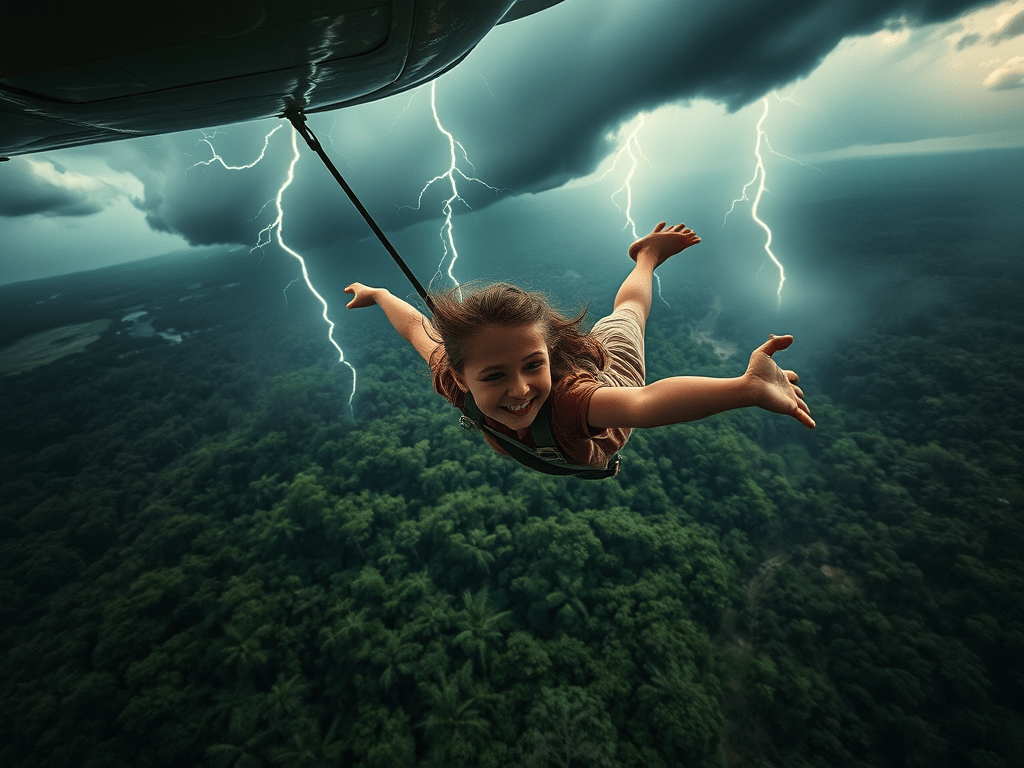
It was Christmas Eve, 1971. Juliane Koepcke boarded LANSA Flight 508 with her mother, heading from Lima to Pucallpa, Peru. The plane flew straight into a thunderstorm—a violent one. As lightning crackled and turbulence shook the aircraft, Juliane clung to her seat, not knowing that within moments the plane would be ripped apart midair.
At 10,000 feet, Juliane was ejected from the disintegrating fuselage, still strapped into her seat, spiraling down through the thick canopy of the Amazon rainforest.
And somehow… she survived.
A Walk Through the Green Hell
When Juliane woke, she was alone in the jungle. A broken collarbone. Deep gashes infested with maggots. One sandal. No food. No gear. No mother.
Most people wouldn’t have lasted a day.
But Juliane was not most people. Raised by two German zoologists who had spent years in the Peruvian jungle, she knew just enough to survive. She knew that predators generally avoid water, so she followed a small stream. She knew the jungle could disorient even the experienced, so she stayed with the water. She knew how to distinguish edible from deadly.
She had no machete to clear the way, so she let the stream guide her. At night, she slept on the damp forest floor, sometimes under logs, always vulnerable. Insects feasted on her. Her wounds worsened. Hunger clawed at her.
But still, she walked.
11 Days of Relentless Will
Juliane’s only “luck”—if you can call it that—was in understanding the language of the jungle. She didn’t panic. She observed. She remembered. She kept moving.
On the ninth day, she found a canoe. A true miracle. She waited for the owners. When no one came, she poured gasoline from the motor over her infected wounds, killing the maggots in a searing flash of agony. A short time later, she was discovered by local lumbermen, and finally airlifted to safety.
She was the only survivor out of 92 passengers and crew.
The Aftermath: A Living Legend
Juliane’s story is almost too improbable to believe. But it’s real. Documented. Verified. And still, fifty years later, it reverberates through history with undiminished power.
She went on to become a biologist, just like her parents. She later wrote a memoir, “When I Fell from the Sky,” where she recounts the crash and her trek through the Amazon with a calm, almost clinical precision—never mythologizing herself, never seeking glory. Just telling the truth.
Which, perhaps, makes it all the more incredible.
Why This Story Sticks
Why does Juliane’s survival captivate us so? Because it pits one teenage girl against a force of nature that has crushed entire expeditions. And she wins—not with weapons or gadgets, but with resilience, humility, and the quiet strength of knowledge.
She didn’t fight the jungle. She worked with it.
And in a world that often screams for attention, her story whispers something unforgettable:
You are stronger than you think. Smarter than you know. And in the end, it’s not panic or bravado that gets you out. It’s calm, steady perseverance.
Your Turn
Here’s a challenge for you: What part of Juliane’s story resonates the most with you—the fall, the walk, the science, the silence? Would you have stayed still and waited, or followed the stream into the unknown?
Drop a comment, share your favorite survival tale, or tell me this:
If you fell into the jungle tomorrow… what knowledge would you need to walk out?


 Chameleon Magazine
Leave a comment