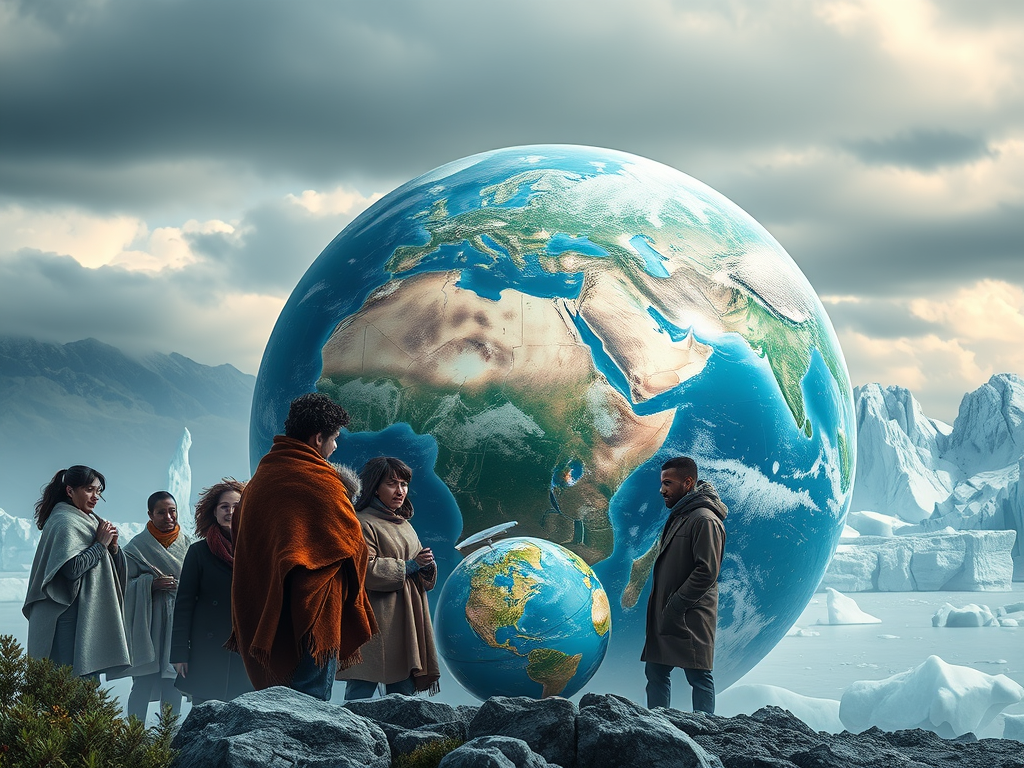
Read Time: 5 minutes — Best paired with a blanket, a globe, and a hot take on climate change
Let’s hop in the time machine — dial it forward 10,000 years. What would you expect to find? Flying cars? Colonies on Mars? Well, according to a study by Cardiff University, there’s a good chance you’d find something far less sci-fi but much more chill: the Earth slipping into its next Ice Age.
That’s right — if left to its own devices, our planet is technically overdue for its next glacial period, part of a natural cycle driven by wobbles in Earth’s orbit (cue the Milankovitch cycles). These slow changes in how Earth tilts, spins, and dances around the sun have been the pacemakers of Ice Ages for millions of years. Think of them as the cosmic metronome that keeps the planet’s long-term climate beats in rhythm.
According to the Cardiff study, the next major beat should land in about 10,000 years. But here’s where it gets interesting — and maybe a bit alarming.
Enter: Humanity and the Greenhouse Effect
While the universe is content to let Earth slowly swing toward a cooler future, humans have been pouring greenhouse gases into the atmosphere like a bad bartender who doesn’t know when to stop. Carbon dioxide levels, now exceeding 420 parts per million, are higher than they’ve been in at least 3 million years. That’s enough to throw off Earth’s natural rhythms.
The Cardiff study suggests that these rising emissions could delay or even cancel the onset of the next Ice Age.
Let that sink in.
We’ve known that human-driven climate change is accelerating global warming — melting glaciers, raising sea levels, and throwing weather patterns into chaos. But now, it appears we’re not just altering our climate. We’re potentially rewriting the planet’s entire glacial cycle.
Climate Change: The Ultimate Plot Twist
Normally, an Ice Age would take thousands of years to build — glaciers growing slowly, sea levels gradually falling, global temperatures dipping degree by degree. But greenhouse gases are like sticking Earth in a thermal onesie and cranking the heat to “tropical.”
And this isn’t just about warmth vs. cold. Delaying the Ice Age could reshape ecosystems, alter ocean currents, and redefine what regions are habitable for both humans and wildlife. The implications stretch far beyond our already daunting 21st-century climate concerns.
It also raises a deeply philosophical (and practical) question: Do we now have a planetary responsibility not just to manage today’s climate, but also to preserve Earth’s natural long-term cycles?
Playing God with the Ice Ages
Some scientists argue that delaying an Ice Age might actually be a good thing. After all, massive ice sheets covering North America and Europe aren’t exactly ideal for civilization. Others warn that tampering with ancient, stabilizing processes could lead to unknown consequences. Nature, after all, tends to have the last word — and it doesn’t like being ignored.
So here we are: teetering between ice and fire, between a future frozen in time or scorched by carbon.
One Final Chill Thought
This Cardiff study doesn’t predict disaster — it predicts possibility. A fork in the climatic road, if you will. And like any good science, it doesn’t hand us the answer. It hands us the responsibility.
Your Turn:
Would you rather humanity find a way to avoid the next Ice Age… or embrace it as part of Earth’s natural rhythm? Share your thoughts, poke holes in the logic, or challenge the science — and don’t forget to like, critique, or send this to your favorite amateur climatologist.


 Chameleon Magazine
Leave a comment