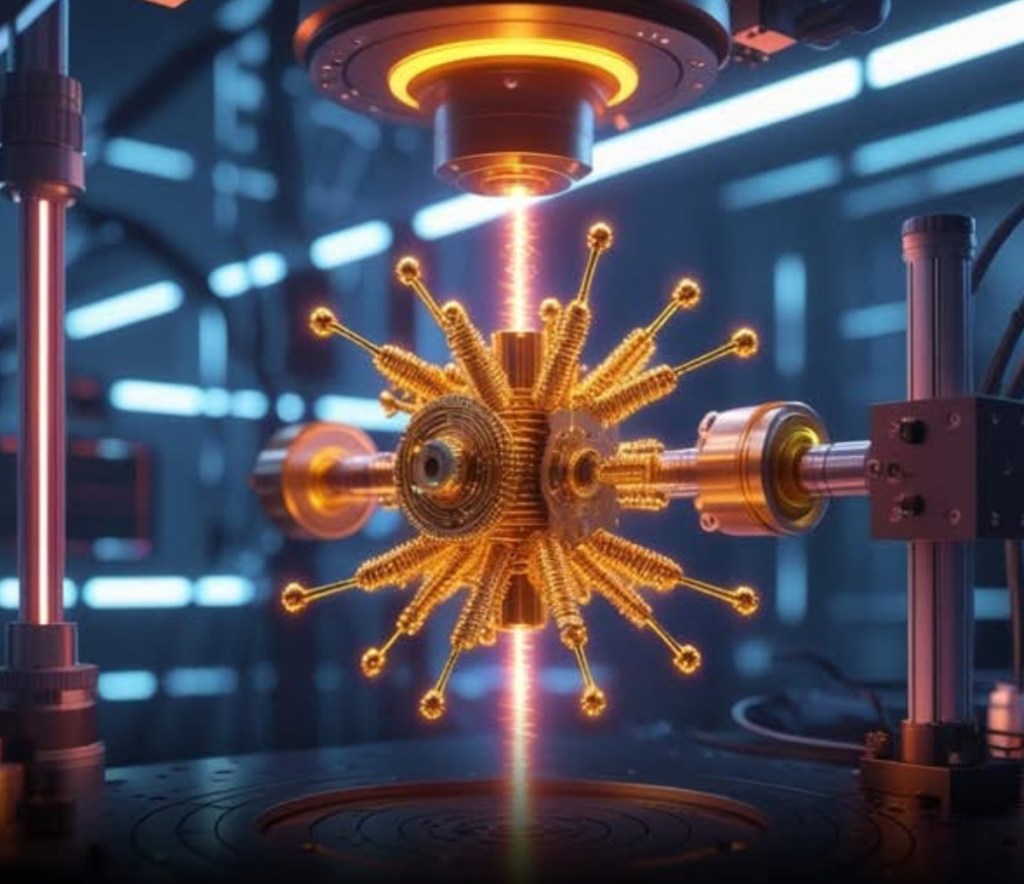
Imagine a motor that doesn’t burn fuel, doesn’t heat up, doesn’t move gears—and yet, it works. Now imagine it runs on light alone. No wires. No combustion. Just photons zipping in, and mechanical motion zipping out.
That’s not just the fever dream of a physicist who’s had one too many espressos—it’s the reality emerging from the labs of Australian engineers, who have unveiled a heat engine unlike any we’ve seen before. And if their discovery holds up, we may be standing at the edge of a technological precipice—one that could tilt our understanding of physics, energy, and even the fate of future machines.
Let’s unpack what this light-powered marvel really is, how it works, and what it could mean for the world.
Not Your Grandma’s Solar Panel
First things first: this is not a solar panel. Traditional solar panels convert light into electricity via the photovoltaic effect. That’s old news—clever, yes, but still reliant on generating electrons to power circuits.
This new device skips that step entirely. It takes in photons (particles of light) and transforms their energy directly into mechanical motion. No electricity needed. No intermediary steps. Just pure light in, force out.
It’s kind of like watching a magician pull a rabbit from a hat—except the rabbit is a nanoscale engine, and the hat is a tiny slab of material designed to dance with photons.
So… How the Photon Does That Work?
The secret sauce lies in the exotic realm of nanostructured materials—we’re talking metals engineered at the scale of billionths of a meter. These materials are tailored to absorb light in very specific ways, causing their electrons to oscillate wildly (a phenomenon known as plasmonic resonance).
These vibrations don’t just fizzle into heat. Instead, the design of the material redirects the photonic energy into actual mechanical stress and strain. In other words, the material flexes or shifts in response to light—just enough to generate tiny, but measurable, mechanical work.
Because this happens on such a small scale, and in a solid-state system (no fluids, no combustion, no spinning turbines), it works in a vacuum. And with no emissions, it’s about as clean as energy tech gets.
A Possible Thermodynamic Headache
Now here’s the juicy part: this engine seemingly violates some of our cherished intuitions about thermodynamics. Classic heat engines require a temperature gradient—you need something hot and something cold to create motion. But this light engine doesn’t rely on temperature at all. It’s photonic, not thermal.
To be fair, it doesn’t actually break the second law of thermodynamics—it just sidesteps it in a way that’s more like parkour than cheating. Instead of extracting work from heat differences, it extracts it from structured light-matter interactions. It’s exploiting a different kind of energy gradient: entropy in the photon field itself.
Some physicists are comparing it to Maxwell’s Demon, the famous thought experiment that imagines a way to violate thermodynamic laws—except this demon seems to be made of clever nanoengineering and some extremely persuasive photons.
What Could This Power?
Right now, we’re talking about microscale and nanoscale devices. But that’s exactly the scale where this breakthrough could revolutionize things:
- Satellites and space tech: A motor that works in a vacuum, has no moving parts, and runs on light? Space engineers are probably drooling as we speak.
- Nanorobots in medicine: Imagine tiny machines in your bloodstream, powered by lasers or ambient light, performing microsurgery or drug delivery.
- Self-powered sensors: Devices that harvest light and move or adjust themselves without needing batteries or wiring.
- Perpetual micro-machines: As long as there’s light, there’s motion. Think of smart dust or tiny surveillance drones that never need recharging.
This could also reshape discussions around sustainability and energy autonomy. A world where small machines self-power using ambient light isn’t just efficient—it’s poetic.
The Catch (Because There’s Always One)
Of course, this is early-stage research. The engine’s power output is tiny for now—measured in nano- or pico-newtons. Scaling it up to replace your car engine or power a factory is still well out of reach.
There are also materials challenges: the engineered surfaces need to be incredibly precise, and current fabrication techniques may not be economical for mass production.
Plus, while the system is theoretically clean and efficient, we still don’t know how long it can operate without degradation, or how robust it is under real-world conditions (like dust, temperature shifts, or exposure to unfiltered sunlight).
The Bigger Picture: A Light-Driven World?
Still, the implications are enough to make science fiction start sweating. If we can coax mechanical work out of light with no moving parts and no fuel, entire classes of machines may get reimagined.
- Machines that don’t need energy infrastructure.
- Autonomous systems that move and act based solely on their environment.
- Tech that thrives in places where traditional engines can’t survive—from the void of space to the chaos of a living cell.
It’s not quite “free energy”—but it’s tantalizingly close to frictionless, maintenance-free, emissions-free motion.
So What Do You Think?
Is this the dawn of a new era in physics and engineering—or just another cool lab trick that won’t scale? Could these light engines become the backbone of a cleaner, more efficient technological future—or are we once again chasing a photon-powered pipe dream?
Challenge for the curious:
What would you design if you had access to a motor that runs on nothing but light?
Sketch your concept, drop a counterargument, or share this with your most skeptical friend. After all, light is meant to be shared—and so are good ideas.


 Chameleon Magazine
Leave a comment