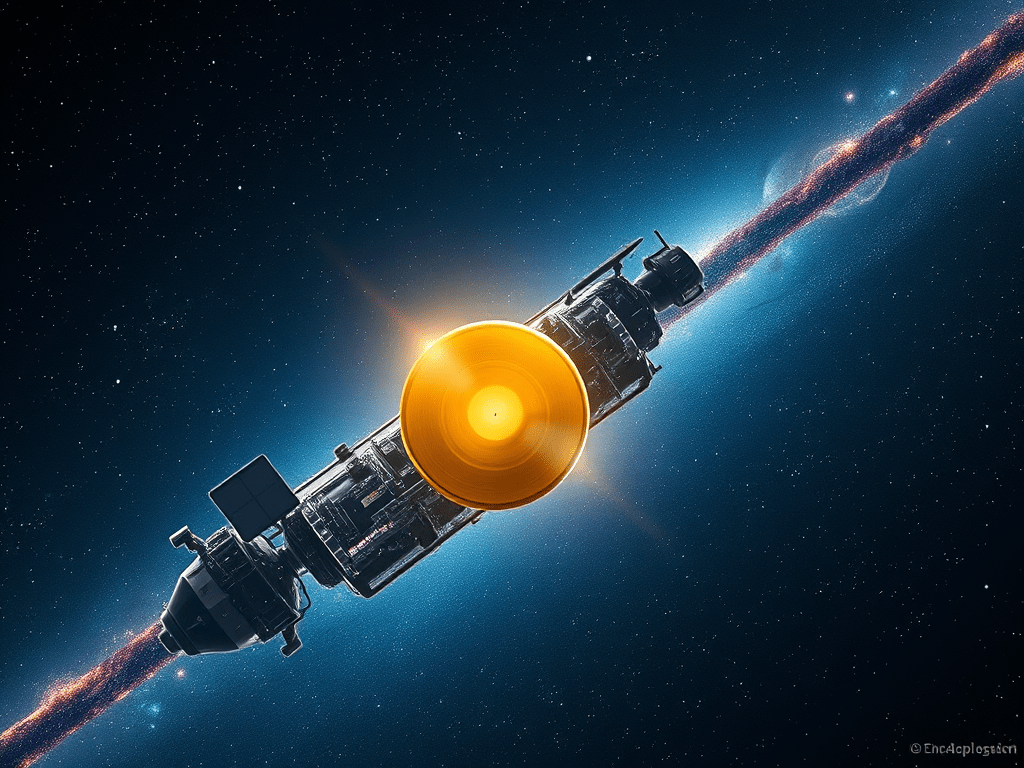
If our first interstellar impression is a gold disc of whale noises and Chuck Berry riffs from 1977, then let’s just say: we really swung for the weird. Thanks to the Voyager spacecraft, humanity’s cosmic debut is a mix between a science project and a sentimental mixtape. Half message in a bottle, half vinyl-laced existential overshare.
📀 Welcome to Earth: Press Play on Existential Crisis
Let’s start here: we launched golden records into the universe nearly five decades ago. Not Spotify links, not streaming platforms, but literal gold-plated LPs. What did we put on them? Multilingual greetings, animal noises, tribal chants, and a sultry saxophone track from the 70s. Basically, if an alien civilization does find one, they’ll assume Earth was either a sentient music festival or the fever dream of a confused anthropologist.
And yet—it’s kind of beautiful. Bold. Delusional. All our best traits.
But now? Now we’re getting louder.
📡 Oops, We’ve Been Broadcasting This Whole Time
Since the dawn of radio, Earth’s been leaking cultural emissions like a cosmic over-sharer. Our electromagnetic fingerprints are expanding outward like an ever-growing galactic blooper reel. Somewhere in space, a bored alien might be bingeing I Love Lucy, dodging Nixon’s resignation, or trying to make sense of The Masked Singer.
We didn’t mean to share that much. It just…happened. Like a butt-dial, but across light-years.
Then came 1974, when we got deliberate. Scientists fired the Arecibo Message—a coded burst of science and stick figures—toward the Hercules cluster. It was humanity’s version of sliding into the galaxy’s DMs. One problem: the estimated delivery time is 25,000 years.
Which makes Amazon look suspiciously fast.
🔭 Meanwhile, on Earth: Bigger Ears, Better Questions
Enter the Square Kilometre Array (SKA): the telescope equivalent of giving humanity a set of hypersensitive, noise-canceling AirPods and telling us to shut up and listen. Built across continents, this colossal machine-in-progress can allegedly hear a Nokia ringtone from Jupiter. (So if your 2003 flip phone starts buzzing, blame SKA.)
It’s not alone. Projects like Breakthrough Listen and Optical SETI are sweeping the skies for anything that smells like intelligence. Not just Morse code or alien podcasts—but patterns, spikes, and stutters in space’s background hum. And they’re not just listening.
We’re preparing to talk back.
✨ Why Bother? Because Wonder’s Still a Thing
Amid all our glorious mess—plagues, wars, influencer feuds—we’re still reaching. Because deep inside the drama and debris, humans cling to wonder like it’s the last clean shirt in the laundry pile.
When we send signals into space, we’re not just saying “hello.” We’re holding up a cosmic mirror and asking, “What the hell is us?” Are we math or music? Chaos or kindness? Do we ship out a Shakespeare sonnet or an episode of Love Island?
Maybe the decision is the message.
🤖 What If They’ve Already Tuned In?
Let’s entertain the wildest theory: aliens are listening. Right now. Parsing our accidental broadcasts like archaeologists sifting through rubble and reruns.
Maybe they think we’re unhinged. Maybe they love our chaotic charm. Or maybe, somewhere in all the static, they heard the tremble in our songs, the questions in our code, and the fact that—despite everything—we keep calling.
And maybe, somewhere in a distant galaxy, they’re drafting a reply. Just… really slowly.
📡 Antennas, Philosophy, and the Art of Screaming into Space
This isn’t just a science project. It’s spiritual stubbornness dressed as a radio transmission. It’s existential therapy via high-frequency broadcast. Every ping, every beam, every song launched into the void says: We are here. We are trying. We are still dreaming.
And if all we get back is a space-text that reads, “Saw your TV. Please stop calling,” at least we’ll know our voice carried.
Challenges
So here’s your cosmic prompt: What would YOU send into space? A recipe? A rant? A breakup playlist? Comment below with your most absurd, honest, or genius transmissions—and help shape humanity’s next galactic mixtape.
Don’t just scroll—scream into the void with us. Comment, like, and share your signal.
The brightest, weirdest replies will be featured in the next issue of the magazine. 📻👽✨


 Chameleon Magazine
Leave a comment