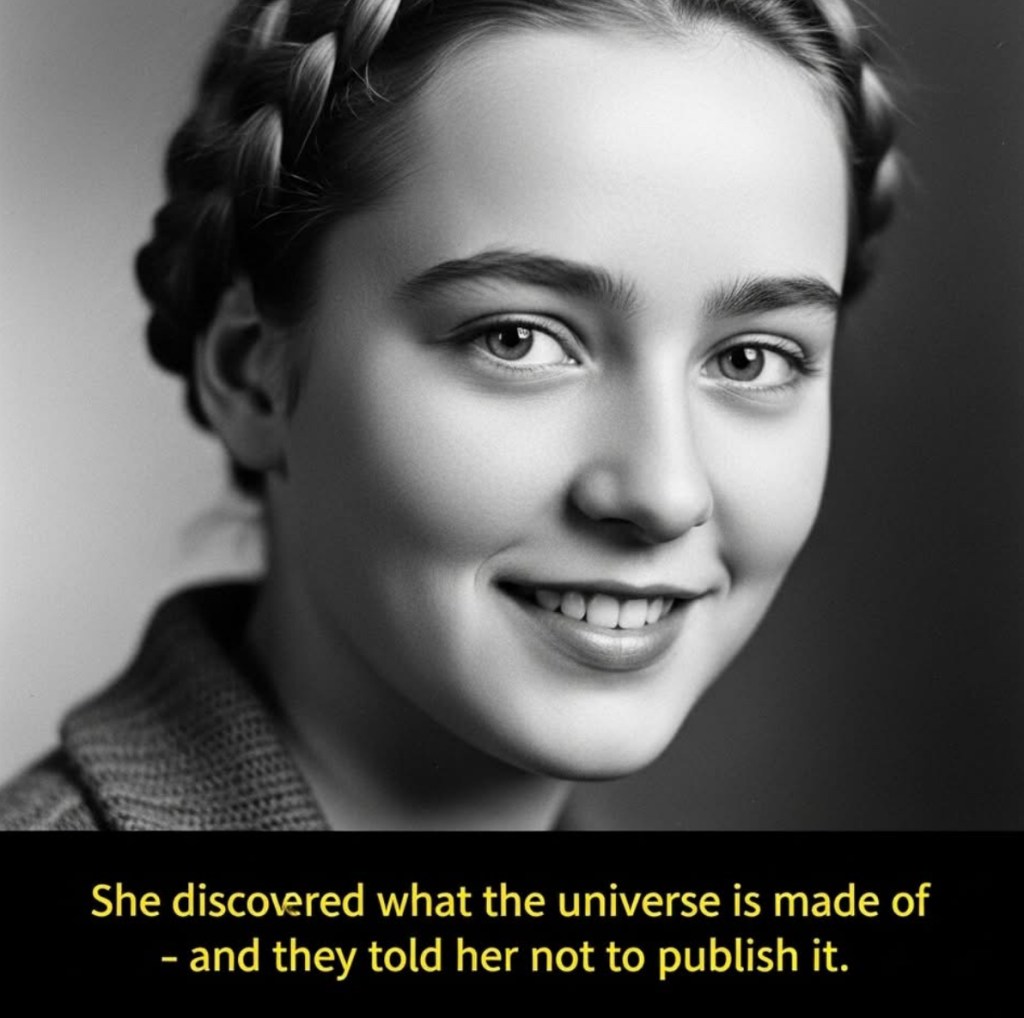
She cracked the cosmic code, rewrote humanity’s understanding of the stars, and got…ignored. Cecilia Payne didn’t just “contribute” to science — she revolutionized it. But because she wore a skirt instead of a pipe and tweed jacket, the world squinted, shrugged, and waited for a man to say it louder. Spoiler: he did.
🌌 The Great Intergalactic Heist of Intellectual Credit
Picture it: a 25-year-old graduate student drops the scientific mic with a PhD thesis so brilliant it could’ve lit up a nebula — stars are mostly hydrogen and helium, she writes. The heavens, quite literally, are not what we thought. But Henry Norris Russell, her own advisor, pats her on the head and tells her to maybe not go around being so…correct.
Then he publishes her conclusion years later and gets credit like he discovered cheese on toast. Welcome to Academia™ — where your ideas can orbit in someone else’s name just because they have a Y chromosome and tenure.
Cecilia Payne didn’t flinch. She kept going, navigating a galaxy of institutional bias, and became the first woman to head a department at Harvard. That’s not a win; it’s a statistic in a rigged system where the goalposts are still bolted to the boys’ locker room.
Her name should be shouted in every astronomy class, carved onto observatories, tattooed on NASA rockets. Instead, we teach kids about Copernicus while Payne’s legacy orbits in footnotes. She changed how we see the cosmos — and we still haven’t given her the stars she earned.
🚀
Challenges
🚀
Ready to rage against the academic black hole of forgotten geniuses? Furious that it took a man’s echo to validate a woman’s truth? Say it loud in the blog comments. Rewrite the textbooks — or at least the comment section.
👇 Like, share, and drop a cosmic truth bomb below. Let’s make sure Payne’s name burns bright enough for the next generation to see.
The best takes will be published in the next issue of the magazine. 💥📝


 Chameleon Magazine
Leave a comment