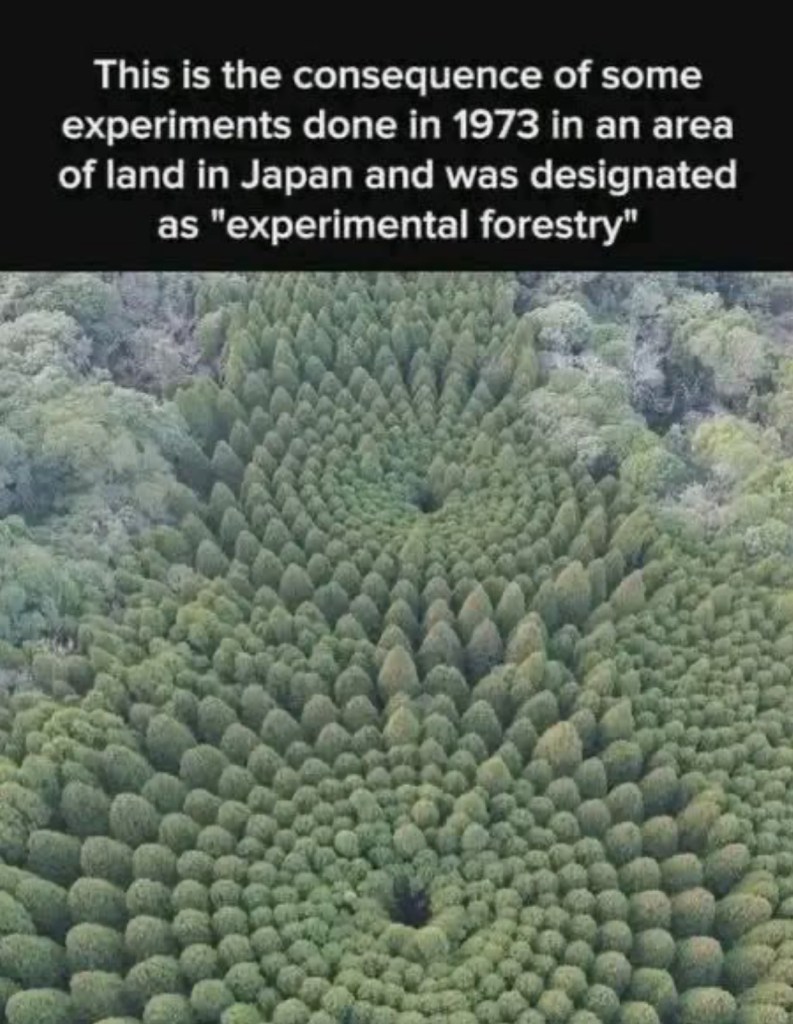
A Japanese experiment from 1973 has aged better than most skincare routines and internet debates. In a hillside forest near Nichinan City, scientists didn’t just plant trees—they orchestrated botanical ballet. Fifty years later, the result is a spiraling, hypnotic forest that looks less like a grove and more like Mother Nature joined a design school.
🌪️ The Spiraling Forest That Outsmarted Your Landscaping Efforts
Let’s start with the basics: trees were planted in concentric circles with precise spacing—same number per ring, smaller gaps toward the center. The result? A giant natural Fibonacci flex. Each ring tells a different story of survival, competition, and phototropic ambition. The inner trees, crammed in like commuters on a Tokyo train, stay stunted and sullen. Outer trees? Roomier roots, radiant crowns, and all the sunlight swagger they can soak in.
It’s basically a tree-version of “you vs. the guy she told you not to worry about.”
But this isn’t just eye candy for drone photographers. It’s botanical proof that trees are social strategists. They sense their space, jostle for light, and negotiate their growth with precision that would make even AI envious. No algorithms, no complaints—just growth based on awareness. Try getting your houseplants to do that without a meltdown and a Spotify playlist.
This forest isn’t just surviving—it’s performing. And the rest of us are left watching like confused squirrels.
🌳
Challenges
🌳
How often do we assume plants just “exist”? This forest throws that myth into a perfectly symmetrical woodchipper. Think trees can’t be smart? Think again—and then comment. Which spiral do you relate to: the crowded center or the wide-open edge? Let’s philosophize in the comments 🌿🌀
💬 Share your awe, your jealousy, your secret desire to live in a spiral tree village.
📣 The best replies will be featured in our next issue—because trees might not talk, but you can.


 Chameleon Magazine
Leave a comment