Read Time: 7 minutes — Best paired with blue light glasses and a strong sense of self.
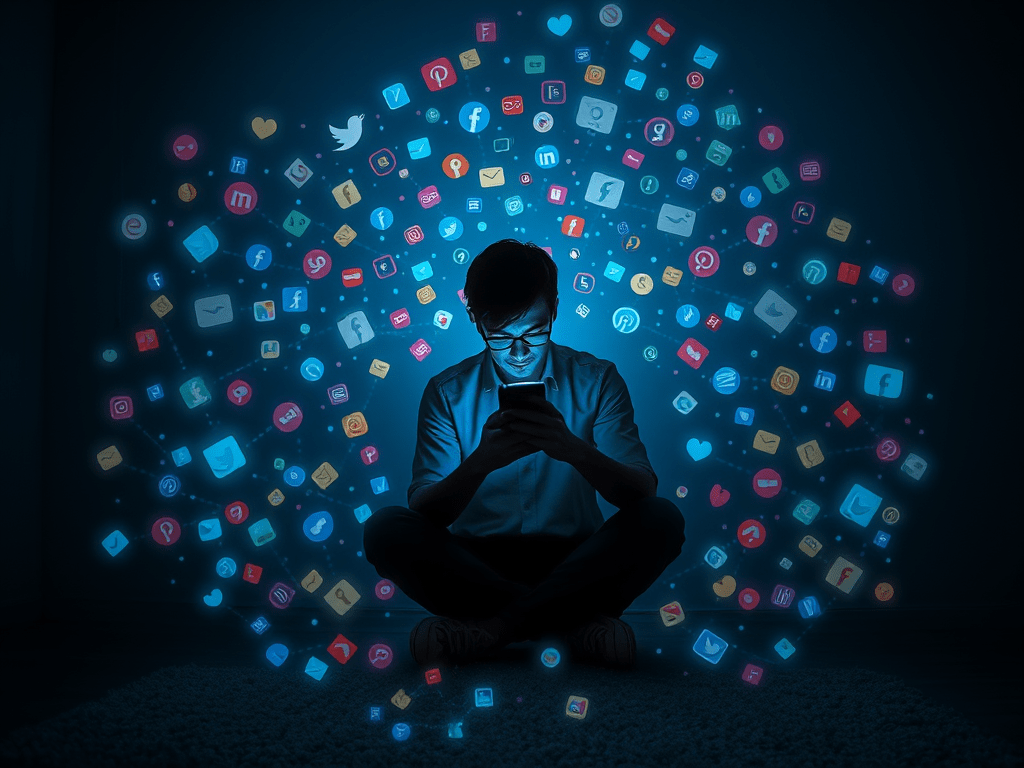
There’s a moment — just before you realize you’ve been staring at your phone for 43 minutes straight — when time gets slippery. You swiped down to check a weather update, maybe an email. But then… TikTok. A meme. A thirst trap. A cooking hack you’ll never try. Somewhere between scrolling and forgetting, you disappeared.
Welcome to the Algorithm Age — a landscape engineered not for your benefit, but for your attention. And like any landscape shaped by profit, the terrain is beautiful, addictive, and slowly erasing your sense of direction.
The Distraction Machine
Let’s get real: the platforms aren’t broken. They’re working exactly as designed.
That infinite scroll you can’t quit? That’s the “slot machine” mechanic pioneered by behavioral psychologists and perfected by Silicon Valley. Every flick of your thumb is a pull of the lever — will you get a funny video, a dopamine hit, a new comment, a like, a surge of validation?
And the longer you stay, the more data it gathers. Not about what you love — but what keeps you hooked. You’re not the customer. You’re the product being optimized.
In psychological terms, it’s called intermittent variable reward. In cultural terms, it’s called doomscrolling. In personal terms? It’s called losing yourself.
Identity in the Age of Influence
Before the algorithm, your identity was shaped by people you knew, books you read, and awkward conversations you had at high school dances.
Now, identity is curated — a highlight reel calibrated for engagement. We’re no longer just living our lives; we’re busy formatting them for viral potential. Your breakfast is a potential aesthetic. Your grief, a chance to raise awareness. Your joy, a trending audio away from a thousand likes.
And what does that do to a person?
For many — especially Gen Z, digital natives fluent in algorithm-speak — there’s a quiet existential dilemma: If I don’t post it, does it even count?
You start to wonder if your preferences are truly yours, or if you’ve simply learned to like what the algorithm favors. (Spoiler: It’s the latter more often than we care to admit.)
Mental Health in the Scroll Era
Let’s not sugarcoat it: social media isn’t just distracting, it’s rewiring us.
Studies show links between heavy social media use and rising rates of anxiety, depression, sleep disorders, and body dysmorphia. But it’s more than just correlation. It’s a full-blown attention economy, and your mental bandwidth is the currency.
In an environment where content is endless, our ability to focus becomes finite.
The algorithm doesn’t reward nuance, reflection, or long-form thought (ironic, since you’re reading this). It rewards rage, fear, novelty, and speed — not because it’s evil, but because it’s efficient. These are the emotions that keep you scrolling. And scrolling. And scrolling.
So how do we claw our way back?
Practical Rebellions: Reclaiming Attention and Identity
Rebellion doesn’t always look like deleting all your apps and moving to a yurt. (Although if that’s your vibe, respect.) You can still participate in digital life without being consumed by it. Here’s how:
1. Curate Your Feed Like You Curate Your Friends
You wouldn’t hang out with someone who makes you feel inadequate, angry, or anxious every day. So why let them live in your pocket? Unfollow, mute, and block like your sanity depends on it.
2. Schedule Your Scrolls
Set time blocks for checking apps. If you scroll intentionally, it’s less likely to spiral into dissociation. Consider using tools like Freedom, StayFocusd, or the built-in screen time controls.
3. Reintroduce Friction
The platforms are designed to be seamless. Make them less so. Remove shortcuts from your home screen. Disable autoplay. Turn off non-essential notifications. Make it just a little harder to fall in.
4. Create Without Performing
Write. Paint. Dance. Sing. Do it offline, or online — but without worrying about likes. Engage in creative expression that feeds your soul, not the algorithm.
5. Read More Long-Form Stuff (Like This!)
Practice deep attention. Articles, essays, physical books — they’re like attention gym workouts. You won’t regret it.
6. Go Analog on Purpose
Try phone-free walks, handwritten journals, analog clocks, actual cookbooks. Let your brain stretch in directions it hasn’t moved in a while.
From Optimization to Intention
The real threat of the algorithm isn’t that it manipulates you — it’s that it makes you forget you had a choice.
We can’t fully unplug from digital life (nor should we). But we can practice digital sovereignty — using technology with intention, not compulsion.
Every moment you reclaim is a quiet protest. Every choice to slow down, reflect, or resist the scroll is a reminder: You are not a data point. You are not a trend. You are not the algorithm’s output.
You are the author.
Now You Scroll
But before you do, here’s your challenge:
🔍 What’s one digital habit you’re ready to rethink — and what’s one analog ritual you’ll reclaim this week instead?


 Chameleon Magazine
Leave a comment