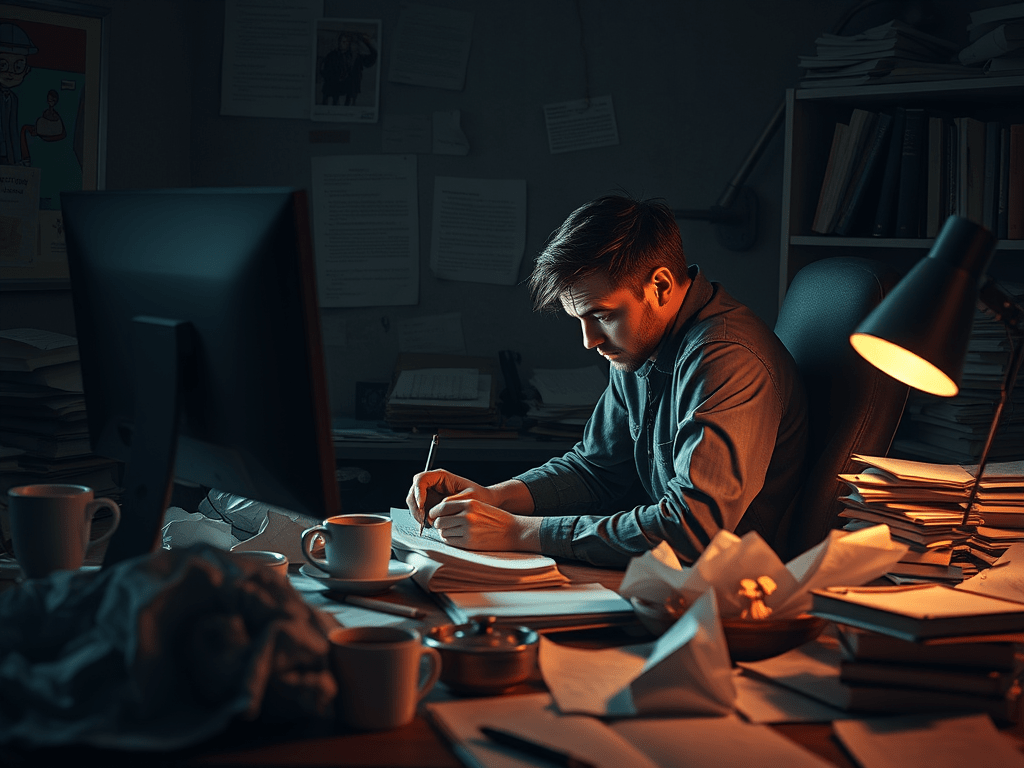
In a world racing to outsource its imagination to machines that don’t sleep (or question the point of it all at 2 a.m.), there’s a revolution bubbling under the surface — a gritty, vulnerable, human one. Because real stories? They don’t come pre-assembled from a menu of tones and themes. They come from ruin, from rage, from staring into the abyss of a blank page wondering if you’re still a writer or just a typist with delusions.
🧠 The “Generate” Button Won’t Cry With You
Look, let’s be honest — pressing a button and watching a neatly written paragraph materialize can feel like wizardry. But it’s not storytelling. Not really. It’s formatting. It’s taxidermy. It’s language without lungs.
A real story? It fights back. It talks in riddles. It refuses to end where it should and bleeds in the places that make no commercial sense. The first draft is a dumpster fire with literary aspirations. But that wreckage? That’s the good part. Because only something alive can fall apart in interesting ways.
When we hand that over to an algorithm, we’re not streamlining — we’re surrendering. And what we get back might be readable, even clever, but it won’t bleed. It won’t ache. It won’t whisper, “This nearly destroyed me, but it was worth it.”
🎨 Paintbrush, Not Photocopier
Let’s clear one thing up — using a tool doesn’t make you a hack. Every writer has tools. The problem isn’t the brush. It’s when we forget we’re supposed to be holding it. When the brush starts painting by itself, you’re not creating. You’re supervising.
You wouldn’t call yourself a chef for microwaving someone else’s lasagna. So why slap your name on a story that doesn’t carry your scars?
The best use of AI isn’t to replace the wild, sweaty, soul-crunching act of writing — it’s to provoke it. Use it like a pickaxe in a diamond mine. Like a rubber duck for debugging your brain. Like a partner in crime who always says the wrong thing just so you can argue your way to the right one.
🔥 What Are We So Afraid Of?
That AI will be better than us? It won’t.
But it might be faster. It might be cleaner. It might be less annoying than your inner critic who sounds suspiciously like your sixth-grade English teacher.
That’s the real threat: not replacement, but relief. The temptation to stop struggling. To trade the beautiful chaos of creativity for the sleek efficiency of autofill. That’s not progress. That’s intellectual gentrification. A world full of well-lit apartments with no one home.
🥊 Write Like a Maniac, Edit Like a Surgeon
Here’s the rub: creation isn’t comfortable. It’s not supposed to be. You’re summoning something that didn’t exist before and dragging it through your psyche until it makes sense to someone else. That’s alchemy, not automation.
So yes, use the AI. Ask it stupid questions. Make it argue with you. Let it be your nemesis, your brainstorming buddy, your punching bag. But never let it be your soul.
And always — always — ask yourself:
“Is this something only I could have written?”
If it isn’t?
Burn it down. Start again. Let it hurt this time.
⚔️
Challenges
⚔️
Where do you draw the line? Are we empowering the muse or outsourcing her entirely? Can a tool help you suffer better — or are we numbing the very nerve that makes writing matter?
Drop your most unfiltered thoughts in the comments 🧠🔥 Let’s make this messy. Let’s make it real.
👇 Smash that comment button, throw a like if you’ve ever cried over a draft, and share this with your writing group before they get replaced by a toaster.
Best takes will be featured in the next issue of the magazine. ✍️💣


 Chameleon Magazine
Leave a comment