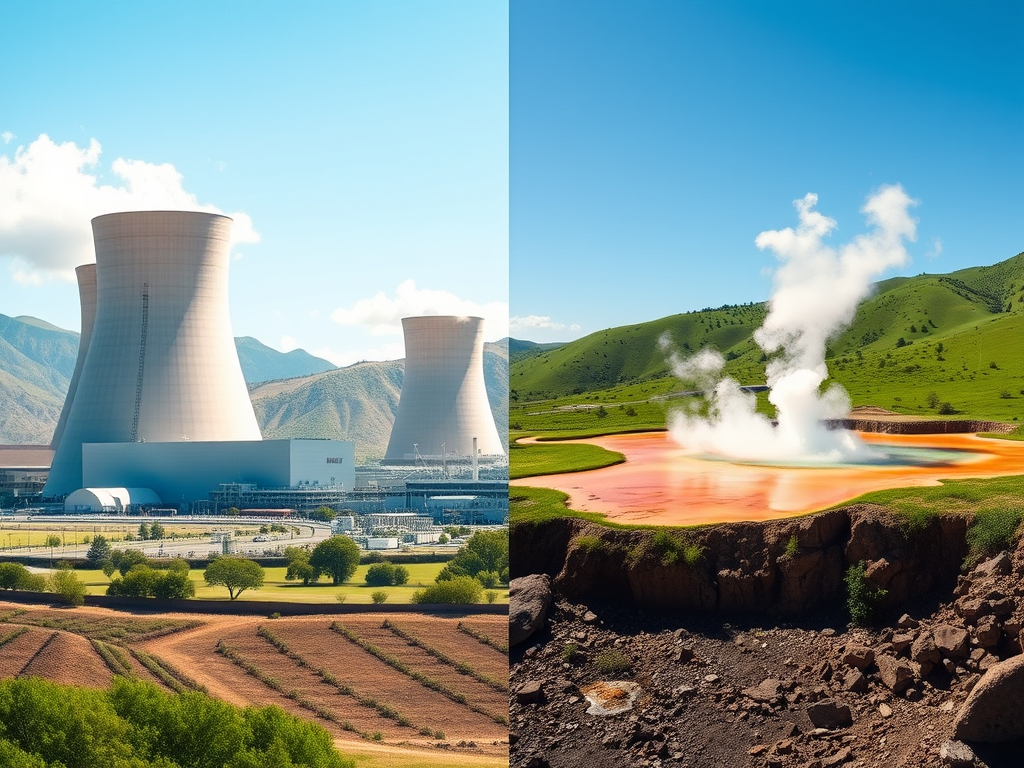
If Ed Miliband is betting big on nuclear as the linchpin of Britain’s clean energy transition, there’s a quieter, earthier contender waiting in the wings: geothermal energy.
Both are low-carbon, both offer baseload power (i.e., consistent 24/7 electricity), and both come with their own risks and rewards. But while nuclear often hogs the policy spotlight, geothermal might just be the underestimated underdog in Britain’s quest for energy security.
So—let’s dig deep and compare them.
🔥 What’s the Source of Their Power?
• Nuclear: Splits atoms (uranium) to produce heat, which turns water into steam to spin turbines.
• Geothermal: Taps into the Earth’s natural underground heat—think volcanic reservoirs or hot rocks—to do the same thing: generate steam and spin turbines.
Verdict: Different mechanisms, same goal—reliable heat to make electricity.
🧩 Energy Consistency and Reliability
• Nuclear: Baseline power champ. It runs day and night, weather be damned.
• Geothermal: Also continuous, provided the resource is viable. In Iceland or the western U.S., geothermal hums along like a Tesla on cruise control.
But in the UK? It’s trickier. The UK isn’t exactly a volcanic hotspot.
That said, new tech like enhanced geothermal systems (EGS) is making it possible to engineer geothermal wells in previously “cold” regions. The UK is already exploring this in places like Cornwall, where ancient granite heats deep aquifers—quietly, steadily, and without splitting atoms.
Verdict: Nuclear is more proven in the UK context, but geothermal has promising localized potential.
💷 Cost, Risk, and Public Trust
• Nuclear: Huge up-front costs. Long build times. Massive regulatory hurdles. And, let’s not forget, a history of public mistrust tied to accidents (Chernobyl, Fukushima) and waste.
But, it scales big—one reactor can power millions of homes.
• Geothermal: Lower up-front costs (depending on depth), faster development timelines, and far less public opposition. It’s also safer—no meltdowns, no radioactive waste.
The catch? Drilling deep geothermal wells isn’t cheap, and there’s a nonzero risk of causing small seismic events. Plus, if the geology’s wrong, the investment can be a bust.
Verdict: Geothermal is cheaper, safer, and less controversial—but also less predictable in terms of UK-wide scalability.
🌍 Environmental Impact
• Nuclear: Very low operational emissions, but uranium mining, waste storage, and decommissioning raise long-term concerns.
• Geothermal: Almost zero emissions if managed properly. Minimal land use. And once drilled, it’s incredibly low-maintenance.
Bonus: Geothermal heat can also be used directly—for homes, greenhouses, even beer brewing.
Verdict: Geothermal wins on environmental footprint, especially when used for heating as well as electricity.
📍 UK Potential: Are We Sitting on Energy Gold?
Here’s where things get spicy.
• Nuclear: The UK has a national roadmap, funding, political will, and experience. It’s already happening.
• Geothermal: It’s emerging—but still niche. Projects like the United Downs Deep Geothermal Power project in Cornwall show promise. Some urban centers, like Southampton, already use shallow geothermal for district heating.
The biggest barrier? Lack of investment, regulatory uncertainty, and the fact that nuclear grabs headlines while geothermal flies under radar.
Verdict: Britain can become a geothermal innovator—but it needs policy love, risk-tolerant investors, and a cultural shift in how we talk about “exciting” energy.
Final Showdown: Which One Wins?
| Category | Nuclear | Geothermal |
| Baseline Power | ✅ Proven | ✅ Potential |
| Scalability | ✅ National | ⚠️ Regional |
| Safety | ⚠️ Risk of meltdown | ✅ Minimal risk |
| Waste | ❌ Long-lived radioactive | ✅ Negligible |
| Cost & Time | ❌ Slow & expensive | ✅ Faster & cheaper (if viable) |
| Public Support | ⚠️ Divided | ✅ Generally supportive |
The Big Idea: Complement, Don’t Compete
We don’t have to choose one or the other.
Nuclear can anchor Britain’s national grid. Geothermal can power and heat homes in regional clusters. Together, they offer a path to decarbonize, decentralize, and democratizeenergy across the UK.
Imagine a future where a Cornish town is kept warm by ancient granite heat, while a city like Leeds draws power from a next-gen SMR—and wind and solar fill in the rest. That’s not science fiction. That’s strategy.
🔍 Your Turn:
Should geothermal get the same political and media attention as nuclear? Or are we too late in the game to bet on heat beneath our feet? Share your thoughts, poke holes in the logic, or pitch your ideal UK energy mix. Let’s heat up this conversation—without melting down.


 Chameleon Magazine
Leave a comment