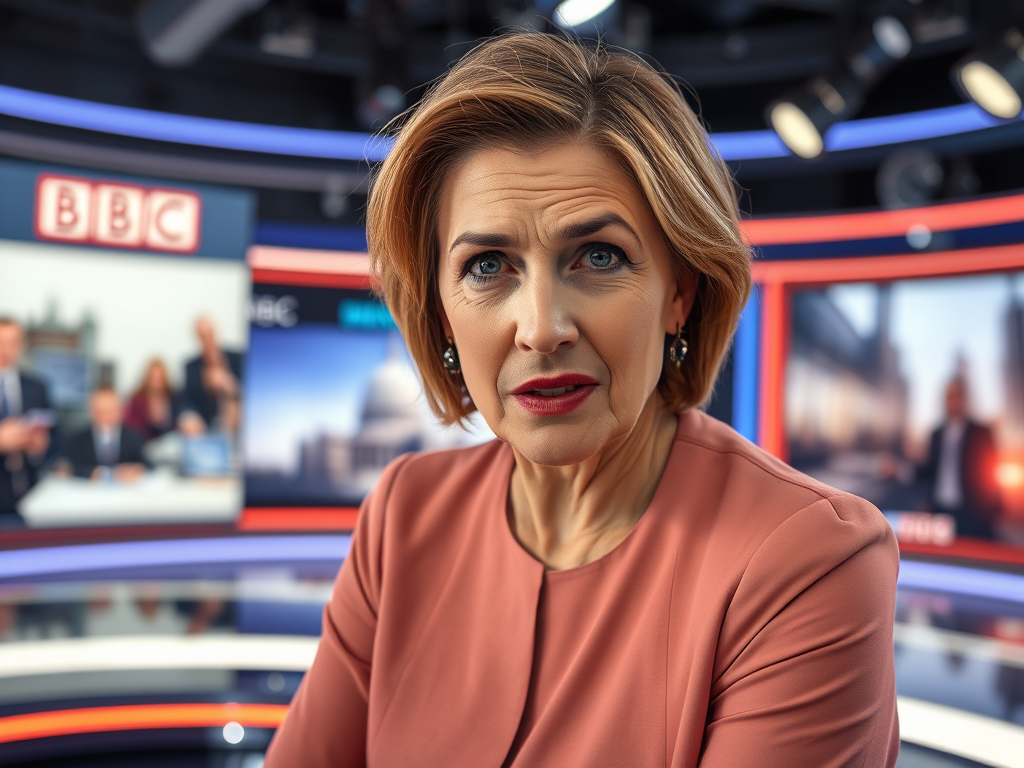
🎙️🙄 In a moment of live TV rebellion, BBC presenter Martine Croxall did what millions at home were likely doing in their heads: she rolled her eyes at the phrase “pregnant people.” It wasn’t just a twitch — it was a tectonic shift in facial muscles that echoed the sentiments of a populace growing weary of ideological gymnastics disguised as journalism.
🌀 Welcome to the Semantic Olympics — Where Biology Is Just a Vibe
Ah yes, “pregnant people.” Because apparently the word “women” is now a controversial term, joining the ranks of “facts,” “definitions,” and “sense.” The BBC, in its valiant quest to offend no one while confusing everyone, has become the linguistic version of a hall of mirrors: everything’s reflective, nothing’s clear.
Croxall’s live-action emoji didn’t just betray her disbelief — it betrayed a crack in the corporation’s forced-smile façade. This wasn’t a flub. It was a rupture between scripted orthodoxy and spontaneous humanity.
And let’s be blunt: if your news anchor can’t say a word with a straight face, maybe it’s time to rethink the script. Journalism’s first loyalty is to truth, not to the Ministry of Approved Terminology. When public institutions start sound-checking reality to suit ideological harmonies, credibility doesn’t just suffer — it packs up and leaves the building.
Inclusion should never require the erasure of common understanding. And yet here we are, watching presenters roll their eyes so hard they risk whiplash every time the teleprompter serves up another round of reality-denial in the name of progress.
🚨
Challenges
🚨
Are you rolling your eyes too? Or do you think this is just the necessary evolution of language in a diverse world? Drop your thoughts — raw, nuanced, hilarious, or furious — in the blog comments. Don’t let Facebook steal the whole debate. 💬🔥
👇 Comment, like, share, and let’s stir up a discussion with more clarity than a BBC script editor on deadline.
The best takes will be featured in the next issue of the magazine. 🧠✍️


 Chameleon Magazine
Leave a comment