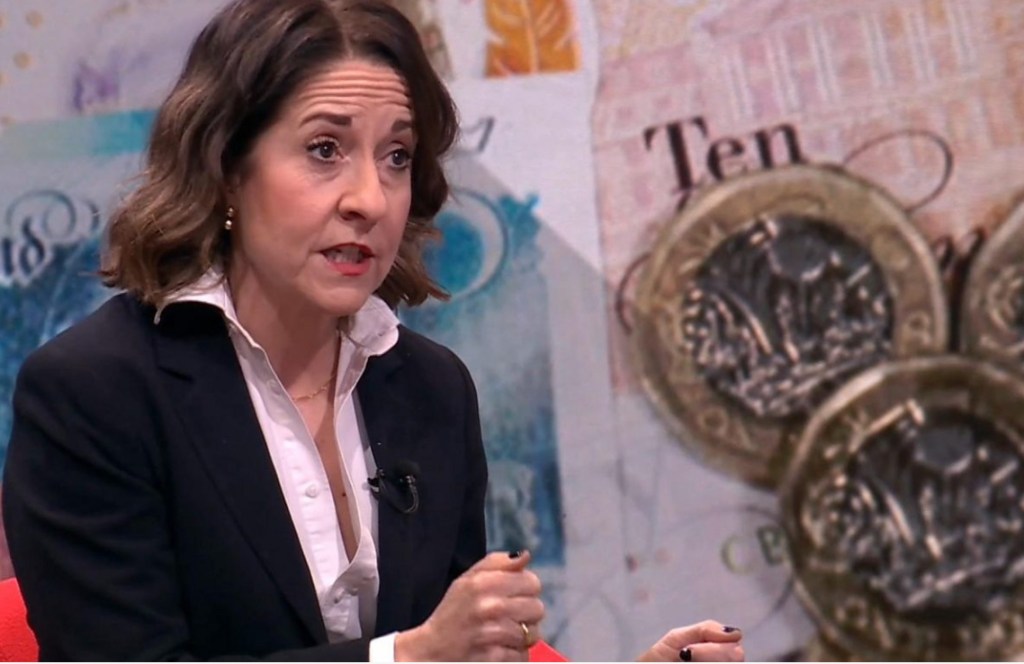
Let us kneel—nay, bow—before the Duchess of Welfare, Lady Elizabeth of Kendallshire, Her Serene Excellency of Privilege-on-Thames. For she is about to decide, with all the raw grit of a silk glove, whether the poor are trying quite hard enough not to be poor.
This week, she will cast her immaculate, unsullied vote on disability reform—because nothing says “qualified to judge vulnerability” like a life spent floating several socioeconomic feet above the pavement.
Let us consider her credentials:
💅 Hardship? She Once Ran Out of Quinoa
Liz Kendall has never faced hardship. Unless, of course, you count “losing the Labour leadership by 95%” a hardship—which she probably does, along with the day she found out Waitrose had replaced the organic pomegranate seeds with regular ones.
Her understanding of real suffering is limited to the time her Uber driver took a wrong turn through a working-class postcode.
🧠 Mental Illness? Only at a Theoretical Level
Mental health, to Liz, is a policy paper. A bar graph. A PowerPoint slide with muted colours and a soothing typeface.
She talks about anxiety the way an architect talks about earthquakes: with abstract concern, detached sympathy, and a healthy dose of insurance.
She has never had to choose between therapy and rent. She has never begged a GP to be taken seriously. But she has written op-eds about “early intervention” while sipping Rooibos in a glass-fronted Westminster café, so that counts.
💼 Work Experience: Political Advisor, Think Tanker, Charity Spokesperson…
Ah yes, the sacred CV: stitched together from the finest linen of “roles adjacent to real work.” She has never scrubbed a toilet, served a pint, answered to a manager named Steve who ends every sentence with “yeah?”, or been told her panic attack doesn’t qualify for statutory sick pay.
Her entire career has been conducted in rooms with bottled water and abstract nouns: “stakeholders,” “frameworks,” “impact metrics.”
She has never stood in a Jobcentre wondering if they’ll believe her.
🦴 A Vote Without Skin in the Game
The irony? She’s voting on whether others are trying hard enough to be well.
She will weigh the morality of a disabled single mother claiming £125 a week while her staff sharpen talking points about “fairness” and “targeting support” — the modern euphemisms for taking it away.
It’s a bit like letting a cat vote on bird protection.
🧚 The Kendall Method: Welfare Reform via PowerPoint
Liz is the kind of reformer who sees a panic attack and thinks, “This could be a skills gap.”
Her reforms are surgical — in that they remove vital organs and then hand you a leaflet on how to breathe without lungs.
Her vision for disability is simple: Don’t look disabled? Don’t feel disabled? Good news! You’re cured! Back to work. Chop-chop.
🏛️ Let Them Eat Personal Resilience
Kendall believes in fairness—so long as it’s spreadsheet-shaped. She wants the system to be “sustainable,” which is Westminster code for “we can’t afford empathy this year.”
In truth, her vision of disability reform has all the moral clarity of a hedge fund—and about the same concern for who sleeps in the rain.
🎤 Final Thoughts from the Chameleon
If you’re going to reform the lives of the vulnerable, maybe—just maybe—you shouldn’t be someone who’s never known what it is to be vulnerable.
Liz Kendall is not heartless. She’s worse: heart-adjacent. She’s what happens when technocracy eats morality for breakfast and calls it a governance model.
And next week, she’ll be voting on your reality—without ever having lived in it.
“Cutting through the fog with a scalpel made of satire.”


 Chameleon Magazine
Leave a comment