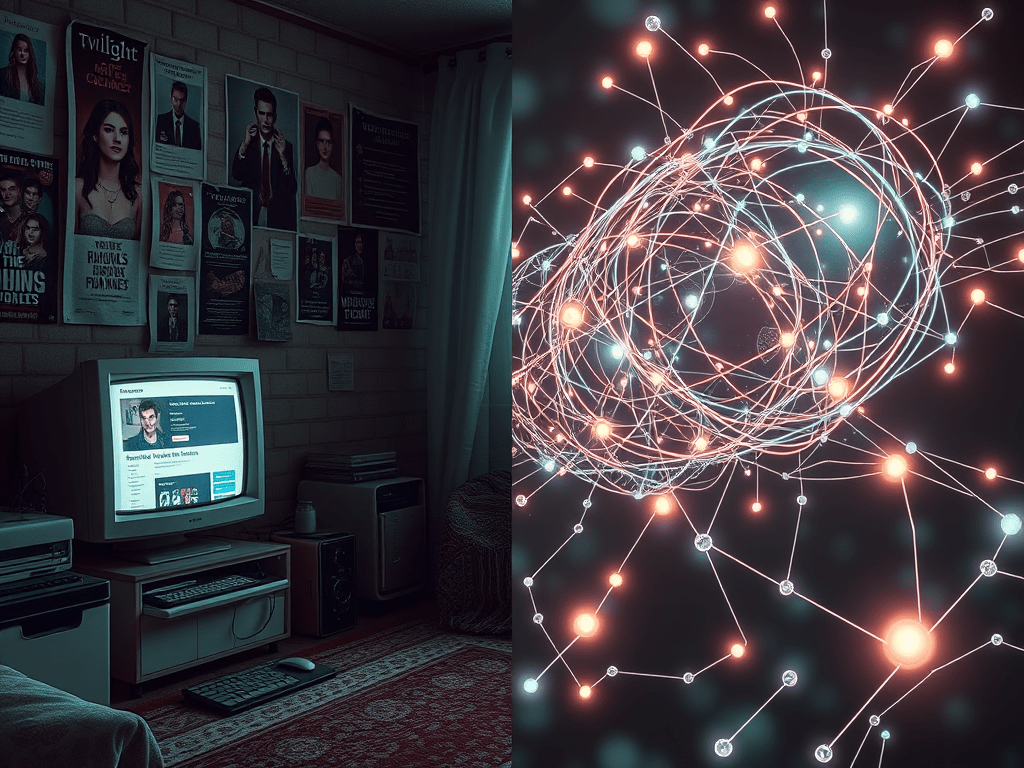
🧠💀A satirical gut-punch on the permanence of digital identity in an era where forgetting is no longer an option—but still very much a right.
🧛♂️ Twilight Takes and Digital Tombstones
Imagine your teenage self at their most volatile: hormonal, caffeinated, and armed with dial-up internet. They blog about Twilight being “the Godfather of our generation.” They wear fedoras. They stan Edward Cullen with cult-like zeal. You’ve moved on. Your therapist says you’re healing. But AI? It remembers. Not with judgment—worse, with infinite recall.
Your cringe is now immortal. Your digital puberty is woven into the very circuits of modern artificial intelligence. Chatbots, deepfakes, and predictive text generators are whispering your blog rants into the ears of millions. You didn’t sign up for this creepy posthumous fame. And yet, here we are: your bad opinions reincarnated in the cloud, eternally searchable, and remixable at scale.
🧠 Neural Networks Don’t Do Amnesia
Turns out, forgetting in AI isn’t like clearing browser history. It’s more like trying to bleach your name out of a soup someone’s already drunk. AI doesn’t keep your content in neat, deletable boxes. It digests it. Absorbs it. Becomes it. Trying to remove yourself after training is like trying to unsneeze in a wind tunnel.
Legal protections like the GDPR give you the right to vanish online—but only from the places where your data sits. Once it’s been assimilated into AI, it’s not sitting anywhere. It’s living somewhere. Somewhere in that chatbot suggesting movie picks, or that voice clone reading bedtime stories. Your “Team Edward” post could be the reason Siri won’t shut up about vampire romances.
🔍 Opting Out Is a Maze, Not a Button
Sure, some companies now offer an opt-out option—bless their pixelated hearts—but good luck finding it. First, you have to know your data was used. Then, you need to locate every model that used it. Then you must whisper a prayer to the algorithmic gods and hope some engineer doesn’t laugh at your puny human request.
It’s not opt-out. It’s obstacle course. And soon, only those with elite access—lawyers, coders, or the ultra-rich with digital scrub squads—will have the luxury of erasing themselves. The rest of us? We become the ghostwriters of future robots. Not paid. Not credited. But deeply, unforgettably archived.
🤖 “Unlearning” Is Hard, Boo Hoo
Tech giants whine that forgetting is “technically hard.” You know what else is hard? Democracy. But we figured that out. The same people who can simulate Einstein’s voice debating Taylor Swift’s discography can surely figure out how to make their models forget my Myspace poetry.
If AI can learn to beat humans at chess, Go, and passive aggression, it can learn to forget Tim’s emo blog from 2008. We’re not asking for magic. We’re asking for motivation. And that only comes from public pressure and collective noise. So crank up the volume.
💿 AI as Historian, Without Consent
We’re not talking about data. We’re talking about digital souls. AI systems are becoming the memory banks of our culture. They hoard vibes, mimic speech patterns, and simulate personalities like digital necromancers. But here’s the horror twist: they’re doing it without permission.
We’ve accepted a future where AI trains on our humanity, but refuses to return our agency. Your digital past—warts, typos, and Twilight—is now content fodder for a machine that sees you not as a person, but as fuel.
🔥 Challenges🔥
If AI owns your past, can you ever reclaim your future? Can tech be ethical if it’s built on un-erasable footprints? 🤯💻
Jump into the comments. Break the silence. Tear down the myth that remembering everything is progress. Let’s debate the boundaries of our digital afterlives.
👇 Drop your comments, tap that like, and share this with someone whose blog posts still haunt them.
The best responses will be featured in our next magazine issue. 💬🧠


 Chameleon Magazine
Leave a comment