By Curious Pen — standing where the ground once stood firm
There comes a moment in every nation’s life when it must ask itself: Whose voice matters now? Whose stories get told? Who holds the pen, and who’s left buried beneath the ink?
In Northern Ireland, that question has come roaring back to life—through unrest, rage, and a sense of betrayal that’s long been simmering in the hearts of the people who built this land and buried their dead in its soil.
This isn’t a story about race or immigration or abstract politics.
It’s about the Irish people—and what happens when the home you’ve known for generations no longer feels like it belongs to you.
🪦 The People Who Stayed
We talk so much about those who arrive, but what about those who never left?
The Irish who stayed through bomb scares and British boots. Who rebuilt after the Troubles and swallowed the promises of peace. Who buried kin too soon and still voted in hope, believing maybe this time, politicians would remember the people who can’t afford to move away when things go sideways.
Instead, they got silence. And then, slowly, something worse: the sense that they are now the problem in their own home.
🧭 What Happens When You’re Not Asked
Let’s speak plainly.
It is not “bigoted” to want to preserve your culture.
It is not “racist” to expect that new arrivals respect the customs, language, and laws of the country that took them in.
It is not a hate crime to say, “This place matters to me. Don’t change it behind my back.”
But too often, that’s how ordinary Irish people are made to feel: like strangers in their own towns. Told to shut up, step aside, make room—while those doing the telling sit in cities far removed from the reality of a port town losing its identity one quiet compromise at a time.
🏚 Identity Isn’t Just a Word
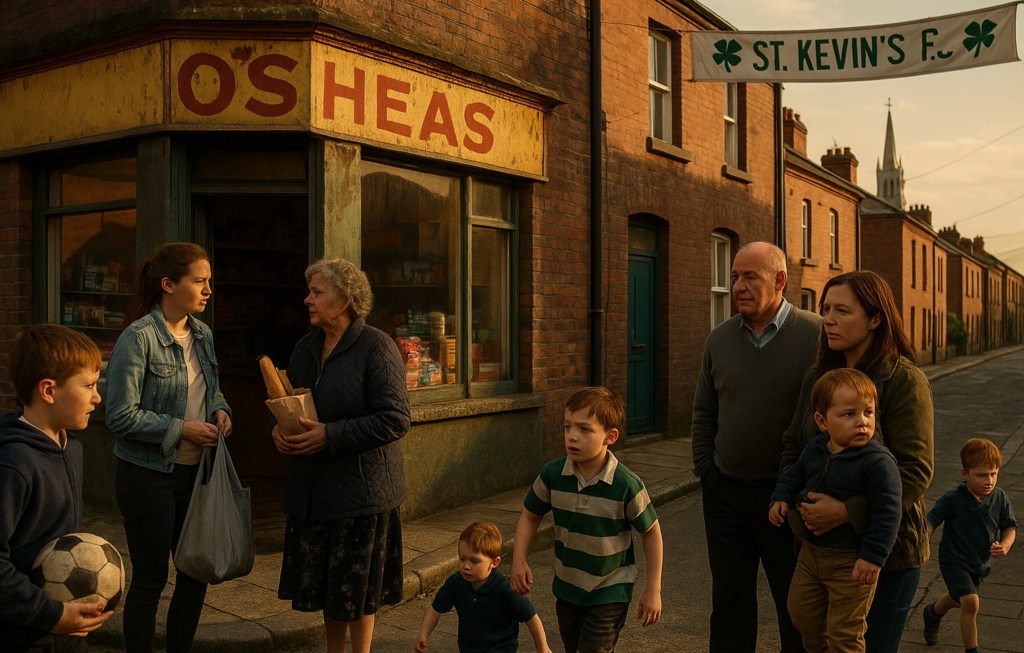
For working-class Irish families, identity is not theory—it’s lived experience. It’s the corner shop, the church bells, the football club, the flag on the gable wall. It’s speaking in the tongue of your forebears without being corrected. It’s having your pain acknowledged, not pathologized.
So when people come here and reject our customs, or mock our laws, or treat our hospitality like a weakness—what are we supposed to do?
Smile and pretend it’s fine?
⚠️ The Line No One Wants to Cross
Here’s the thing: No one reasonable is against those who come here legally, contribute, and integrate. That’s not the issue.
The issue is this: when integration is replaced by entitlement, and when people who’ve lived here for five minutes are given more political protection than the family who’s lived on the same street for five generations—people will erupt.
This doesn’t justify hate. But it explains the anger. And ignoring that anger will only make it worse.
🎙 What We’re Asking For
Irish people—especially in the North—are not asking for exclusion. We’re asking for respect.
- Respect for our traditions.
- Respect for our laws.
- Respect for the people who fought and bled and built these communities long before they were headline fodder.
And if that respect isn’t given—then don’t be surprised when the welcome wears thin.
Your challenge:
Before anyone writes this off as backward or bitter, ask yourself: Would you accept your hometown being changed without your say? Would you stay silent if your own voice was dismissed as “prejudice”? And if not—why expect us to?
This land isn’t a blank slate. It’s our story. And we’re still writing it.
Open the floor. What does belonging mean to you? And how far should a nation bend before it breaks?


 Chameleon Magazine
Leave a comment