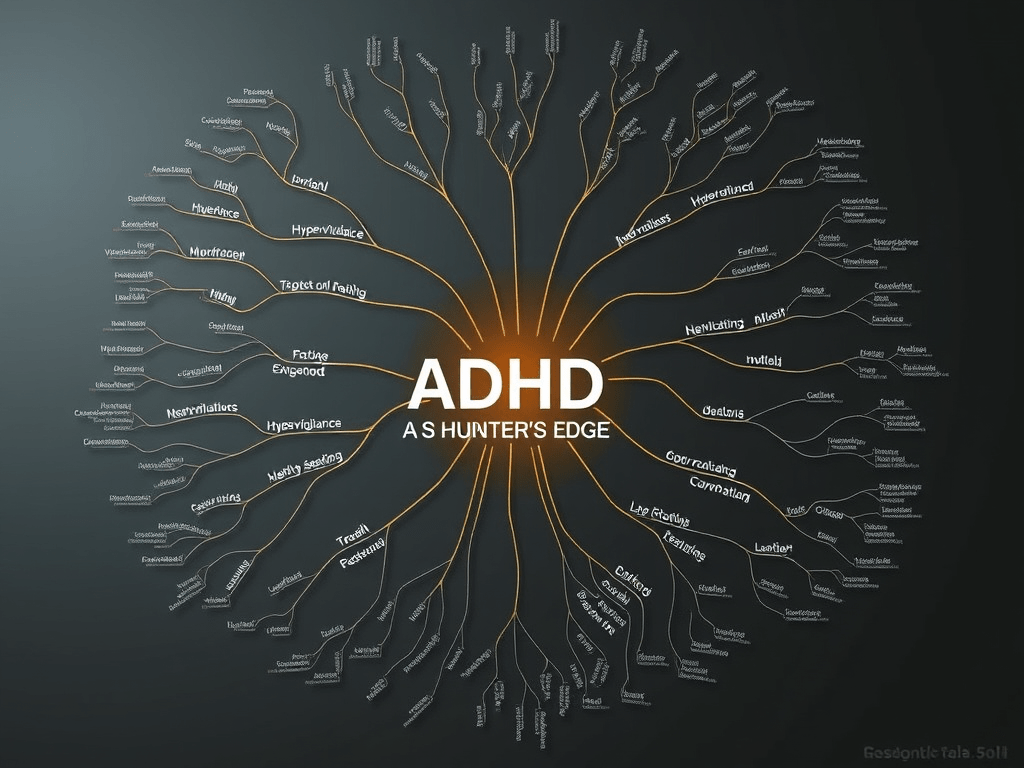
Back in 1993, radio host and author Thom Hartmann flipped the ADHD conversation on its head with a radical reframe: what if people with ADHD aren’t broken—but brilliantly adapted?
In his groundbreaking book Attention Deficit Disorder: A Different Perception, Hartmann introduced the “hunter in a farmer’s world” hypothesis. He argued that ADHD traits—often seen as deficits in modern society—were once indispensable assets in our hunter-gatherer past. What we now label as impulsivity, distractibility, and restlessness were tools of survival in a world where scanning the horizon, chasing prey, and reacting fast could mean the difference between dinner and death.
Now, more than 30 years later, science is finally catching up.
The Berry-Picking Breakthrough
A recent study from the University of Pennsylvania, published in Proceedings of the Royal Society B, put Hartmann’s theory to the test with a deceptively simple experiment: an online berry-picking game. Participants had eight minutes to collect as many virtual berries as possible. But there was a twist—each berry patch depleted over time, forcing players to choose between sticking with declining returns or risking a time-consuming move to a fresh patch.
Guess who shined?
Participants with high ADHD traits consistently gathered more berries. They abandoned worn-out patches faster and were more willing to explore. Their supposed “distractibility” turned into strategic mobility. Their “impulsivity” became efficiency. In other words, they foraged like evolutionary rockstars.
From Stone Age to Scantron
This study doesn’t just validate Hartmann’s metaphor—it delivers measurable, experimental proof that ADHD traits can be highly adaptive in dynamic environments. It reframes behaviors that schools and workplaces often pathologize as indicators of cognitive excellence… in the right context.
The traits that helped our ancestors thrive include:
- Hypervigilance: Ideal for spotting predators or sudden threats.
- Quick decision-making: Crucial when hesitation could mean death.
- Hyperfocus: Perfect for tracking prey with laser-like precision.
- Novelty-seeking: Essential for finding new food, shelter, or migration routes.
- Restlessness and high energy: Necessary for constant movement and endurance.
- Delayed sleep cycles: Beneficial for keeping night watch while others slept.
These aren’t glitches in the matrix. They’re survival software still running in modern hardware.
Genetic Proof in the Bones
The evolutionary story deepens with genetics. A 2020 genomic analysis tracing ADHD-associated alleles from Neanderthals to modern humans revealed these traits aren’t random malfunctions—they’ve been preserved through millennia because they served a purpose. They worked.
And in present-day nomadic communities like the Ariaal of Kenya, the contrast is striking. Ariaal individuals with ADHD-linked genes excel in their mobile, hunter-style lifestyle—they’re better nourished and hold higher social status. But their agricultural cousins with the same genes? They’re seen as unreliable and suffer higher rates of malnutrition.
It’s the same brain, but a different environment—and that makes all the difference.
The Mismatch Theory in Action
This is a textbook case of evolutionary mismatch: traits once beneficial become problematic only because the environment has changed.
We’re asking modern “hunters” to thrive in environments designed for “farmers.” Schools demand stillness, repetition, and linear attention. Offices prize conformity and quiet focus. But hunter minds aren’t built for domestication—they’re wired for dynamism, exploration, and rapid adaptation.
That’s why so many people with ADHD feel like they’re sprinting through a world built for slow walks.
Modern-Day Hunters Still Thrive
The upside? When you put ADHD traits in the right environment, they don’t just survive—they soar.
- Entrepreneurs tap into ADHD-fueled creativity, risk-taking, and fast pivoting.
- Emergency responders thrive on the rapid decision-making and alertness it brings.
- Artists and inventors use hyperfocus to lose themselves in creative flow.
- Salespeople and performers channel their energy into connecting with others in magnetic ways.
We don’t need to “fix” these people. We need to stop trying to make them fit a mold they were never meant for.
Rethinking the Remedy
That’s not to say medication doesn’t help—it absolutely does for many. But it should never be the only lens through which we view ADHD. Instead of asking how to normalize the hunter, let’s ask how to create environments where hunters can thrive.
That means:
- Schools with more movement, exploration, and play.
- Workplaces that embrace agility, innovation, and novelty.
- Cultures that celebrate—not stigmatize—neurodiversity.
Because here’s the truth: evolution doesn’t make mistakes. If a trait survived this long, it’s because it had value. The problem isn’t the brain—it’s the setting.
The Final Word
The science is clear. ADHD isn’t a disease—it’s an evolutionary strategy. It didn’t just show up in the last century alongside standardized testing and fluorescent-lit offices. It’s a deep, ancient, adaptive brain style that kept us alive, moving, and discovering new worlds.
It’s time to stop trying to “farm out” the hunter. Let’s celebrate what these brains can do—and redesign our world to welcome them back.


 Chameleon Magazine
Leave a comment