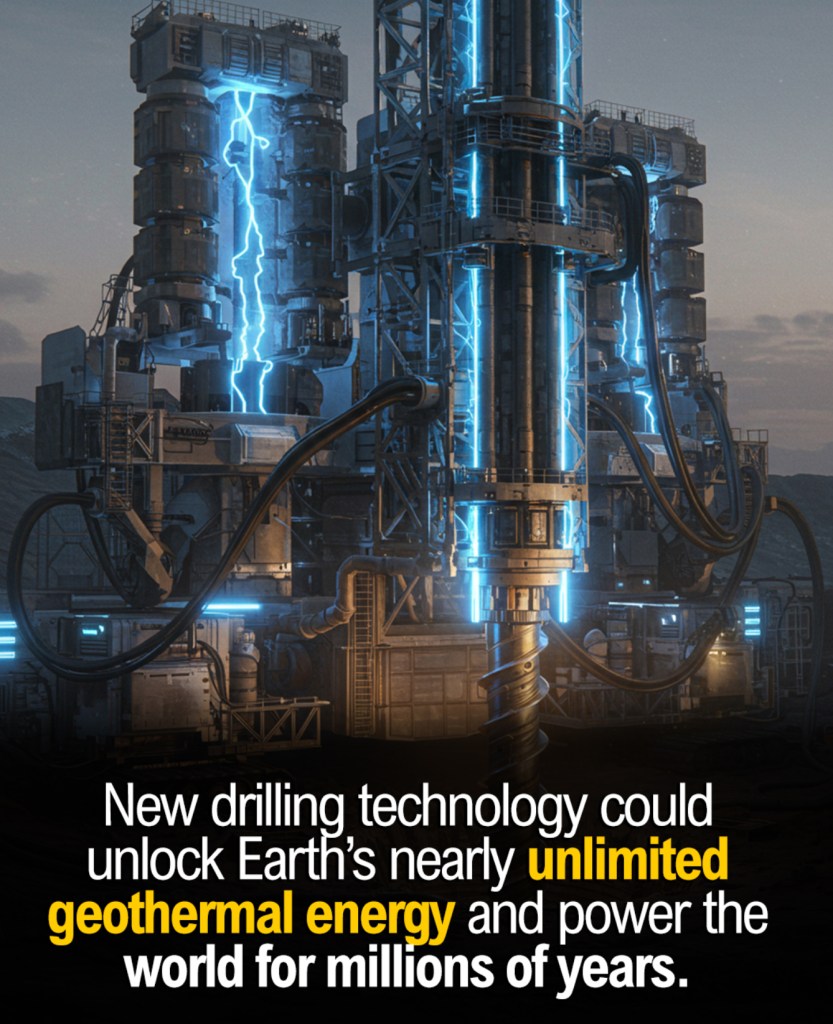
If someone told you the ultimate clean energy source was beneath your feet all along, you might roll your eyes and go back to doomscrolling climate news. But hang on—because what used to sound like Jules Verne-level fantasy is now inching closer to reality, thanks to a sci-fi-sounding drilling method and one very hot idea: tapping into the Earth’s core heat.
Geothermal energy has always been the unsung hero of clean power. It’s not as flashy as solar or as blustery as wind, but it’s always on, day or night, rain or shine. The problem? We’ve never been able to dig deep enough to truly unlock its potential.
Until now.
🌍 The Earth’s Inner Furnace: A Primer
Our planet is a glowing ember at heart. Temperatures at the Earth’s core soar to 9,392°F (that’s five times hotter than lava and hotter than the surface of the Sun), all thanks to two things:
- Residual heat left over from when Earth formed about 4.5 billion years ago.
- Radioactive decay, which works like a cosmic slow cooker, releasing heat over time.
This energy radiates outward like a planetary heat lamp, warming everything above it. Tapping just a tiny fraction of that heat—less than 0.1%—could power humanity for over 20 million years. Not bad for something that’s been quietly glowing beneath us since before the dinosaurs.
But, of course, there’s a catch…
⛏️ The Problem With Going Deep
Drilling into the Earth is no walk in the (Jurassic) park. As you go deeper, the rock gets harder, the pressure cranks up, and the temperature becomes drill-meltingly intense.
Take the Kola Superdeep Borehole in Russia—once the deepest hole ever drilled, it reached 7.6 miles below the surface before engineers had to call it quits. The heat and pressure were too much; even the best materials we had couldn’t handle it.
To put it in perspective: traditional rotary drills can only go about 400 feet into tough basement rock before they risk breaking or overheating. That’s like trying to reach the center of a tootsie pop with a toothpick.
This limitation has kept geothermal power as a niche player—accounting for less than 1% of the global energy mix. Not because it’s not a good idea, but because it’s been practically impossible to reach the good stuff.
⚡️ Enter the Gyrotron: Sci-Fi Meets Bedrock
Now, let’s meet the hero of this story: the gyrotron. It sounds like a weapon Iron Man might use, but it’s actually a high-powered beam generator used in nuclear fusion experiments. Gyrotrons shoot out millimeter-wave electromagnetic radiation, which can vaporize rock—without even touching it.
Boston-based Quaise Energy is combining this with traditional drilling tech in a hybrid approach that might just change everything. They’ve already tested it on a small scale, successfully melting through rock using beams of energy instead of brute force. Think less jackhammer, more surgical laser cannon.
Their goal? Drill down to 12.4 miles—where the rock hits around 932°F—hot enough to turn water into superheated steam, which can power turbines with ease. And since this heat never runs out, those turbines can spin nonstop, unlike wind or solar setups that depend on weather and daylight.
🌀 Why This Could Flip the Energy Game
Let’s be clear: if this works, we’re talking about a complete rewrite of the global energy script.
- Clean and carbon-free: No emissions, no mining for fuel, no shipping of coal or gas.
- Always available: No intermittency like solar and wind. Just constant, reliable power.
- Tiny land footprint: A geothermal plant could fit on a single city block yet power an entire town.
- Retrofit-ready: Quaise’s system could potentially be installed at existing fossil fuel plants, replacing coal burners with geothermal steam generators—an elegant solution to a messy legacy.
Imagine every power plant that’s belching CO₂ today becoming a clean, closed-loop Earth-powered engine tomorrow. Ambitious? Yes. Impossible? Not anymore.
🌐 The Road Ahead (And the Rocks in the Way)
Of course, this isn’t a guaranteed fairy tale ending. There are still monumental challenges ahead:
- Scaling the technology from lab tests to full-scale industrial drilling.
- Managing costs, which are high now but could plummet if the tech proves viable.
- Navigating environmental concerns (yes, even clean drilling can shake up ecosystems if done irresponsibly).
- And, as always, battling inertia—governments, utilities, and industries tend to favor the status quo.
But if even a handful of pilot projects prove successful, this could ignite a geothermal renaissance, especially in places without easy access to solar or wind infrastructure.
💥 Final Thought: The Power Beneath Our Feet
What’s wild is this: the Earth has been a perfectly reliable nuclear reactor all along—quietly burning, endlessly spinning, its molten heart radiating power in all directions. We’ve just never had the keys to open the vault.
Now, with gyrotrons, vapor-drills, and a bold new vision, we might finally unlock the basement.
And it turns out, the future of clean energy might not be floating in the sky or blowing in the wind… it might be burning underfoot.


 Chameleon Magazine
Leave a comment