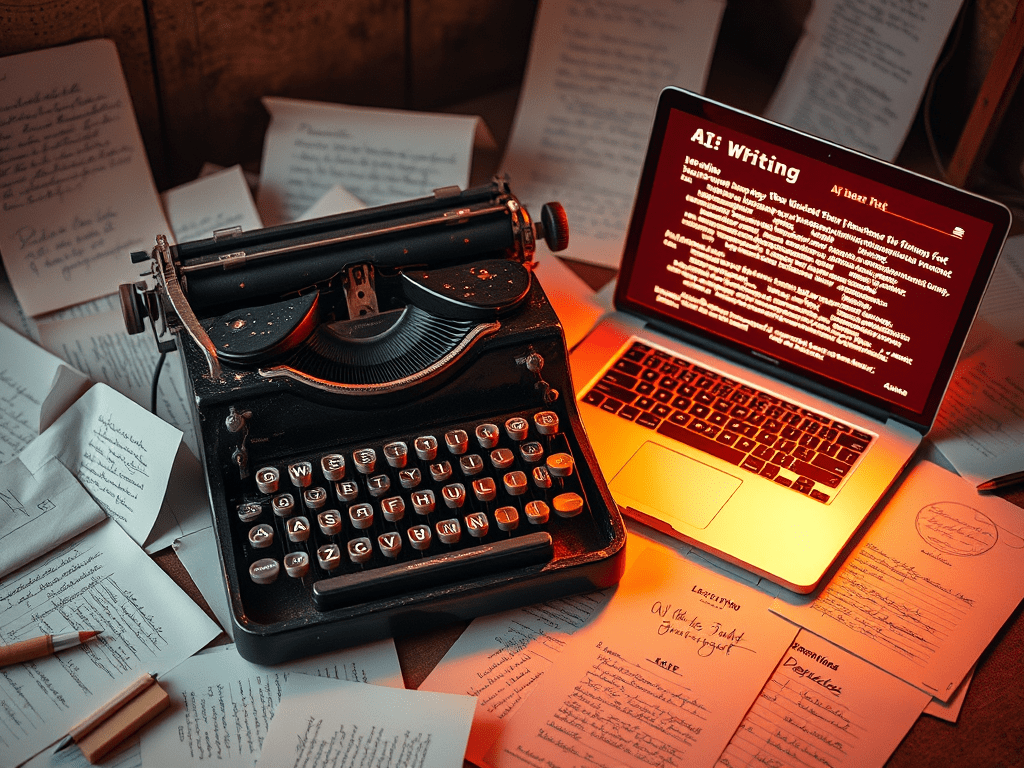
There’s no point pretending: writing, as we knew it, is dying.
Not long ago, a writer was someone who sat with silence and turned it into meaning. A blogger poured their spirit into stories, hoping someone—anyone—might feel a pulse of connection on the other side of the screen. Writing was a slow, human craft, stitched together with memory, experience, and blood.
Now? The internet is saturated with the soundless murmur of machines. Thousands of words generated in seconds. Articles without authors. Poems with no pain. Content without consequence.
So yes—maybe AI did destroy writing. Maybe we should bury it. Thank it for thousands of years of service. Thank the monks who illuminated manuscripts, the rebels who self-published in bedrooms, the teachers who showed us how to hold a sentence like a living thing. Thank all of them. And then lay the whole thing to rest.
Let the machines take over.
But here’s the part no one’s talking about.
While many grieve the loss of something sacred, something else—something quietly profound—is happening. AI isn’t just erasing old forms. It’s giving tools to the people who were never allowed to use them.
Writing has always been a form of communication, yes—but it’s also been a weapon. For centuries, only the educated could write. In Latin, no less—a language reserved for the gatekeepers of law, religion, and power. You couldn’t be heard unless you learned the code. It wasn’t about connection. It was about control.
And even now, in modern times, legal language still locks out the poor. Academic prose still alienates the curious. Most people are taught not to trust their own voice because it doesn’t sound “correct.”
But what happens when someone who’s never written before sits down with an AI assistant and says, “Help me say what I mean”? What happens when they find a way to shape their story, their anger, their dream, and send it into the world? That’s not the death of writing. That’s a resurrection.
Of course, we should be worried. We’ve reduced our attention spans to 400 characters. We swipe past nuance. We skim past feeling. We live in a culture where stupid isn’t the absence of knowledge—it’s the absence of care. Of depth. Of time.
But blaming AI for that is like blaming fire for the house burning down when it was us who left the stove on.
AI didn’t dumb us down. We did. We taught ourselves not to read. Not to wait. Not to feel.
But for those who do care—for those still listening—AI isn’t a threat. It’s a strange, patient teacher. A mirror. A sparring partner. Not a replacement for emotion, but a tool that can clear the noise so you can hear your own heart beat back.
Because emotional writing—real writing—can’t be generated. Not truly. A machine can mimic heartbreak, but it will never know the sound of your mother’s voice when she was tired but still proud. It can write about loneliness, but it will never feel what it’s like to fall asleep next to someone who doesn’t love you anymore.
That’s where we live. That’s what we keep. That’s what no algorithm will ever hold.
So no—I won’t pretend we’re not in the middle of something massive. Writing, as we knew it, is changing beyond recognition. Maybe that’s frightening. But maybe it’s also necessary.
If the polished, pretentious, exclusionary form of writing dies—and what rises is raw, awkward, human, and universal—then maybe we haven’t lost writing at all.
Maybe, for the first time in history, we’re just finally giving it back to everyone.


 Chameleon Magazine
Leave a comment