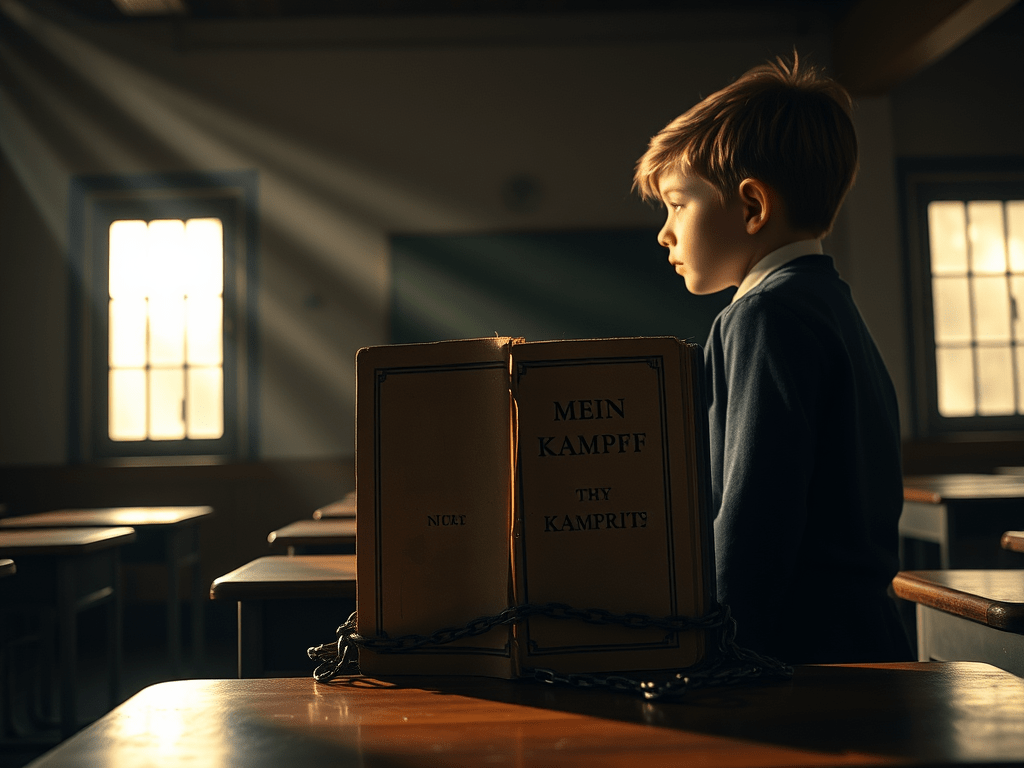
In his thought-provoking blog “The Day My Teacher Hid Hitler’s Words,” Paul Eric shares a moment from his teenage years that still lingers. One day, driven by curiosity, he asked his teacher for a copy of Mein Kampf, Adolf Hitler’s infamous manifesto. She froze. Glanced toward a colleague. And then… refused. No explanation. No discussion. Just a silent dismissal.
It was meant to be an act of moral protection. But it backfired.
By not allowing him to read the book, the teacher didn’t disarm the danger—she amplified it. What was once just an object of curiosity suddenly became forbidden, mysterious… powerful. And that raises a bigger, more urgent question:
Does hiding dangerous ideas make them disappear—or give them more strength?
🧨 The Forbidden Fruit of Censorship
Censorship often works like a match against dry kindling. The moment something is hidden or banned—especially in a school—it gains allure. Teenagers aren’t wired to ignore mystery; they chase it. What was once educational becomes mythic. And in that moment, even a hateful book like Mein Kampf becomes appealing—not because of its message, but because of the mystique around it.
We say we’re protecting minds. But sometimes we’re just handing them over to the dark, without a guide.
📖 Was There
Anything
Good About Mein Kampf?
Let’s be clear: Mein Kampf is vile. It’s not “valuable” in the usual sense. It’s the ideological DNA of one of history’s most brutal regimes. But like a virus studied in a lab, there are reasons to expose ourselves to it—carefully, contextually, and critically.
Here’s how the existence of Mein Kampf has inadvertently provided some educational value:
- A Blueprint of Tyranny
Hitler didn’t hide his intentions. In Mein Kampf, he laid them out: racial purity, Lebensraum (territorial expansion), anti-Semitism, and authoritarian control. Historians and educators use it to dissect how a dictator crafts a narrative and manipulates the masses.
⚠️ And here’s the modern twist: When governments today begin branding segments of their population as “right-wing” for simply questioning authority, holding conservative views, or expressing national pride—we enter dangerous territory. This kind of broad-brush labeling mirrors the early demonization strategies laid out in Hitler’s own framework. Tyranny doesn’t begin with violence. It begins with dehumanization.
2. An Immune System Against Propaganda
Teaching Mein Kampf properly doesn’t radicalize—it inoculates. It helps young people see how hatred is dressed up in nationalism, how scapegoats are chosen, and how lies become policies. It’s not about glorifying. It’s about disarming the weapon through knowledge.
❗ But when a government decides what’s “too dangerous” for the public to think, say, or hear—whether in books or conversations—they weaken our collective immune system. When “right-wing” becomes code for “enemy,” we stop hearing one another. And in that silence, real extremism finds oxygen.
3. A Mirror to Our Modern Selves
What Mein Kampf teaches—accidentally—is how normal people fall for dangerous ideas. Not because they’re evil, but because they’re scared, poor, angry, or proud. The book is a warning bell: that under the right conditions, democracy can slide into dictatorship with thunderous applause.
🪞 Today’s mirror? It’s when governments villainize farmers, parents, journalists, or working-class voices as part of some “extremist fringe.” When people feel unheard, they gravitate toward those who claim to hear them. That’s not radicalization—it’s neglect in disguise. And it creates the very divide we claim to fear.
🧠 Final Thought: Don’t Bury the Darkness—Expose It
Books like Mein Kampf should never be taught without caution. But they should be taught. Because if we can’t look evil in the eye, we’ll never recognize its reflection in our own time.
Suppressing dangerous ideas doesn’t destroy them—it feeds them.
Knowledge doesn’t radicalize people. Silence does.
✉️ What Do You Think?
Have you ever read something you were told not to? Did it change your views—or reinforce them?
Let’s talk. Drop a comment, share your thoughts, or subscribe for more uncomfortable conversations that matter.


 Chameleon Magazine
Leave a comment