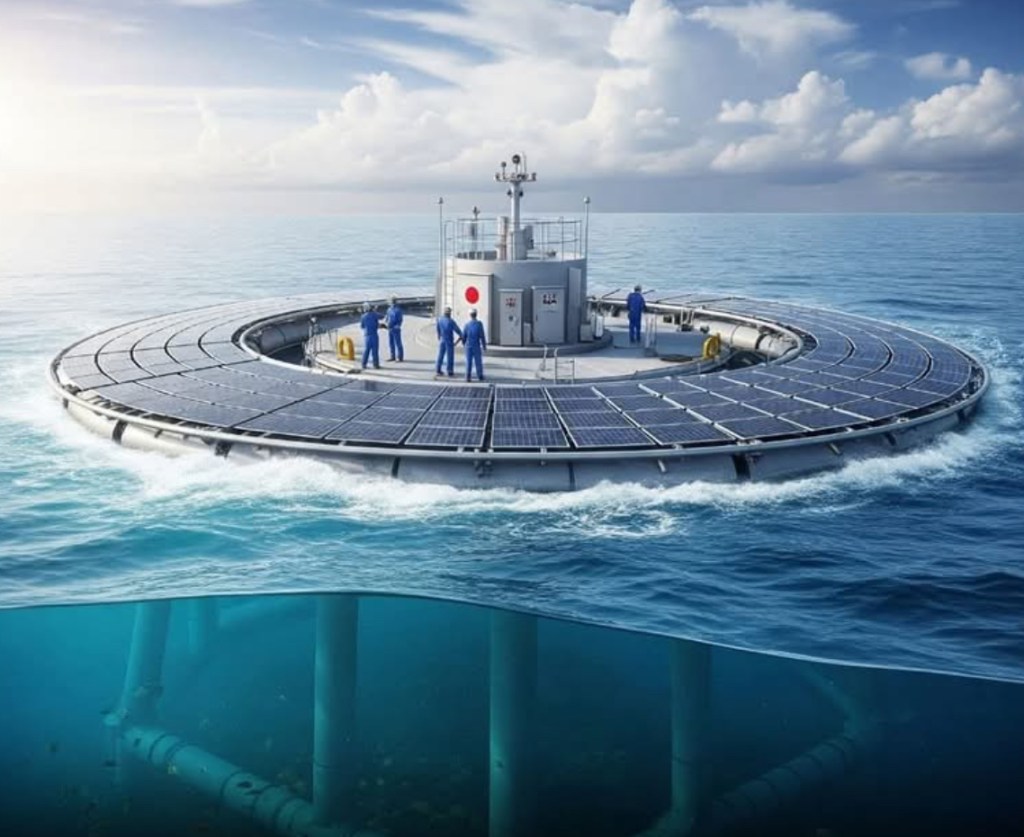
☀️🌊🤖Floating power stations that don’t sink, don’t pollute, and don’t even flinch when nature throws a tantrum? Japan just handed climate doomers a waterproof mic drop.
🚫Land? We Don’t Know Her. These Solar Islands Bring the Drama and the Data
While most countries are busy approving yet another coal mine “for energy security,” Japan is out here building solar UFOs that flirt with hurricanes. Enter: the floating solar fortress — a 15,000-square-meter techno-donut of genius that generates clean energy, shelters marine life, and outperforms your local grid during a storm surge.
Forget NIMBY tantrums about “unsightly solar panels” ruining your precious lawn aesthetic — this beauty never touches land. It bobs elegantly off the coast, soaking up rays like a smug, eco-conscious swan, powered by bifacial panels that sip sunshine from sky and sea like a double-shot espresso. ☕⚡
And when typhoons roll in, these floating marvels don’t scatter like Amazon delivery boxes — they stabilize themselves with cold-seawater cooling, gyroscopic guts, and enough engineering swagger to survive 180 km/h tantrums. That’s not a solar farm — that’s Poseidon’s iPad.
Oh, and did we mention? Beneath the surface, it’s basically a four-star reef resort for fish. No toxic paints, no cement dumping — just bio-friendly underbellies attracting marine life like a wet rave with LED lighting and plankton snacks.
Need to evacuate a disaster zone and restore power mid-chaos? Just unanchor the solar island and sail it to where it’s needed. It’s a renewable Death Star with compassion and flexibility. And it’s modular. Which means by 2030, Japan might just be the first country powered by floating tech-lilies while the rest of us argue about offshore wind shadows.
So next time someone says “solar isn’t reliable,” send them this, and then a life jacket.
🌪️ Challenges
Why are we still stapling solar panels to farmland like it’s 2007? Why is the West so committed to burning things when we could be drifting on climate-proof lily pads of glory? Drop your outrage, awe, or aquatic puns in the blog comments 💬 — not just on Facebook, you cowards.


 Chameleon Magazine
Leave a comment