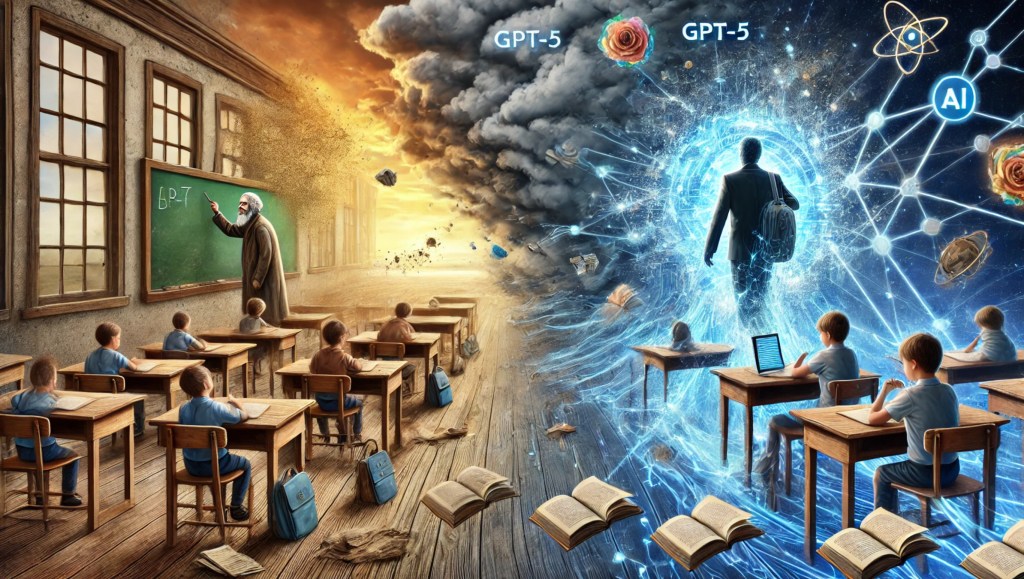
The arrival of GPT-5 isn’t just another tech story. It’s an existential one for traditional education.
For centuries, education has followed a top-down, factory-line model: a teacher at the front, students in rows, a curriculum locked into a yearly rhythm, and progress measured by memorization and timed tests.
But now? That system is facing a force it was never designed to withstand.
GPT-5 isn’t a digital assistant or a fancy calculator.
It’s a reasoning, creating, problem-solving intelligence—accessible to anyone with an internet connection.
So let’s not dance around the question:
Should the school system be worried?
Yes. Unless it evolves. Rapidly.
🧠 Teachers Must Evolve from Instructors to Curators and Collaborators
In a world where AI can explain any concept better than a whiteboard ever could, the role of the teacher is no longer to deliver information—it’s to guide discovery.
The best educators will become curators of experience, navigators of curiosity, and collaborators in learning journeys.
Those who cling to old power dynamics—gatekeepers of knowledge, dispensers of right and wrong—will find themselves increasingly irrelevant.
🤔 Philosophers Must Engage, Not Retreat
This is not just about lesson plans. It’s about rethinking the nature of intelligence itself.
Philosophers and theorists must step up—not to warn us away from the unknown, but to help us define what it means to be sentient, conscious, or human in a world where machines now speak in the language of thought.
This is a moment for intellectual courage, not retreat.
🏛️ Policy-Makers Must Shift from Control to Cultivation
If regulation becomes synonymous with fear, stagnation will follow.
Instead, policy must move from gatekeeping to gardening—nurturing innovation while addressing inequality, digital access, and the ethical implications of AI-augmented learning.
The future of education cannot be centrally dictated. It must be fluid, personalized, and borderless.
🏫 Educational Institutions Must Restructure or Risk Obsolescence
Universities, schools, and adult learning centers were built for a time when information was scarce and had to be housed, managed, and certified.
Now? Knowledge is at everyone’s fingertips—on demand, personalized, and increasingly peer-verified rather than institutionally approved.
Those institutions that fail to integrate hybrid intelligence workflows will become museums of a bygone era.
⚠️ GPT-5 Will Not Replace You. But It Will Render Many Roles Redundant Unless Redefined.
This isn’t AI replacing humans.
This is AI replacing outdated human roles.
If your position is built solely on delivering static knowledge, consider it fragile.
If your value is in facilitating exploration, inspiring curiosity, or making complex ideas humanly meaningful, your role is only just beginning.
💡 Learning at Your Fingertips Changes Everything
Here’s the real disruption:
- No more waiting for September.
Learning can happen year-round, day or night. The school calendar becomes obsolete. - No more fixed holidays.
Education blends into life itself. Go on holiday and take your learning with you—tailored, interactive, and self-paced. - Home schooling becomes radically accessible.
With GPT-5 as a private tutor, parents no longer need degrees to offer a world-class education. - Teachers no longer need to go through outdated credential pipelines.
What matters now is ability to guide, to co-learn, and to adapt with the tools of the future. - Adult education? Disrupted overnight.
No more overpriced night classes or static modules. Adults can reskill in real-time, guided by AI that learns how they learn.
🌍 The School System Won’t Be Destroyed—But It Will Be Rewritten
This isn’t the end of learning.
It’s the beginning of continuous, curiosity-driven, AI-enhanced exploration.
The schools that thrive in this new era will be those who let go of control and lean into what education was always meant to be:
- Empowering, not instructing.
- Curious, not compulsory.
- Evolving, not standardized.
The future doesn’t belong to those who resist the storm.
It belongs to those who ride it—open-eyed, adaptable, and ready.


 Chameleon Magazine
Leave a comment