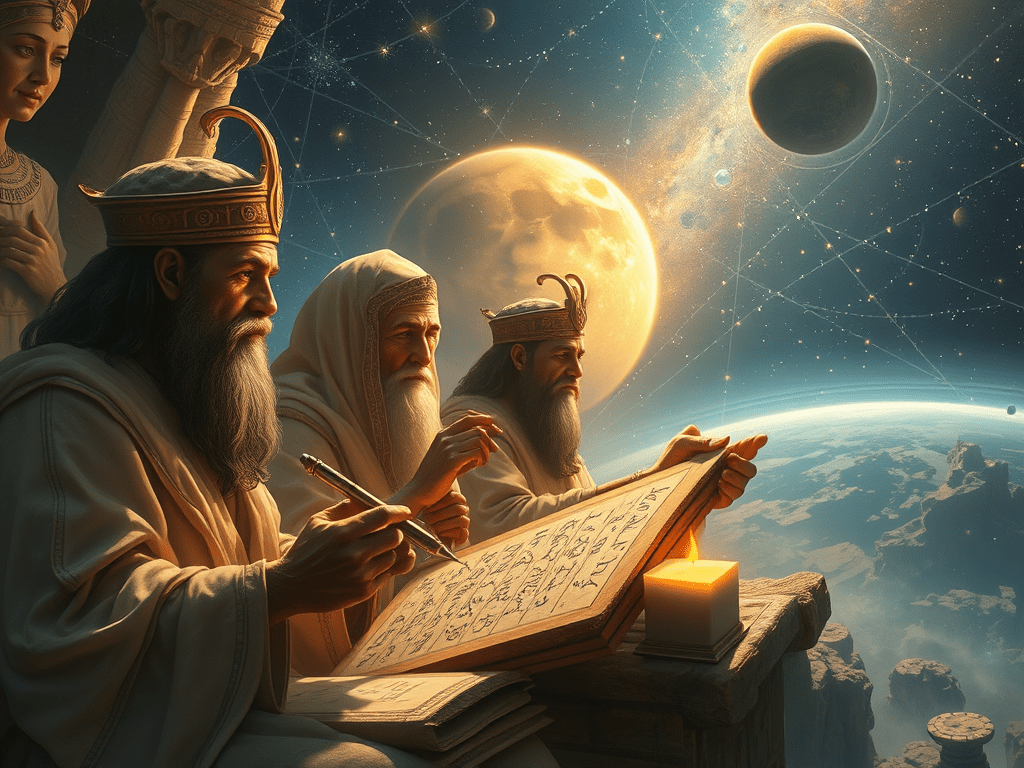
👽🛸 What if the world’s first written language wasn’t created to log crops—but to dial long-distance to the gods? The Sumerians may have invented cuneiform, but the content of their earliest tablets suggests they weren’t just pioneering bureaucracy—they were taking notes during extraterrestrial office hours.
🌌 The Original Star-Lords Were Basically Space Auditors
Let’s break this down:
We’re told Sumerians, around 3200 BCE, were humble farmers who one day woke up and said, “You know what would make herding sheep more efficient? Writing.” And somehow, without any recorded slow build-up, they skip finger painting and jump straight into celestial math, stellar calendars, and interdimensional user manuals for calling down beings known as the Anunna.
Totally normal, right?
These Anunna weren’t minor nature spirits either. According to surviving texts like the Enuma Elish, these weren’t gods in the Zeus-throws-lightning sense—they were beings who descended from the heavens, taught humans geometry, metallurgy, irrigation, and divine law, then conveniently bounced just before a cataclysmic global flood. 🚿🌍
Let’s pause and ask:
Why would Bronze Age Mesopotamians invent an entire writing system just to tell bedtime stories about space gods?
And how do we explain that the earliest cuneiform tablets aren’t full of cute drawings or phonetic syllables but instead contain obsessively detailed astronomical data? Including references to planetary bodies that wouldn’t be officially “discovered” for thousands of years? (Looking at you, Pluto 👀)
Even the most credentialed scholars admit it’s “weird” how obsessed the Sumerians were with mapping the heavens. One tablet literally outlines a sequence of instructions for building a “ziggurat landing platform” (that’s ancient-Sumerian for sky tower with a spiritual Wi-Fi hotspot). Yet we’re supposed to believe these guys just wanted to track harvest cycles? 🤨🌾
But no—according to modern academia, it was all just about sheep.
Because the most advanced civilization of the ancient world—armed with pi, square roots, and trigonometry—must’ve just really, really cared about counting goats. 🐐💫
🛸 Ancient Knowledge or Bureaucratic Fan-Fiction?
You know what’s suspicious? Every time a civilization starts talking about “sky beings” or “knowledge from the stars,” historians break out their “Metaphor Only” stickers and start slapping them on everything.
“Oh, those weren’t real gods—they were symbols of rain and abundance!”
Right, because nothing says “rain ritual” like mathematically precise orbital alignments.
The Sumerians weren’t alone, either.
Mayan codices. Egyptian glyphs. Vedic scriptures.
Every time humans claim they were “taught” by sky visitors, we’re told it’s “just mythology.”
Yet somehow we credit Aristotle with the invention of logic, but call it “coincidence” that ancient Sumer knew about the 26,000-year precession of the equinoxes. 🤔📚
So here’s the big question:
What if the first written word wasn’t human at all?
What if we were simply transcribers—the ancient version of stenographers—taking down cosmic dictation from something (or someone) that flew in, dropped knowledge, then noped out before the flood hit “Ctrl + Alt + Del” on early civilization?
🧠 Challenges
Is it still just “primitive mythology” when the math checks out? Or are we overdue for a rewrite of what we think we know about “history”? Comment your weirdest theory, your most unhinged ancient alien take, or that late-night epiphany about how Mesopotamia might’ve been Earth’s first spaceport. 🚀💬
👇 Smash the comments, drop your cosmic thoughts, and beam your theories to the collective hive-mind.
The best replies will be featured in our next issue—unless the Anunna intercept us first. 🌠👁️


 Chameleon Magazine
Leave a comment