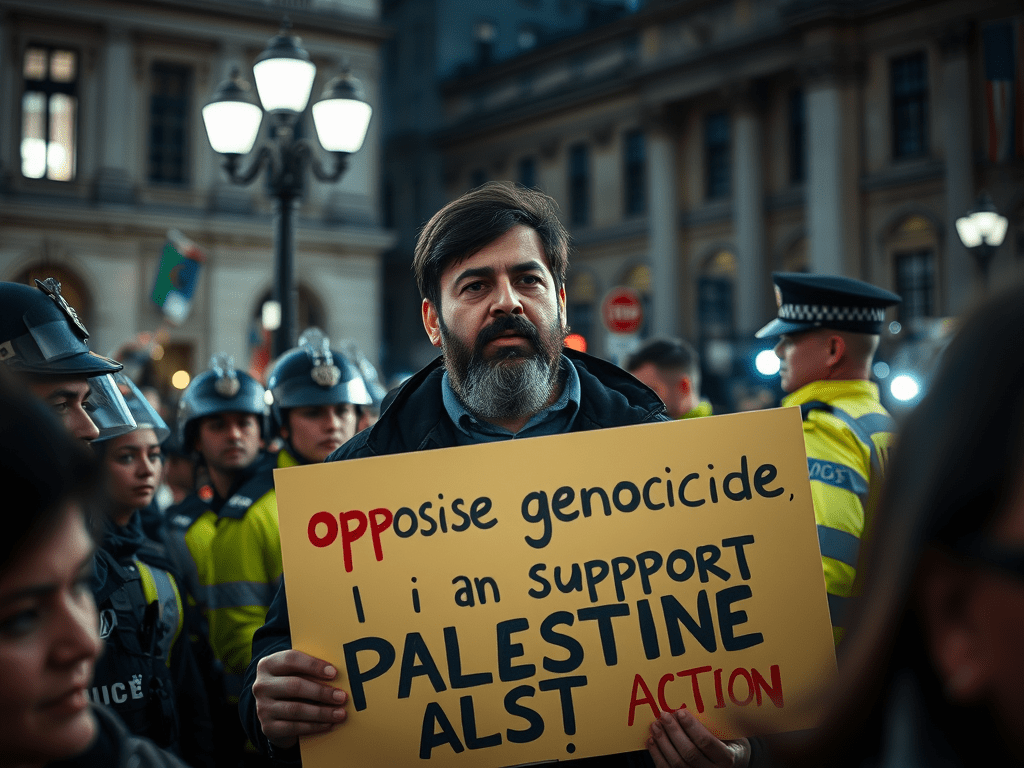
🚨🪧Once accused of being al-Qaeda’s pen pal, Moazzam Begg is now in the headlines again—this time for waving a sign in Parliament Square. Begg, along with at least 465 others, was arrested for openly supporting Palestine Action, a group the UK recently slapped on the terror list after members sabotaged RAF aircraft destined for Israel.
🕵️ The Protest That Became a Mass Arrest
It was meant to be a clever test: activists publicly defying the ban in the hope there’d be too many people to arrest. A “safety in numbers” approach—until the police decided to treat it more like “Black Friday crowd control with cuffs.” By noon, Parliament Square looked less like a political rally and more like the queue for an especially grim airport security checkpoint.
The trigger? A banner reading: “I oppose genocide, I support Palestine Action.” Within minutes, officers encircled the banner holder, and in the sweep that followed, Begg himself was led away. If the aim was to force the government to either back down or arrest everyone… well, they chose door number two.
📜 From Guantanamo to Genocide Signs
Begg’s past reads like a political thriller that Netflix would cancel after one season for being “too unbelievable.” In 2002, he was grabbed in Pakistan, sent to Bagram Air Base in Afghanistan, then shipped to Guantanamo Bay in 2003. He was released without charge in 2005, went on to become a human rights campaigner, and now—nearly two decades later—finds himself once again on the receiving end of the handcuffs.
It’s hard not to note the symmetry: once accused of global terror links, now accused of supporting a UK-banned protest group. Different decade, different accusations, same legal jeopardy.
⚖️ The Free Speech Discrepancy
If Lucy Connolly can be jailed for a social media post, this feels like a free speech category 5. We’re no longer talking about online words typed in a moment of rage—we’re talking about 466 people arrested for holding physical banners in public. The scale is massive compared to that case, and it raises the awkward question: if both are “criminal,” where exactly is the line between dissent and danger? And who gets to move it?
🎭 The Stage-Managed Security State?
Critics will see this as proof the government is criminalising dissent. Supporters of the ban will say it’s just enforcing the law. But the optics—police surrounding banners like they’re live explosives—make the whole scene feel less like British democracy in action and more like an awkward West End play called The Great Suppression.
🔥 Challenges 🔥
Is this about stopping real threats, or is it a dress rehearsal for criminalising political speech that makes the government uncomfortable? And if Lucy Connolly’s post got her jailed, should 466 banner-holders be bracing for decades behind bars? Drop your sharpest takes in the blog comments. ✊📜
👇 Comment, like, share—keep the debate as loud as the arrests were quick.
The most cutting takes will be featured in the next issue of the magazine. 📝🎯


 Chameleon Magazine
Leave a comment