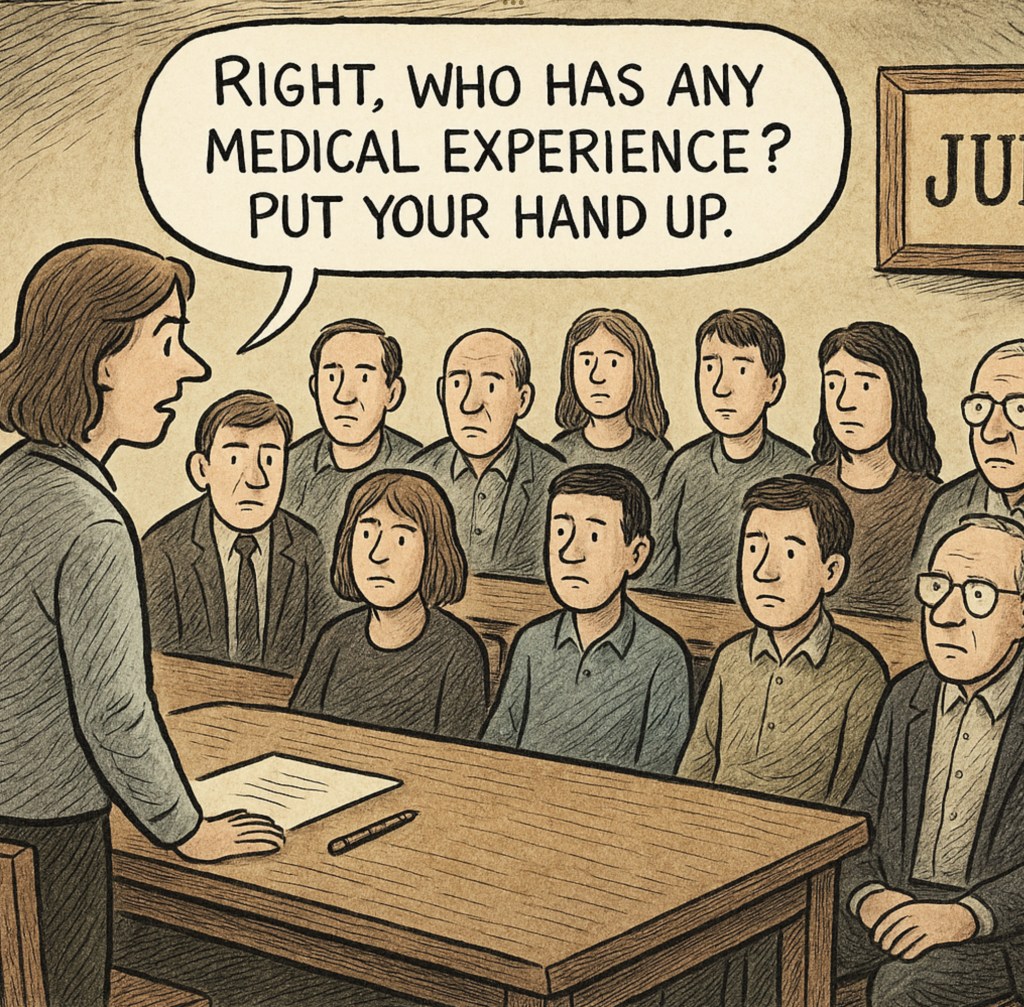
🧠⚖️Lucy Letby’s trial was supposed to be the moment justice roared — the cathartic slam of the gavel, the cleansing fire of truth.
Instead, it was a reminder that the British jury system is essentially a game of “Guess Who?” played with real lives.
Twelve strangers in a beige room, armed with nothing more than a pencil, a plastic jug of water, and whatever legal knowledge they half-absorbed from binge-watching Making a Murderer. They’re tasked with sifting through complex medical evidence, contradictory testimony, and the kind of forensic detail that would make actual experts double-check their notes.
🚨 Let’s be crystal clear — they had NO qualifications for this 🚨
To sit on the jury of one of the most complex medical trials in British history, you needed:
- Be aged 18–75.
- Be on the electoral roll.
- Have lived in the UK for 5 years since age 13.
- Not be currently in prison.
That’s it. No medical degree, no training in evidence analysis, no background in statistics, no ability to interpret neonatal charts — not even a crash course on “how to read a pathology report without panicking.”
And yet these twelve people were expected to:
- Absorb months of technical testimony from paediatricians, nurses, forensic experts, and statisticians.
- Interpret complicated biochemical evidence — insulin readings, oxygen saturation data, microbiology reports.
- Weigh up conflicting expert opinions in a field where specialists themselves disagree.
- Decide if someone spends the rest of their life in prison.
We wouldn’t trust a dozen random people from the bus stop to rewire a kettle, but we happily hand them the fate of a human being.
🥔 How to Botch a Trial in Twelve Easy Steps
- Pick your jurors at random.
- Drown them in technical jargon they’ve never heard before.
- Ban them from taking any evidence home to actually study.
- Let the media feed them headlines all year.
- Encourage gut feelings over careful reasoning.
- Put them in a room with one loud personality who dominates discussion.
- Let fatigue set in until they’d vote guilty just to go home.
- Pretend “beyond reasonable doubt” is self-explanatory.
- Hide their reasoning forever — verdicts need no explanation.
- Accept the outcome as sacred, no matter how flawed the process.
We romanticise juries as “the people judging the people”. But in high-stakes, hyper-technical trials like Letby’s, they’re just twelve untrained volunteers wrestling with complexity that should terrify them.
When they get it wrong? The accused pays in years — maybe life. The jurors? They disappear into anonymity, sipping tea and reading about the verdict in the paper like they were spectators, not participants.
The Lucy Letby trial didn’t just put one nurse under the microscope — it should have put the entire jury system there too. And what we’d see, magnified, is a system still relying on the myth that a random dozen can untangle the most intricate human and scientific knots simply because… democracy says so.


 Chameleon Magazine
Leave a comment