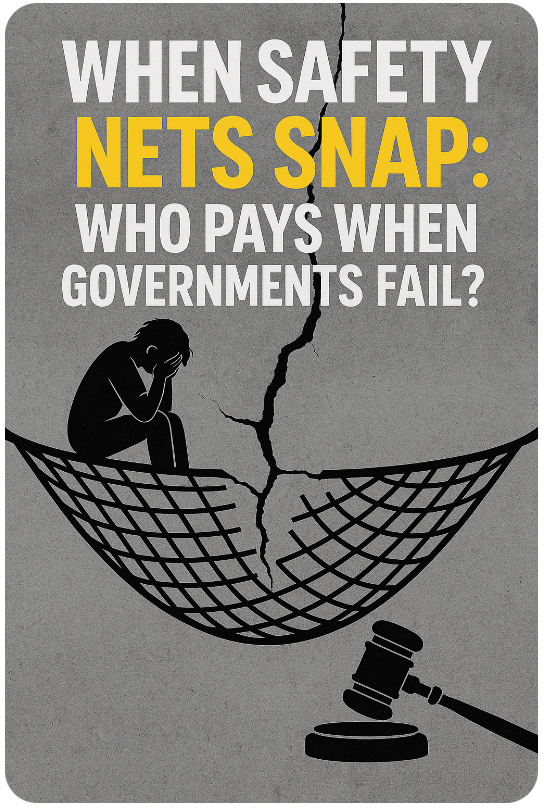
🕳️⚖️A horrific crime left a young girl traumatised, and the defence offered was that the perpetrator simply “did not understand” because of cultural differences. Let’s pause here: there is no culture on Earth where rape is a misunderstanding. The blame is, and always will be, on the predator. Full stop. But once we establish that, the bigger question looms like an elephant in a courtroom: when governments fail to protect their citizens, who shoulders the responsibility?
🏛️ The Predator vs. The Protectors
Of course, the criminal bears the ultimate responsibility. No cultural loophole, no translation error, no misplaced shrug changes that fact. He acted. He chose. He must face the full force of the law. But while the individual is guilty, the government does not walk away unscathed. Because beyond individual crime lies institutional failure. And in this case, it’s glaring.
Governments are not just ceremonial flag-wavers; they exist to protect their people. Safety is supposed to be part of the contract between citizen and state. Yet when vetting is sloppy, integration is neglected, and safeguarding collapses, those “gaps” become entry points for tragedy. And when those cracks widen, the victims fall straight through.
🩸 When Negligence Becomes a Co-Defendant
This girl’s suffering is not just the story of a predator—it’s the story of a government that failed to vet properly, failed to integrate effectively, and failed to safeguard adequately. She carries the scars of one man’s crime, but also the fingerprints of systemic negligence.
Think about it: in almost every other area of public life, government failure is actionable. When police ignore warnings, when child services overlook abuse, when hospitals blunder catastrophically, victims can pursue accountability. Why does that principle vanish the moment the issue touches safeguarding or crime prevention?
💰 A Case for Compensation
If the state has a duty of care—and fails to uphold it—victims should have the right to claim compensation. Not as a political stunt. Not as a culture-war headline. But as basic justice. Accountability doesn’t just belong in courtrooms; it belongs in parliament, in government departments, and yes, in the nation’s wallet.
Because if a government knowingly creates conditions where its citizens are unsafe, then it cannot wash its hands when tragedy strikes. Otherwise, victims are not only left with trauma but also abandoned to carry the weight of institutional failure.
🔑 The Bigger Question
Strip away the headlines and the outrage, and the core principle remains:
- Do citizens have the right to expect their government to keep them safe?
- And if that government fails, do they have the right to hold it accountable—financially and morally?
The answer must be yes. If not, then governments remain untouchable while victims are left with nothing but broken promises, hollow apologies, and lives shattered by failures that were preventable.
🔥 Challenges 🔥
How safe do you really feel under the government’s “duty of care”? Should victims be compensated when the state’s negligence leaves them unprotected—or does that open a door to endless claims? Drop your take in the comments. Don’t just vent on Facebook—bring the heat where it counts. 💬⚡
👇 Comment, like, and share this piece. Let’s drag the conversation into the open.
The sharpest insights and boldest takes will be featured in the next issue of the magazine. 📰🎯


 Chameleon Magazine
Leave a comment