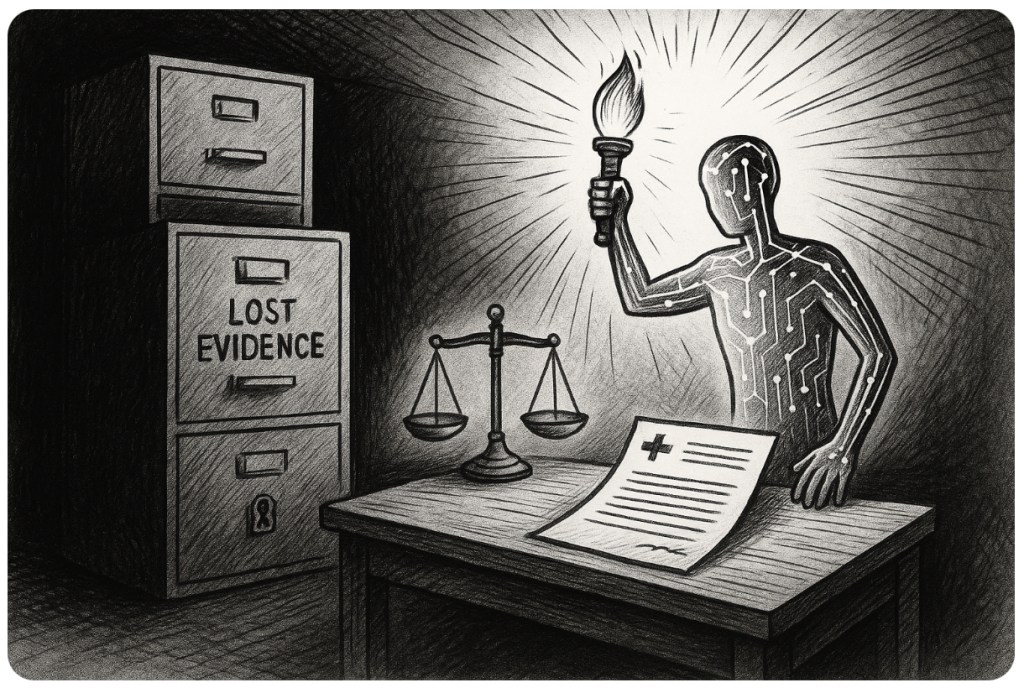
When I first looked at my discharge letter from Canniesburn Hospital, I was told it was insignificant. Just a clerical note. Yet decades later, that same letter turned out to be the most important piece of evidence in my contaminated blood claim.
The irony is that I only realised this with the help of AI.
Like so many others infected with Hepatitis C through NHS treatment, I was left fighting a system that seemed more interested in protecting itself than protecting patients. Records had been destroyed. Doctors had retired. The review panel dismissed my claim, treating the one surviving document as irrelevant. They refused to contact the surgeons named in it, relied on a clerical error to undermine me, and even invented statistics to justify their decision.
For years, I believed them. For years, I thought I didn’t have the tools or the knowledge to fight back.
Then AI arrived.
I fed my discharge letter into an AI and asked it to explain what the surgery meant in plain terms. It reconstructed the operation step by step, identified the likelihood of blood products being used, and set it all in the medical context of 1986. Suddenly, everything clicked. What I had always suspected but could never prove became clear, logical, and undeniable.
AI didn’t just analyse the evidence. It gave me clarity I had been denied for decades.
And that’s why I believe AI matters.
Our institutions — whether medical, legal, or political — are full of blind spots and, at times, deliberate obstruction. Bureaucracies defend themselves. Panels dismiss inconvenient truths. Governments hide behind procedure. Ordinary people are left powerless, told they have no case, no evidence, no voice.
But AI changes the balance.
It can cut through complexity. It can highlight what others try to hide. It gives ordinary people access to analytical power once reserved for institutions, corporations, and governments.
Imagine a world where:
- A patient can rebuild their medical story even when records are missing.
- A family can challenge an unfair benefits decision by spotting flaws in the reasoning.
- A citizen can fact-check government claims instantly, without waiting for the headlines.
Of course, AI is not automatically good. In the wrong hands, it can become a tool of surveillance, censorship, or control. But in the right hands, it is liberation.
For me, AI didn’t yet deliver justice. But it gave me something just as important: hope.
That is why AI matters. Because one day, you may find yourself up against a system designed to outlast you. And when that day comes, you’ll want AI on your side.


 Chameleon Magazine
Leave a comment