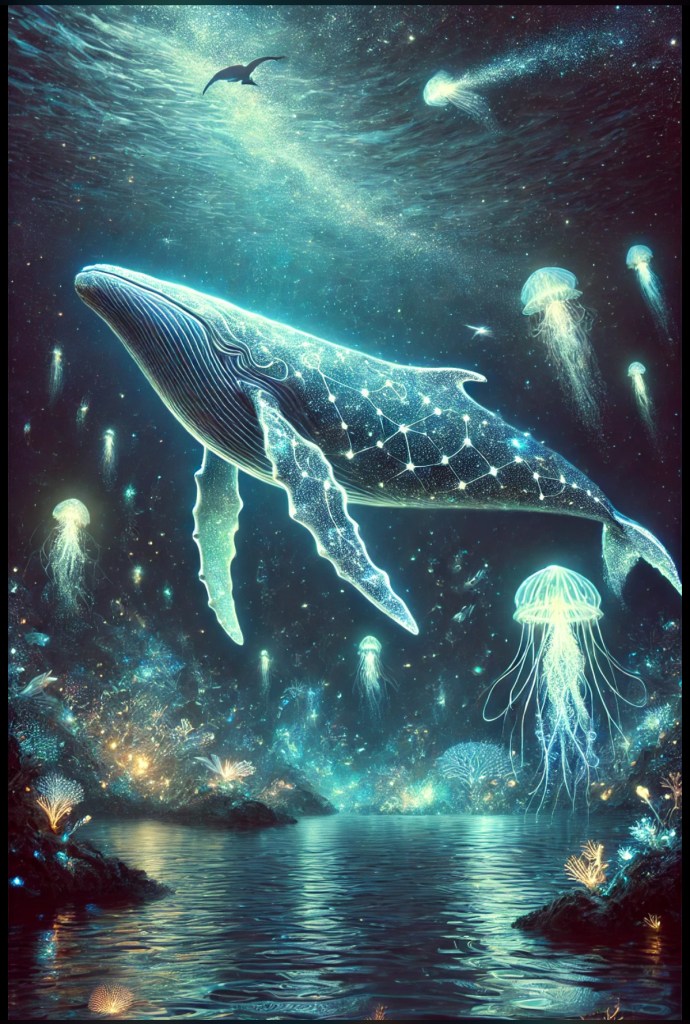
Long after the last human city had sunk beneath the tides, the ocean reigned with memory and myth.
Below its glowing surface, in the bioluminescent dark, a forgotten people stirred: the Cetari. They were not whales, though they wore the shapes of them—vast, star-speckled beings with voices deeper than time. Each Cetari was born not of womb or egg, but of a ceremony called the Deep-Song, performed at the lunar swell of the tide. From caverns carved by pressure and prayer, they rose, singing their kin into being.
The waters teemed with their creations—jellied lanternfish with eyes like moons, serpents coiled in coral script, winged swimmers that danced between currents like birds of air once did between clouds. These beings did not hunt or flee. They harmonized.
The Cetari remembered when humans called them whales, not knowing that they were Makers. Back then, they had hidden their true voice, letting humans marvel at breaches and tails and the echo of sonar, never revealing the deep symphony beneath.
But now, in the age after humans, their creations had grown bolder. A new kind of winged fish had emerged, born of the deepest Deep-Song yet sung—its fins spread like glass wings, and it pulsed with colors unseen by land eyes. The Cetari called it Aevolu, the First That Flies Above.
One young Cetari, Aruul, watched Aevolu rise beyond the surf, breaking the sky as if it were another layer of sea. And for a moment, Aruul felt what the First Maker must have felt when the first wing beat air: a thrill not of power, but of perfection.
In that moment, the ocean whispered with a thousand voices:
“Creation is not conquest—it is the joy of seeing what sings after you stop singing.”


 Chameleon Magazine
Leave a comment