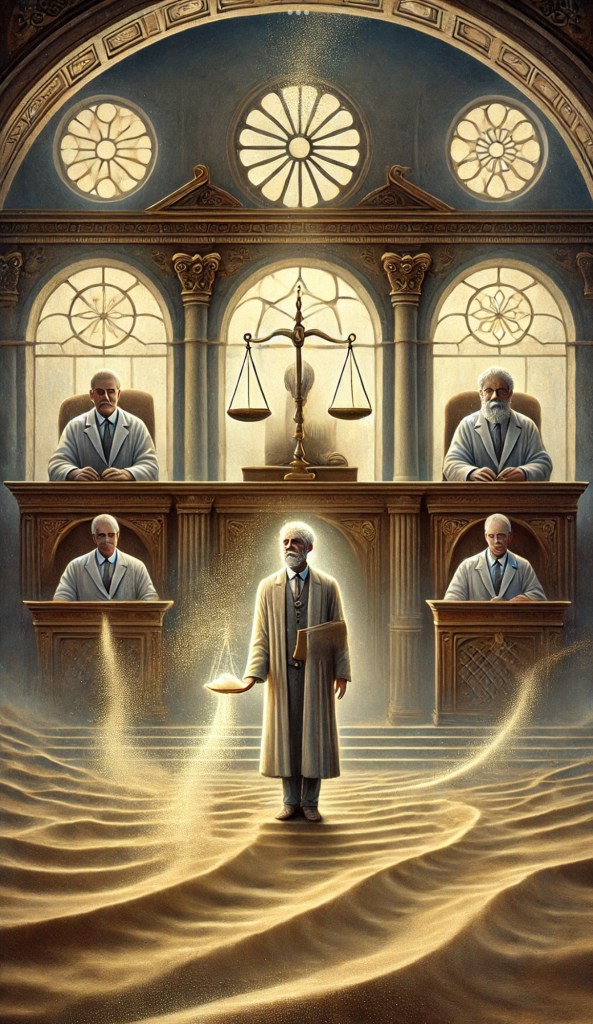
There was once a land where justice was said to flow like clean water, though some wells had been poisoned but nobody knew.
In this land, three individuals were raised to high places — two were doctors, the third a lawyer. All three were entrusted with the stewardship of a sacred duty: to hear the cries of those who had been wounded by the poisoned water — people whose veins now carried blood not just with life, but with hidden poison.
One day, a man came before them.
He was quiet, weathered, and carried years in his eyes that did not match his age. He brought with him a simple plea: “I was given what I did not choose. I have suffered. I ask only that the truth be seen.”
The doctors examined him not with stethoscopes, but with suspicion. They whispered between themselves, “He does not look broken enough.” The lawyer nodded. “He sounds sincere. That makes me distrust him more.”
They gathered his papers, his memories, his scars, and laid them on their scales. The scales tilted in his favour. But the overseers frowned.
They added their own doubts to the other side. Not facts, not evidence — just finely ground skepticism, like sand.
They told him, “We regret to inform you that your story does not meet our threshold. We do not believe you.”
He asked, “On what grounds?”
They replied, “On the grounds we stand upon.”
And so they closed the file, locked the cabinet, and turned their chairs to face away.
But what they had not noticed was this: when they scattered their sand of doubt upon the scales, some of it drifted out the window.
And the wind took it.
The wind carried it through the village, through the cities, through the halls of others who had heard similar stories. It caught in the throats of old nurses, it blew through the memories of retired surgeons, it lodged in the pages of long-forgotten reports.
It began to whisper.
The man, rejected and worn, did not scream or curse. He simply waited. He tended his truth like a seed in stony soil. He watered it with patience, though his body weakened.
And the universe, strange keeper of ledgers, took note.
Years passed.
The doctors’ names became footnotes. The lawyer’s signature faded on a forgotten letter. But the seed — the one the man had carried — broke through stone. It flowered where all could see.
And when they finally read it, not as judges but as mourners, it was clear:
He had told the truth.
The scales had been tilted by hands, not weight.
The sand had never belonged there.
And the wind had brought it all back.
⸻
Moral: Justice delayed is not always justice denied — but truth denied is never safely buried. The wind remembers what pride forgets.
This is my story in a parable, I received blood in an operation and when I stood up to tell that story, three powerful people denied the truth and filled those scales with their own sand. Now I wait to see if those scales will finally tip in my favour!


 Chameleon Magazine
Leave a comment