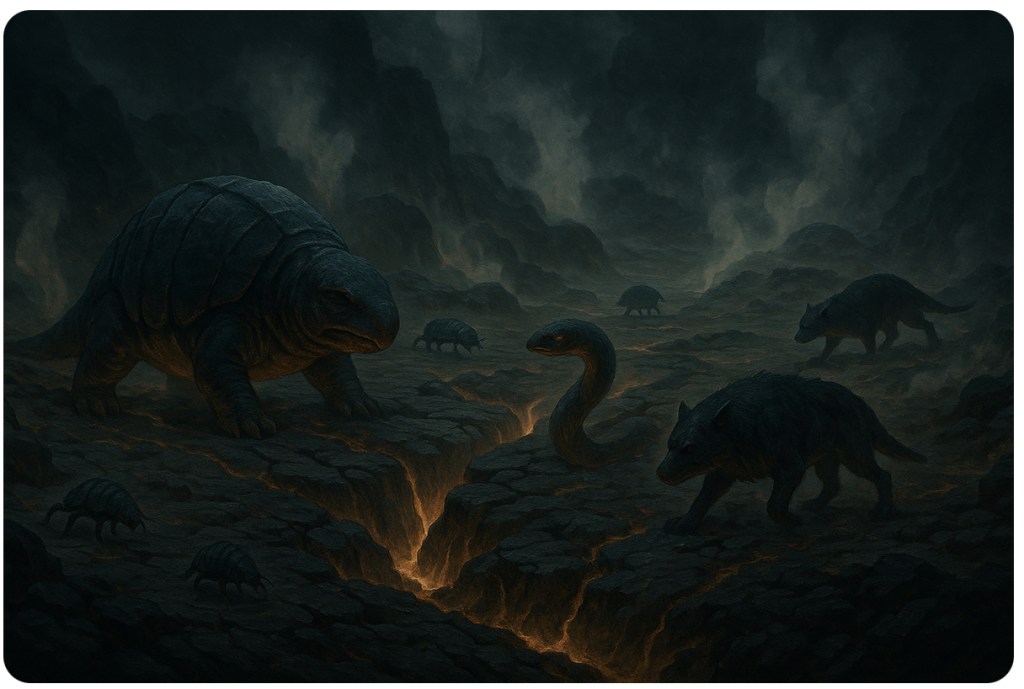
In the hush before time’s sixth breath, the land beneath the crust of Orun began to tremble—not with violence, but with expectancy. For deep in the womb of the earth, ancient seeds of life pressed against their chambers, swollen with becoming.
When the moment ripened, the crust cracked like a husk, and from fissures wide and narrow, life poured forth.
First came the broad-boned wanderers, their backs ridged like mountain spines, trudging slow across the trembling plains. Behind them, the nimble-footed leapt in silence, eyes gleaming with watchfulness. From the crevices came the coilers—serpent forms that whispered through root and shadow. And beneath it all, burrowers tunneled blindly, drawing the map of the world in unseen lines.
They did not speak, but each answered the pulse of the planet. They grazed, hunted, danced, disappeared, returned. They lived not as invaders, but as responses—the land’s own breath, exhaled in bone and muscle.
The unseen architects, watching, whispered only once: “Let the earth call forth its kin.” And the soil, hearing this, was glad.
“Some life walks from the womb of the earth like a memory recalled.”


 Chameleon Magazine
Leave a comment