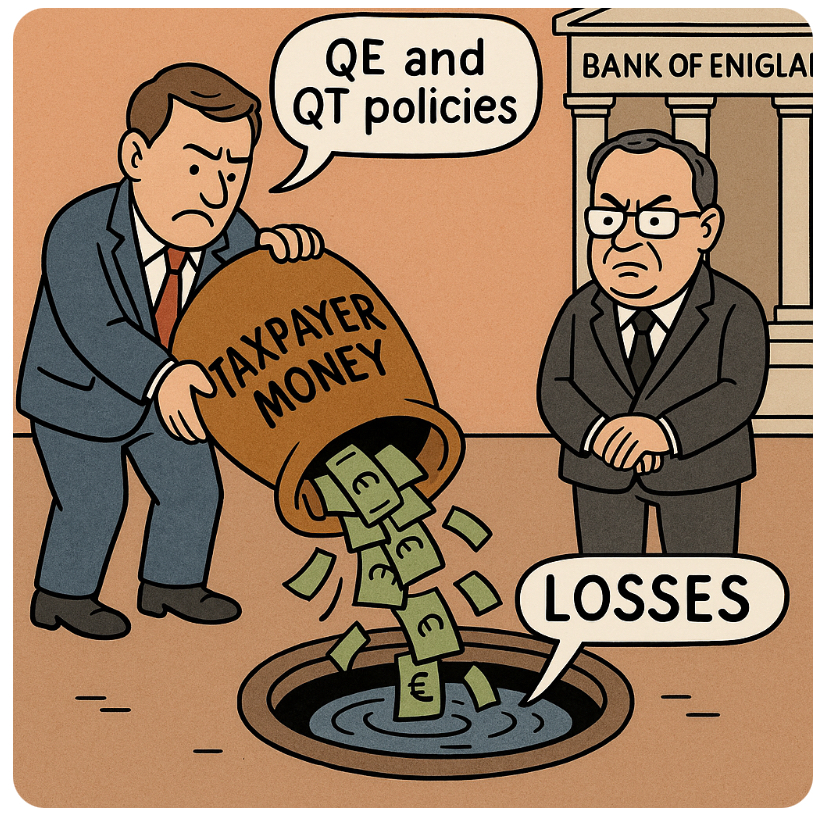
Nobody likes wasting money—unless, apparently, you’re the Bank of England treating taxpayer cash like Monopoly notes after a heavy night out. Quantitative easing (QE) and quantitative tightening (QT) sound like dry financial jargon, the kind of thing that makes your eyes glaze faster than supermarket doughnuts. But here’s the kicker: they’ve quietly racked up over £200 billion in losses that you and I are footing the bill for—without a single serious parliamentary debate.
🏦 QE: The Neighbour Who Prints Money and Then Charges You Rent
Remember the analogy: printing money to help a struggling neighbour. Except in this version, not only do you never get the cash back—you also agree to pay him interest forever. That’s QE in practice. Banks got rescued in 2008, cushioned again during Covid, and now they’re rolling in profits. Meanwhile, taxpayers are stuck holding the receipt for an eye-watering £900bn money-printing spree.
The Treasury select committee? Sleepwalking through the whole affair. The Bank of England? Shrugging, while other central banks manage not to torch quite as much public cash. Parliament? More rigorous about councillors’ biscuit budgets than billions disappearing in QE interest payments. 🍪➡️💸
This isn’t some abstract “policy debate.” It’s real money—your money. And the punchline? We’re told tax hikes are inevitable, while £200bn evaporates into banker bonus season.
🔥 Challenges 🔥
Why is Parliament asleep at the wheel on this? Should the Bank of England be reined in before it sets another pile of taxpayers’ cash on fire? And do you buy the line that “losses were unlikely in the extreme”—or is that just banker-speak for “oops, sorry, you lose”? 🏚️📉
👇 Drop your comments, your outrage, or your dark humour below. Share this with someone who still thinks QE is “boring finance stuff.”
The sharpest replies will be featured in the next issue of the magazine. 🎯📝


 Chameleon Magazine
Leave a comment