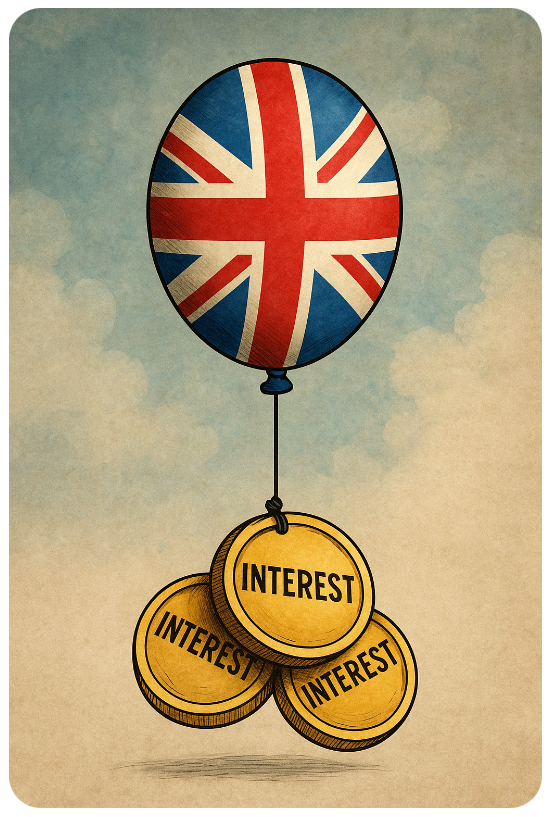
To everyone still clinging to the illusion that Britain is a rich country — it’s time for a cold splash of reality straight from the Shadow Chancellor’s spreadsheet. Apparently, the cost of just paying interest on our national debt will soon outstrip what we spend on every single public service combined. Yes, that means the government will spend more keeping creditors happy than keeping citizens alive, educated, or even remotely comfortable.
📉 Champagne Economy, Instant Noodle Reality
Britain has spent decades pretending it’s still the empire that printed prosperity on demand. But here’s the truth: we’re borrowing cash to keep the lights on. Literally. The Treasury has been maxing out the nation’s credit card for years — and now, interest rates are biting back with all the subtlety of a tax audit.
Every borrowed billion of yesterday is now a ball and chain dragging us down. The NHS? Understaffed and underfunded. Local councils? Selling off public parks to make payroll. Schools? Running on goodwill and glue sticks. But the real growth industry? Debt servicing — the one department where the budget always expands.
Imagine the UK as a family that still insists on taking holidays to Tuscany while hiding the final demand letters under the doormat. The debt interest bill has become our national rent — and no matter how patriotic you are, you can’t pay it off with nostalgia or flag-waving. 🇬🇧💸
🏦 The Quiet Collapse of “Rich Country” Thinking
The Shadow Chancellor isn’t fearmongering — she’s stating the obvious. Britain is no longer a rich country pretending to be broke; it’s a broke country pretending to be rich. We’ve built a system where every promise, from pensions to potholes, depends on the Bank of England’s ability to juggle inflation, interest rates, and political delusion.
The “good old days” when debt was cheap are gone. Global markets have stopped treating the UK like a responsible adult and started pricing us like that flaky mate who swears they’ll pay you back next week. The moment interest payments surpass public service spending, it’s not just a bad headline — it’s a flashing red warning sign that the social contract itself is on life support.
And yet, in Westminster, the denial is Olympic-grade. Ministers talk about “fiscal discipline” while announcing new spending sprees. Opposition leaders decry austerity while whispering about “efficiency savings.” Everyone wants to look responsible — no one wants to touch the bill.
So here we are: a proud nation stuck in a paradox. We can’t afford to fund our services, but we also can’t afford not to borrow. We’re not managing a budget anymore — we’re running a Ponzi scheme with bunting.
🔮 The Coming Reckoning
Sooner or later, something’s got to give. Either taxes rise, spending falls, or the pound sinks faster than a minister’s credibility. Because here’s the uncomfortable truth: debt interest isn’t an optional payment. It’s the one direct debit the UK can’t cancel.
The question isn’t whether the crisis is coming — it’s whether anyone in charge has the courage to say so out loud. Britain’s fiscal story has become a tragicomedy: part farce, part slow-motion car crash, soundtracked by ministerial soundbites about “growth.”
And through it all, we — the taxpayers, the citizens, the investors in this grand experiment — are the audience, clapping politely as the theatre burns. 🎭🔥
💣 Challenges 💣
Can Britain really keep calling itself a “rich country” when its debt payments are eating its public services alive? Or are we finally waking up from a century-long dream of borrowed wealth and borrowed time?
👇 Drop your takes in the blog comments — cynical, hopeful, furious, or just financially fluent.
Hit like, hit share, and tag that friend who still believes “the money will come from somewhere.”
The sharpest insights — and most brutally honest truths — will feature in the next issue of the magazine. 💷🔥


 Chameleon Magazine
Leave a comment