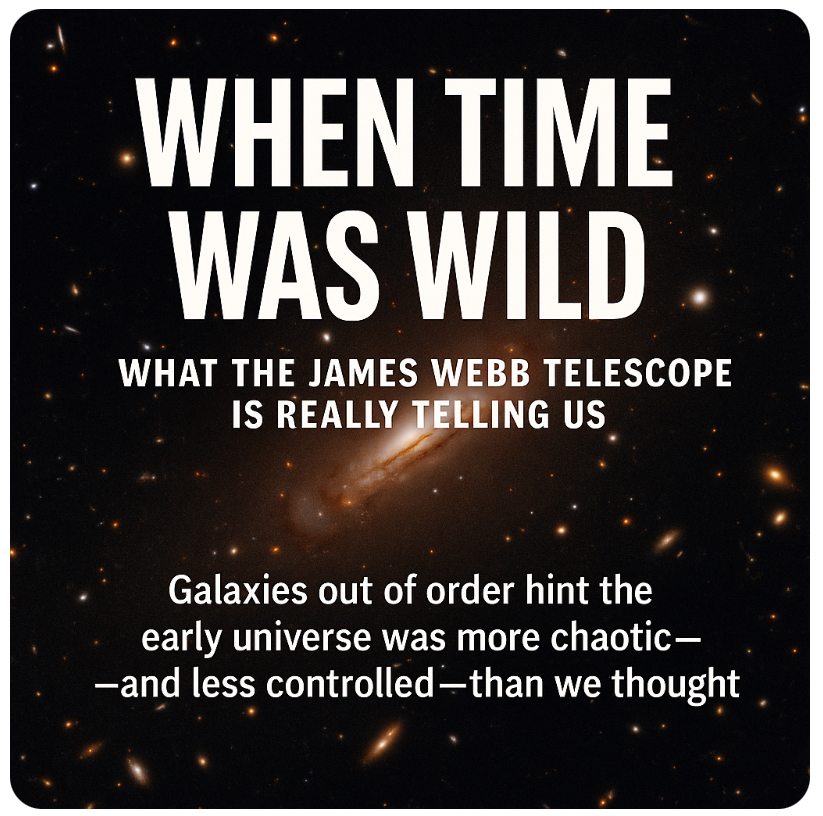
For more than a century, cosmology has pictured a neat, clock-like universe: the Big Bang ticks, gravity gathers, galaxies bloom, and everything cools on schedule.
Then the James Webb Space Telescope (JWST) turned its gold mirrors toward the deep past—and the timetable fell apart.
🚀 Galaxies Out of Order
JWST keeps finding vast, mature galaxies only a few hundred million years after the supposed beginning. They look too evolved, too heavy, too soon.
If the cosmic clock were steady, gravity shouldn’t have had enough time to build them.
So maybe the clock wasn’t steady at all.
🧭 A Universe Without a Master Clock
Einstein taught us that time stretches with gravity and speed, but we’ve still assumed those effects balance out globally.
What if they didn’t—what if, in the furnace of the early universe, time itself expanded and contracted in bursts, not smoothly?
In that case:
- Gravity could have acted in quick, intense pulses—condensing matter far faster than our equations allow.
- The “age” of those ancient galaxies might be a mirage, their light shaped by a period when seconds were shorter.
- The constants we treat as eternal—light speed, G, even particle mass—may have crystallized only after cosmic chaos cooled.
⚛️ The Living-Law Hypothesis
Some physicists already suspect that the universe’s rules emerged rather than pre-existed.
Imagine spacetime as liquid metal, hardening unevenly: pockets where gravity briefly ran wild, where time accelerated or stalled, where matter multiplied.
JWST’s snapshots could be fossils of those turbulent zones—evidence that the cosmos learned order gradually, not instantly.
🌍 Echoes on the Local Scale
If cosmic time once flowed differently, maybe planetary formation carried traces of that turbulence.
It wouldn’t make the pyramids weightless, but it hints that the fabric of physics itself was once softer, pliable enough that reality could settle into different shapes before firming into today’s steady rhythm.
🕰️ The Moral of the Telescope
JWST isn’t just looking backward; it’s looking beneath our assumptions.
Each distant, impossible galaxy whispers that the universe was never a metronome—it was a storm that learned to keep time.


 Chameleon Magazine
Leave a comment