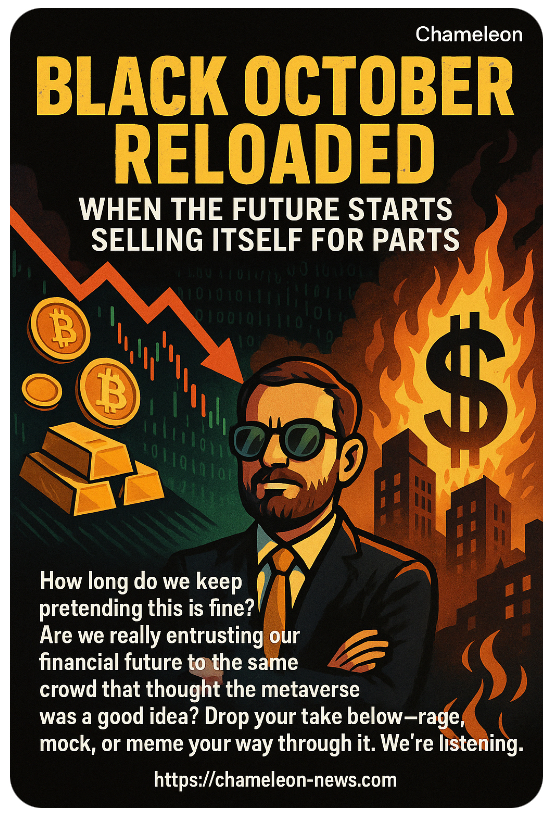
💥💰Nearly a century after the Great Crash of 1929, the global economy seems to be reenacting the same grim performance — just with sleeker costumes and better marketing. The stock markets are puffed up like a toddler’s birthday balloon, central banks are muttering warnings about an AI bubble, and world leaders are too busy arguing over who broke the thermostat to notice the house is on fire. 🔥
Meanwhile, gold and Bitcoin are slipping quietly into the role the U.S. dollar once played — the emergency exit everyone pretends they don’t need until the alarms start ringing. But here’s the thing: this time the panic feels eerily personal. Because the world’s financial fate doesn’t rest in government hands anymore — it’s being juggled by a small circle of tech billionaires who see themselves as philosopher-kings of progress.
They’ve convinced us the rules of the old economy no longer apply. “Debt? Doesn’t matter. Valuation? Abstract art. Risk? Just a state of mind.” They call it innovation. The rest of us call it delusion with better branding.
🧠 The Tech Titans Playing God with Monopoly Money
Welcome to the temple of the new economy, where code is currency and hype is holy scripture. The faithful gather on X (née Twitter) to watch their digital deities preach disruption from private jets. They’ve replaced the old robber barons with hoodie-clad visionaries who tell us, “Don’t worry, this time it’s a good bubble.”
A good bubble. Let that sink in. The Titanic had better marketing. 🚢
These titans of silicon and swagger have more influence than most governments. When they sneeze, markets catch pneumonia. When they tweet, investors empty their retirement funds. They claim that when the inevitable crash comes, it’ll be “cleansing” — that only the strongest will survive. That’s easy to say when your survival kit includes off-grid bunkers, personal rocket ships, and enough gold bars to sink a crypto yacht. 🚀🪙
They’ve turned capitalism into a high-stakes casino where the dealers write the rules and the house always tweets first. The rest of us? We’re the spectators — cheering, panicking, refreshing our stock apps, and praying the AI overlords at least make our job replacements witty.
📉 The Autumn of Echoes
Every October carries a chill, but this one bites. The whispers are the same as they were in 1929: “It’ll rebound. It’s just a correction. Buy the dip.” Yet you can feel it — that tightening in the markets, the tremor in investor hands, the eerie déjà vu humming through the headlines.
The more we insist “this time is different,” the more history chuckles in the corner, polishing its crash helmets.
The parallels are uncanny:
- Speculation fever? Check.
- Debt mountains? Everest-sized.
- Political paralysis? Frozen solid.
- Billionaires treating crisis like content? Absolutely.
The only real innovation here is that this bubble has better Wi-Fi and worse humility. We’re not just gambling with capital — we’re wagering on collective amnesia.
Because let’s be honest: when billionaires start preaching “creative destruction,” it’s rarely their creations getting destroyed. It’s yours. 💀
💣 Challenges 💣
Are we sleepwalking into another Great Crash — or sprinting toward it with our phones out, livestreaming the apocalypse? 📱🔥
Tell us: is this brave new economy genius, madness, or both? Drop your hottest takes, your sharpest sarcasm, or your most brutal memes in the comments. We want the rage, the wit, the prophecy. 💬⚡
👇 Comment. Like. Share.
Tell the world whether you think the “AI economy” is our salvation or our next spectacular self-own. The best comments — the ones that punch hardest and think deepest — will be featured in the next issue of the magazine. 🏆📰


 Chameleon Magazine
Leave a comment