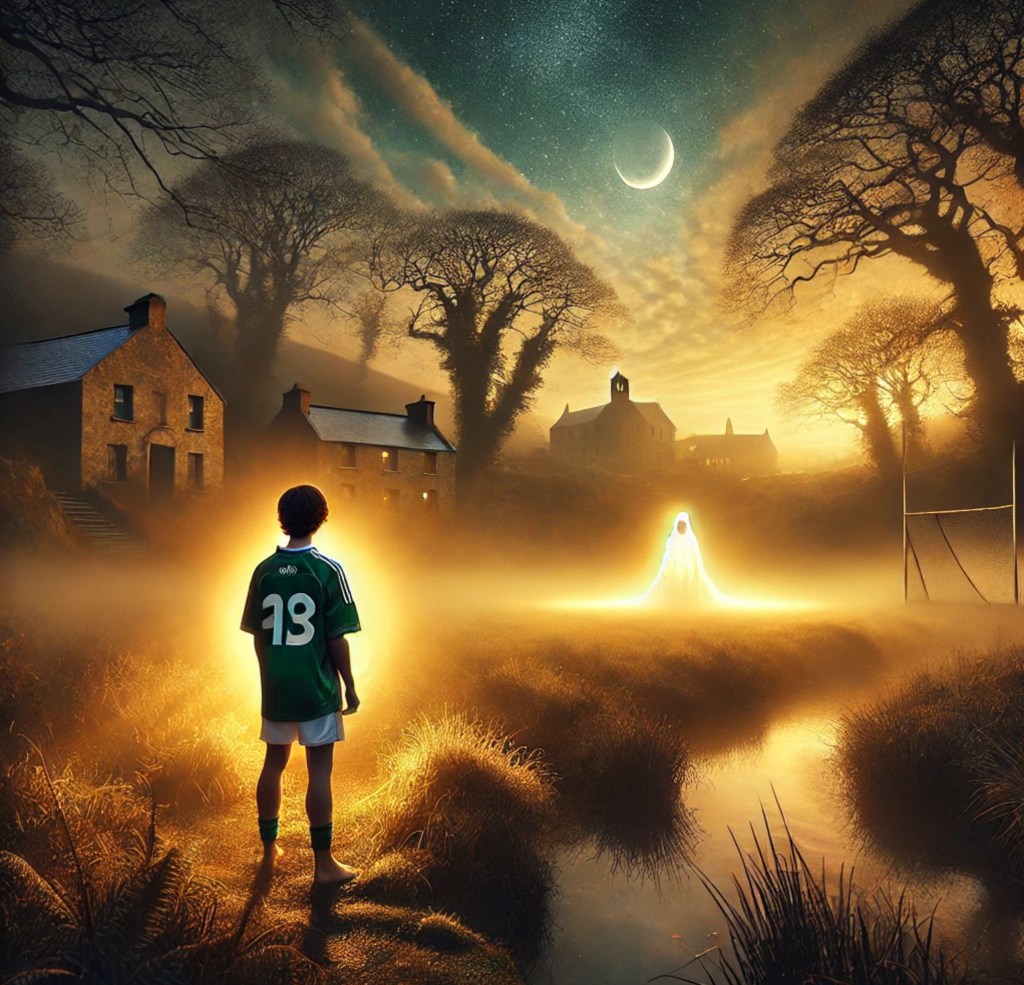
Long ago, in a valley cradled by dreaming trees and silver mists, there was a village called Killeagh. The villagers said it was spun from ancient threads—one green, one white—woven by time itself where the forest met the flowing river. In this place, the land did not just live beneath your feet. It listened. It remembered.
A boy named Fionn was born under the gaze of the moonlit woods, his cry answered by the hush of Glenbower and the ripple of the Dissour’s waters. The elders whispered that he was stitched from the soul of the place—a child woven from lichen, fog, and the breath of old songs.
As he grew, the village taught him to speak to the land—not with words, but with rhythm. The strike of hurl against the sliotar was its own kind of language, echoing in the hills like prayer. The jersey he wore—green like the mossed stone walls, white like the rising mist—was more than cloth. It was covenant.
But dreams began to flicker in Fionn’s eyes, dreams of distant towers and golden lights, far from the whispering trees. The land, wise and gentle, let him go.
“Take the thread with you,” said his mother, her fingers brushing his chest. And she tied a thin cord of green and white around his wrist.
He journeyed into cities where the stars were hidden by glass and no one knew the scent of peat smoke. Time thickened. The thread on his wrist frayed, and with it, his memories. But sometimes, in sleep, the forest would return: leaves whispering secrets, river calling his name.
One night, beneath a clock tower that never rested, he dreamt of a match played under an amber sky. He stood at the edge of the pitch, barefoot, his mother in the goalmouth not as she was, but as she had been—young, glowing, ageless. She looked at him with eyes full of home.
Fionn woke with the thread warm on his skin, pulsing softly.
He returned on the seventh morning of the seventh moon. Killeagh had not changed—it had only waited. The woods parted like curtains. The river sang louder. And the pitch, slick with dew, shimmered as if stitched from stars.
He stepped onto the field once more—not a prodigal son, but a note returning to its song.
“When the land dreams of you, it never forgets.”


 Chameleon Magazine
Leave a comment