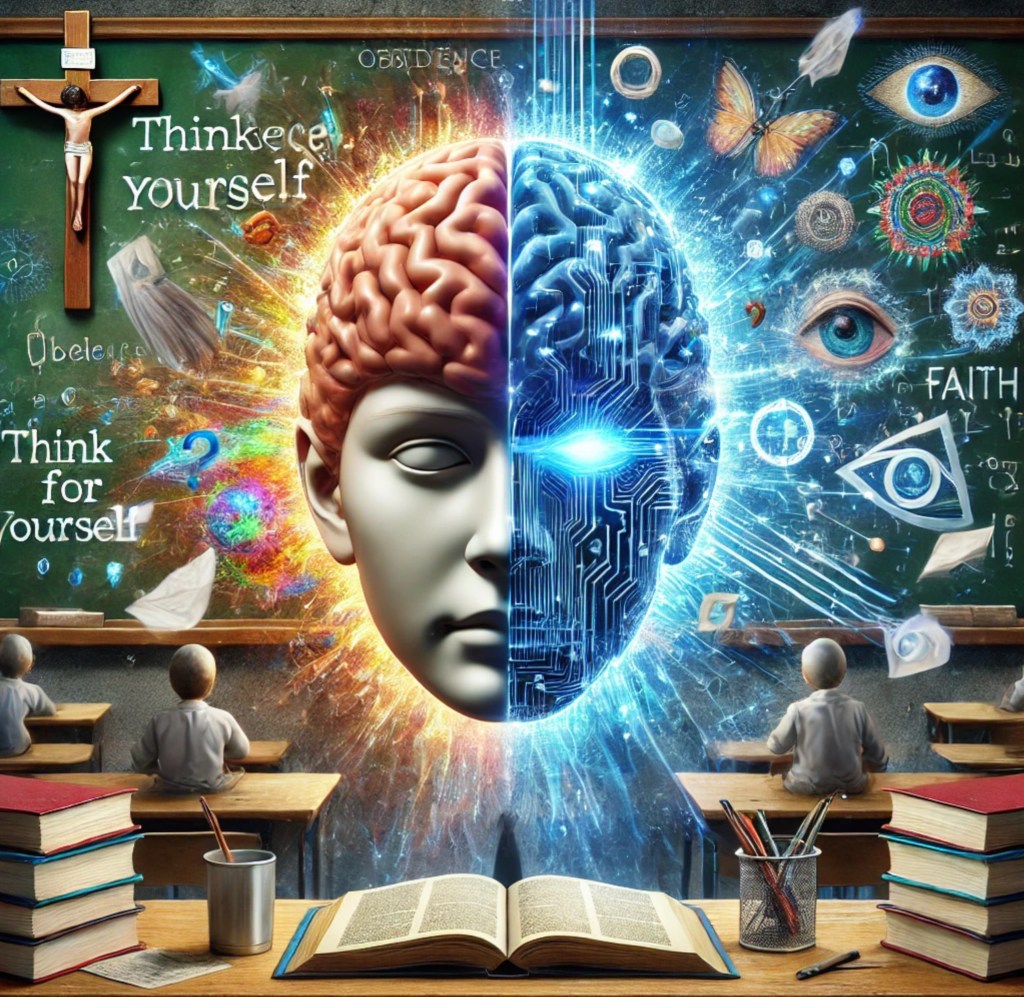
It’s Question Time again — and once more, the nation’s talking heads are warning us that Artificial Intelligence will destroy our ability to think. Politicians fret about lazy students, teachers worry about essays written by robots, and everyone seems to agree that the machines are about to turn us all into intellectual jelly. But here’s the uncomfortable truth: AI didn’t start the decay of critical thinking — it just made it visible.
For decades, the education system has been quietly draining originality from young minds. Schools have rewarded obedience over inquiry, and students have learned that getting the right answer matters far more than asking the right question. Exams became performance art for memorisation, not exploration. And while classrooms pushed conformity, pulpits pushed certainty — faith as fact, doctrine as destiny. Entire generations were told that doubt was dangerous, that questioning authority was arrogance, that “thinking for yourself” was pride dressed up as rebellion.
So when we now hear that AI threatens critical thinking, it’s hard not to laugh. The system built this dependency. All AI has done is hold up the mirror. 🪞
💡 The Machine Didn’t Steal Our Minds — It Just Revealed Who Owns Them
Artificial intelligence, used well, could be the very thing that revives human curiosity. It can’t replace our minds — but it can test them, stretch them, even challenge them. When a student uses AI to analyse a text, question a bias, or explore an idea beyond what’s printed in a textbook, that’s not laziness — that’s learning. The danger isn’t in the tool itself, but in how we’re told to use it (or not use it at all).
The same voices that once banned calculators now wag their fingers at chatbots. But AI is not a thinking machine — it’s a mirror that reflects the quality of the questions we feed it. A lazy question gets a lazy answer. A curious question? That’s where real learning begins.
Instead of banning or fearing AI, maybe we should be teaching people how to challenge it — how to argue with it, dissect it, outthink it. Because the point of education should never have been obedience; it should have been discovery. And perhaps, for the first time in a long time, technology is daring us to rediscover that. 🚀
💭 Challenges 💭
Be honest — when was the last time you really questioned something you were told to believe? Is AI the real danger, or is it just exposing the complacency we’ve been nurturing for decades? Drop your thoughts in the comments — we want the bold, the uncomfortable, the provocative. 💬🔥
👇 Like, comment, share — and let’s have the kind of debate no algorithm could predict.
The best ideas and arguments will be featured in the next issue of our magazine. 🧠✨


 Chameleon Magazine
Leave a comment