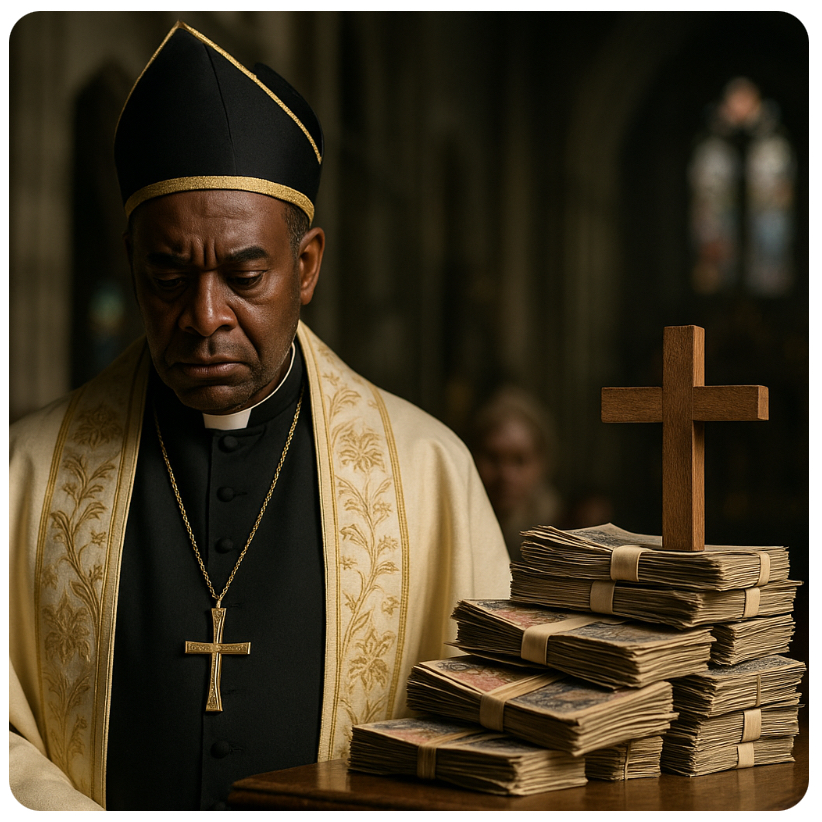
The Church of England has decided that forgiveness needs a funding model. As Sir Lenny Henry floats a celestial £18 trillion reparation bill, the bishops are patting themselves on the back for offering a humble £100 million “Fund of Healing, Repair and Justice.” It’s a curious thing — centuries of complicity in slavery, and now a corporate-style “project” to smooth the spiritual books. Sounds noble, right? Until you realise it’s less “repairing history” and more “rebranding guilt for modern audiences.”
The Church calls it Project Spire — which sounds less like repentance and more like a mindfulness app. It’s the kind of initiative that lets wealthy institutions appear penitential while keeping the endowment portfolio comfortably intact. “Healing” for whom, exactly? The descendants of the enslaved — or the bishops trying to sleep better at night on 800-thread-count sheets?
🙏 The Almighty Audit: When God’s House Hires Accountants
Picture it: oak-panelled rooms filled with clergy and lawyers, sipping fair-trade coffee while debating how much redemption is worth per pound sterling. They aren’t just grappling with sin — they’re calculating it, like spiritual stockbrokers balancing eternity’s balance sheet. “Register a new charity,” they say. “Tick the legal boxes.” And thus, salvation becomes a spreadsheet.
Somewhere between divine mercy and legal compliance, the Church seems to have mistaken a trust fund for atonement. Because nothing says “healing the wounds of history” quite like incorporating a new entity called The Fund of Healing, Repair and Justice. It sounds profound — until you remember it’s really just a PR firewall against moral liability.
Meanwhile, parishioners up and down the country are fundraising for leaking roofs and food banks while the Church of England’s £10 billion investment fund hums along nicely. You’d think “love thy neighbour” might include, say, fixing the roof over their heads. But apparently, divine compassion is a line item reserved for corporate-level sins.
💔 The Forgotten Flock: Sins Closer to Home
And yet, the Church’s moral bookkeeping doesn’t stop at slavery. Because what about the others — the victims closer to home? The thousands of children abused by priests sworn to protect them? The survivors who’ve spent decades screaming into a stained-glass void while bishops issued “deep regrets” with all the emotional sincerity of a boiler warranty?
Where’s their Fund of Healing, Repair and Justice?
And what of the Irish mothers — those women locked in laundries, whose babies were torn from their arms in the name of God’s love? The Church presided over institutions where cruelty was dressed as virtue, where forgiveness was preached but never practiced. Does redemption stop at the shoreline of empire, or will the Church finally face the atrocities it committed in its own sanctuaries?
Every penny of this new fund might soothe the conscience of clerical elites, but it does little for those who were personally crucified by the institution’s sins. For every sermon on compassion, there’s a silent ledger of exploitation, pain, and systemic cover-ups. The Church may be turning its eyes to history — but it still averts its gaze from the mirror.
If the Church wants true “repair and justice,” it could start by paying reparations not just for the sins of empire, but for the ones it buried in its own backyard.
🔥 Challenges 🔥
Is £100 million really a sign of repentance — or just the latest entry in a long tradition of moral window-dressing? Should the Church be writing cheques for all its sins, not just the fashionable ones? And how do you measure redemption in pounds and pence, anyway?
Drop your unfiltered verdict in the comments — righteous fury, dark humour, or weary disbelief all welcome. 💬⚡
👇 Hit comment, like, and share — let’s turn this sermon into a reckoning. The sharpest takes, boldest burns, and fiercest truths will be featured in our next magazine issue. 🗞️🔥


 Chameleon Magazine
Leave a comment