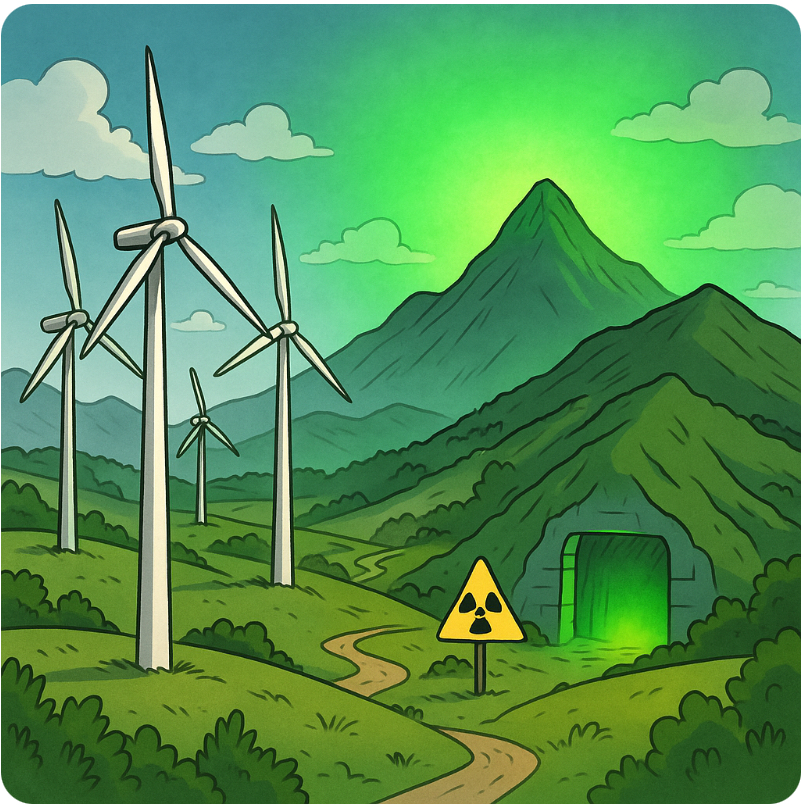
Scotland, once famed for wild glens and sweeping skylines, now looks like a sci-fi set sponsored by bad planning and good intentions. The hills that once inspired poets now host battalions of wind turbines whirling like demented daffodils, and just when you thought the view couldn’t get any busier — along comes a proposal to bury nuclear waste beneath it.
💨 When Progress Becomes a Panoramic Eyesore
Let’s start with the wind turbines. The idea was noble: harvest clean energy from the wind and lead the world in renewables. What we actually got was an army of steel giants marching across the Highlands, each one humming, blinking, and quietly reminding you that the scenery used to be enough on its own.
Walk through the Cairngorms or look out from a ferry on the west coast — it’s hard not to feel like you’re staring at an unfinished Meccano project. Developers call it “sustainable beauty.” Locals call it “the death of a horizon.”
Yes, turbines generate clean energy. But they also generate profits for companies whose headquarters are often somewhere south of Gretna or across the North Sea. Meanwhile, rural communities get disrupted landscapes and a polite thank-you note.
☢️ Nuclear Hills: Because Apparently Windmills Weren’t Bold Enough
Just when the view couldn’t get more cluttered, the talk turns radioactive. A half-mile-deep nuclear waste site — at the bargain price of £70 billion — is now the latest vision for “green progress.”
You can’t make this up. We’ve gone from wind farms that blight the surface to nuclear bunkers that glow beneath it. “Energy independence,” they call it. More like a national experiment in geological hide-and-seek.
Imagine it: trekking through the Highlands not for solitude or scenery but to wonder if your walking stick will start ticking. “Eco-tourism” takes on a new meaning when the countryside hums louder than your phone battery.
🌍 The Irony of the Green Revolution
Scotland’s natural beauty — its greatest renewable resource — is being repackaged as a testing ground for every expensive form of “sustainable innovation” politicians can dream up. First came the turbines. Now comes the underground vault of radioactive regret.
Geothermal energy? Tidal power? Home-grown tech that could actually fit the land and employ local workers? Barely a whisper. Apparently, if it isn’t shiny, noisy, or nuclear, it’s not “visionary.”
🔥 Challenges 🔥
How did Scotland’s green revolution become a landscape-altering industrial sprawl? Is there still time to reclaim the hills before they all sprout blades or start to glow? 🌄💭
👇 Share your thoughts in the blog comments (not just on Facebook!).
The most vivid, witty, or outraged replies will feature in the next issue of our magazine. 🗞️💬
Now they are just pushing it too far!


 Chameleon Magazine
Leave a comment