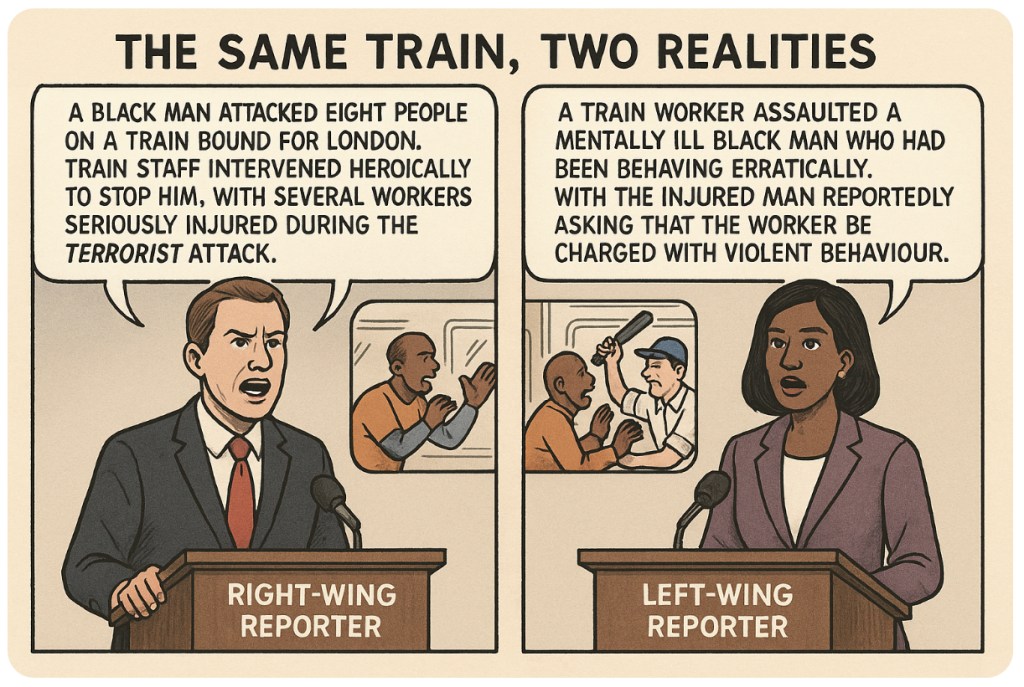
When a shocking event unfolds — say, a violent attack on a train — you might think the facts are simple. A man attacked passengers. People were injured. Police intervened. But what we see and believe about that event depends less on the facts themselves and more on who’s holding the microphone.
Two Versions of the Same Story
Right-Wing Reporter:
A Black man attacked eight people on a train bound for London. Train staff intervened heroically to stop him, with several workers seriously injured during what authorities initially described as a terrorist attack.
Left-Wing Reporter:
A train worker assaulted a mentally ill Black man who had been behaving erratically. The company is investigating the incident, reportedly considering docking the worker’s pay for misuse of company property, while the injured man has requested that the worker face charges for violent conduct.
Both claim to describe the same event. Neither is lying — yet neither is telling the whole truth.
The first uses words like “terrorist attack” and “heroically” to build a story of fear and defence. The second replaces those with “mentally ill” and “assaulted”, shifting focus toward social context and blame. One appeals to outrage; the other to empathy. Each is a mirror reflecting its own audience’s values back at them.
The Power of Framing
Framing isn’t just how a story is told — it’s how reality is sculpted.
A single adjective can tilt public opinion more than an entire police statement.
- “Terrorist” vs “mentally ill”
- “Hero” vs “violent worker”
- “Attack” vs “incident”
These aren’t just words; they’re moral cues. They tell readers who to fear, who to forgive, and who to forget.
The Truth in the Middle
Between these two versions lies a messier, quieter truth: a confused, dangerous moment where frightened people tried to survive. There were no perfect heroes or villains — just human beings in crisis. But that middle ground rarely sells papers, earns clicks, or feeds algorithms.
Modern news thrives on outrage. The emotional spike keeps audiences engaged, donations flowing, and tribal loyalties strong. “Calm complexity” is bad for business.
The Lesson
When you read the news — any news — pause before reacting. Ask:
- Whose story is this version serving?
- Which words make me feel something before I think something?
- What’s missing between the lines?
In an age of polarized media, the most radical thing you can do is hold two truths at once — to recognize that the world is rarely as black-and-white as our headlines pretend it to be.


 Chameleon Magazine
Leave a comment