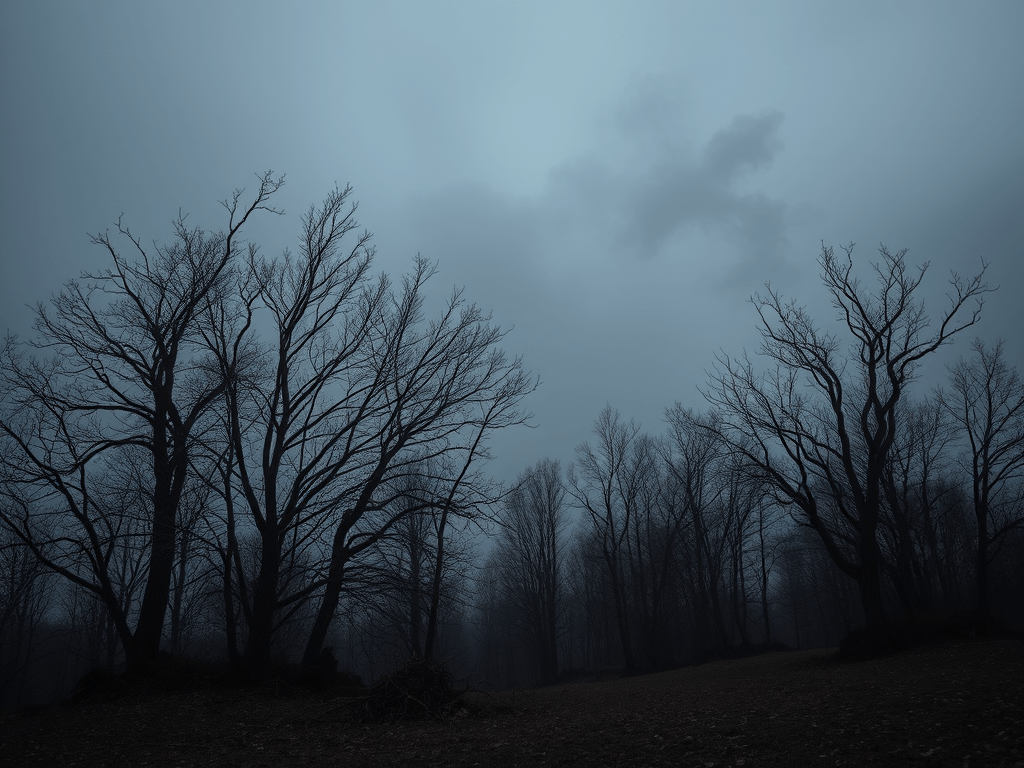
When the light fades early and the world turns inward, the mind follows. November asks us to sit with our own shadows — not to fear them, but to understand what they have to teach. In a culture obsessed with brightness, this is the month that gives us permission to rest, reflect, and dream.
The Quiet Descent
There’s a particular silence that belongs only to November. It’s the hush after the wind has shaken the last leaves loose, when the trees stand bare and unapologetic against a pewter sky. The earth exhales, the air tastes of smoke and soil, and the world feels momentarily suspended between one heartbeat and the next.
Nature withdraws. The hedgehog burrows, the sap sinks, and even the light seems to rest its head a little lower on the horizon. This is not decay — it is retreat, renewal, a gathering of strength beneath the surface. November reminds us that stillness is not the same as emptiness.
We, too, are creatures of this rhythm, though we’ve forgotten how to follow it. Our cities blaze long after sunset; our minds never truly power down. The world whispers, “rest,” but the culture replies, “produce.” The result is dissonance — an ache that many can’t name, a weariness that deepens as the light wanes.
The Shadow in the Mind
Psychologists have given it a name: Seasonal Affective Disorder, or SAD — the low mood, sluggishness, and sense of meaninglessness that often settle in during the darker months. The clinical explanation is simple: less light disrupts the circadian rhythm and lowers serotonin levels. But beyond the chemistry, something older and more symbolic is at play.
The Swiss psychiatrist Carl Jung called it the Shadow — the part of the psyche where we bury what we refuse to face: unprocessed grief, unrealized potential, unspoken fear. It’s not the villain within us, but the unseen companion that waits for acknowledgment. “One does not become enlightened by imagining figures of light,” Jung wrote, “but by making the darkness conscious.”
November, then, is a psychological mirror. As daylight fades, so do the distractions that usually keep our inner world at bay. The result can be uncomfortable: we see what we’ve been avoiding. But that confrontation can also be deeply healing.
Instead of resisting the gloom, we can learn to move through it — to mine its depths for meaning. Darkness is not the absence of light, but the womb of transformation. Seeds break open underground. Butterflies are born from cocoons of shadow. Why should the human spirit be any different?
The Fertile Dark
In agrarian societies, the fields were left fallow in winter so the soil could recover its fertility. We, however, live in an era of perpetual harvest. Every hour must yield — content, profit, productivity, self-improvement. We fear stillness because it looks too much like failure.
But the creative mind, like the soil, needs its quiet seasons. Every artist, thinker, and dreamer knows the strange paradox: the richest ideas often emerge not during moments of feverish activity but in still, half-lit spaces — on solitary walks, sleepless nights, or wordless afternoons.
Virginia Woolf once described November as “the month of inward seeing.” The light is dim enough to make the invisible visible — the imagination, the intuition, the half-formed thoughts that can only surface when the glare of daily life softens.
To embrace November is to recognize that darkness has a purpose. It’s the interval in the symphony, the breath before the next phrase. The longer nights stretch our sense of time, asking us to linger rather than rush. In this pause, the subconscious can finally speak.
Creativity and the Shadow Self
The relationship between creativity and shadow is ancient. Myths are filled with heroes descending into darkness to return with treasure — Orpheus into Hades, Inanna into the underworld, Christ into the tomb. These aren’t stories about punishment, but about integration. The artist, too, must descend: into memory, fear, and longing — to bring something honest back into the light.
Neuroscience has begun to confirm what poets already knew. When external stimulation drops — fewer hours of daylight, less sensory overload — the brain’s default mode network activates, the part associated with daydreaming and insight. The quiet of November isn’t mental stagnation; it’s an opening of inner space.
So if you feel unmotivated, melancholy, or introspective this month, don’t rush to fix it. Instead, treat it as an invitation to create — not necessarily art, but meaning. Keep a journal. Walk without headphones. Read slowly. Let ideas drift in like fog and take shape in their own time.
The shadow is not a threat to the creative process; it is the creative process.
The Modern Fear of Darkness
We have grown allergic to night.
From streetlights to smartphones, we drown the dark in electric imitation daylight. Our ancestors feared the dark because they couldn’t control it; we fear it now because we can’t stand to be alone with it.
But this constant illumination is costly. Studies link artificial light at night to insomnia, anxiety, and even depression. Emotionally, it keeps us overstimulated, unanchored — like staying perpetually awake at the wrong hour of the soul.
To live fully in November means reintroducing the natural rhythm of darkness into our days. Dim the screens. Light a candle instead of a lamp. Listen to the sound of your own breathing. In that simplicity, we begin to reinhabit the ancient cycle of light and shadow — a balance as old as fire itself.
The darkness is not your enemy; it is your teacher.
Ancestral Fires and the Line of Memory
Our ancestors lit fires in November not just for warmth, but for connection. The Celts celebrated Samhain, marking the year’s end when the veil between worlds was thinnest. They gathered around bonfires to honour the dead and prepare for rebirth.
That ritual lives on — in Bonfire Night, in Remembrance Sunday, in every candle placed on a grave or windowsill this month. Fire is the bridge between shadow and light, between the seen and the unseen.
We, too, carry our small fires — the memories, the hopes, the names we refuse to let fade. When the nights grow long, we remember who we are, and who we’ve lost. November becomes less about mourning and more about continuity — the warmth that survives extinction.
To light a flame in November is to declare faith: that even in shadow, meaning endures.
Ways to Walk the Shadow Season
- Make peace with the night. Step outside under the early darkness. Watch the stars. Let your eyes adjust; let the world reappear.
- Keep a “shadow journal.” Each night, write one truth you usually avoid thinking about. Don’t judge it. Just witness it.
- Practice candlelight hours. Spend an evening without electric light — reading, thinking, or simply being. Notice how your mind slows.
- Embrace creative solitude. Don’t fill every silence. Inspiration often arrives disguised as boredom.
- Rest without guilt. The earth is sleeping. You’re allowed to as well. Renewal begins in stillness.
The Light Within Darkness
The real lesson of November isn’t about loss at all — it’s about integration. Light is precious not because it destroys darkness, but because it emerges from it. Shadow gives form, contrast, and truth.
By learning to dwell in the dimness, we rediscover our inner compass. When the world outside grows cold and bare, the warmth must come from within — from the stories we tell, the fires we tend, and the quiet understanding that everything passes through this same rhythm of dying and rebirth.
So this month, don’t chase the summer that’s gone. Welcome the stillness that remains. Sit beside your own thoughts as though by a hearth. Watch how they flicker and shift in the half-light.
This is the season of shadows, but also of revelation. For in every shadow lies a shape — waiting not to be erased, but to be seen.


 Chameleon Magazine
Leave a comment