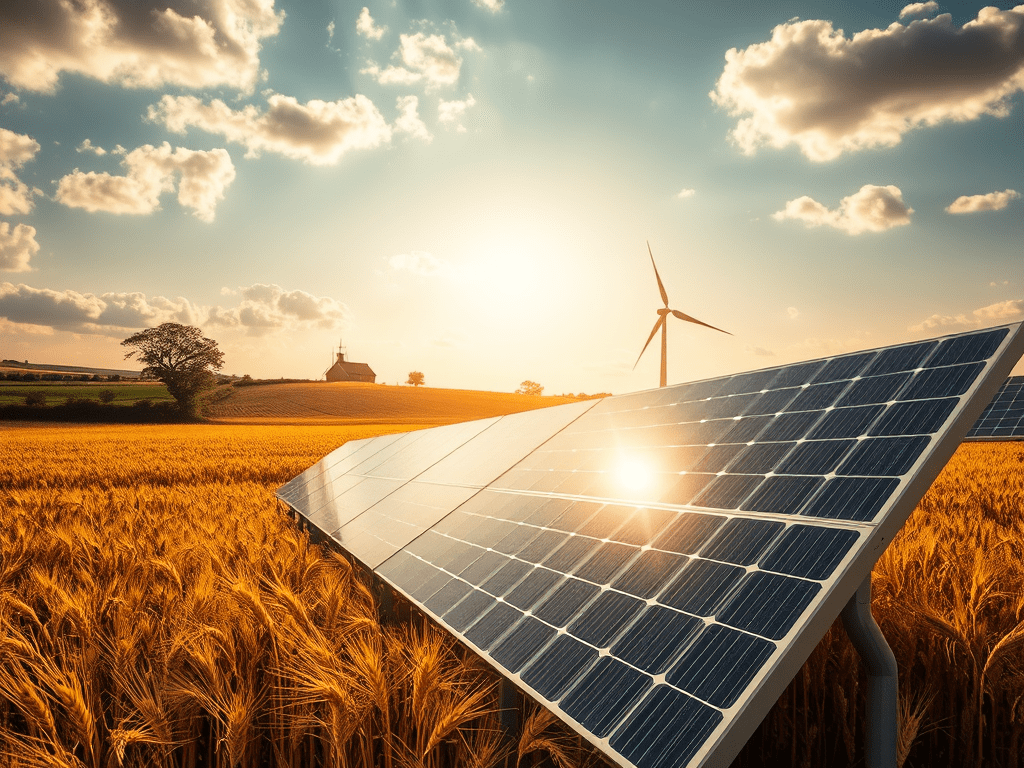
☀️🚜When TV naturalist Chris Packham bounded onto Good Morning Britain calling for the UK to cover its farmland in solar panels, he probably imagined himself as the eco-Messiah of the moment. But beneath the noble rhetoric lies a plan that would trade wheat for watts and farmers for photo ops. Britain’s path to green leadership doesn’t lie in turning fertile fields into Silicon Valley light shows — it lies in smart strategy, not sun-chasing stunts.
🌾 From Farm to Farce: Why Solar Panels Don’t Belong in the Countryside
It sounds poetic, doesn’t it? The sun, shining down on solar panels across the rolling British countryside, powering the nation cleanly. But poetry doesn’t feed people — farms do. Turning arable land into a tech experiment is the eco-equivalent of selling your fridge to buy a smoothie blender.
Food security is climate security. Replacing crops with panels doesn’t just shrink domestic food production — it sends us back into the arms of high-emission imports from countries with lax regulations and collapsing ecosystems. That’s not saving the planet. That’s outsourcing guilt.
And let’s not forget the obvious: we’re in the UK. Home of “sunny spells” and “light drizzle,” not desert skies and endless solar bounty. Betting our energy future on sunlight here is like investing in surfboards in Sheffield. We need balance, not blind optimism.
⚡ The Great British Blind Spot: When Idealism Becomes Erosion
To Packham, every patch of green probably looks like a wasted opportunity for a documentary drone shot. But to the people who live there, that green is sacred — it’s livelihood, history, and heritage. You don’t just drape a solar blanket over centuries of agricultural identity and call it progress.
The worst part? Once the countryside becomes an industrial grid, the farmers leave. Their land gets bought out. Their way of life gets bulldozed. And suddenly your “green utopia” is just a ghost town with excellent energy ratings.
🏗️ There Is a Better Way — And It Starts Above Your Head
Britain doesn’t need to sacrifice its soil to prove its green credentials. The rooftops of our homes, car parks, shopping centres, and industrial estates already offer millions of square metres of dead space — perfect for solar without the sacrifice.
And then there’s our coastline — one of the richest wind and tidal resources on Earth. But no, let’s ignore actual engineering potential to chase some fantasy of sunflower-swathed substations in Surrey.
Want innovation? Try agrivoltaics — combining solar panels with farming. Or small modular reactors. Or green hydrogen. Britain can lead. But only if it stops trying to look green and starts being smart about it.
🧠 Real Leadership Doesn’t Sacrifice One Crisis for Another
Chris Packham isn’t the villain. He’s just looking at the horizon with a pair of solar-tinted spectacles. But if we let these well-meaning but shallow gestures dominate our national conversation, we’ll find ourselves with clean energy and empty plates.
True climate leadership balances food, energy, and ecology — it doesn’t pick favourites based on which one gets better Instagram engagement.
Farms aren’t the problem. They’re part of the solution. Let’s treat them that way.
🔥 Challenges 🔥
Are we chasing climate progress — or climate pageantry? Are our policies solving problems, or just performing them for applause? Sound off in the comments below. We want your fury, your fixes, your one-liners. 🗣️💥
👇 Like, comment, and share if you’re tired of solar spin and want real solutions.
The sharpest takes will be featured in the next issue of the magazine. 💣📰


 Chameleon Magazine
Leave a comment