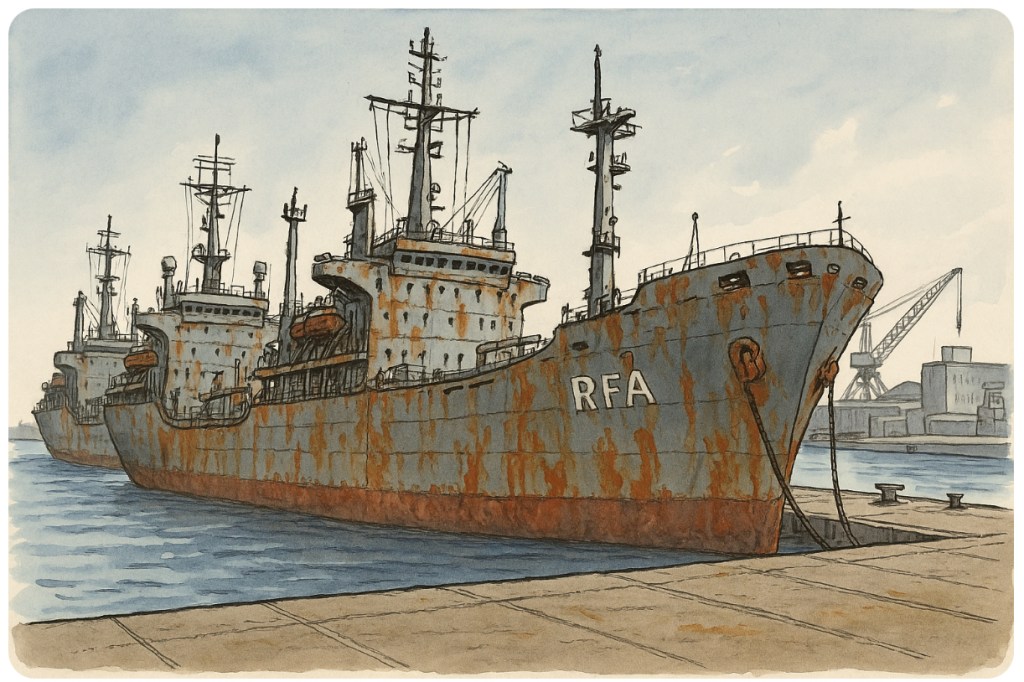
⚓🛑The auxiliary fleet meant to fuel, supply, and save the Royal Navy in wartime is currently doing a cracking job of… gathering seagull droppings at dock. Because nothing says “global military power” quite like warships supported by a crumbling, static, and borderline ornamental fleet.
🛳️ Floating Nowhere Fast: The Empire Strikes… A Maintenance Delay
Remember when “Britannia ruled the waves”?
Well, now Britannia is idling in Portsmouth, stuck behind a maintenance backlog and a lack of cash that could make even a budget airline wince.
We’re talking about the Royal Fleet Auxiliary (RFA) — the unsung logistical backbone of British naval power. You know, the ships that:
🔹 Refuel destroyers
🔹 Transport ammo and rations
🔹 Provide humanitarian and medical support
🔹 Keep things afloat while the big guns do the flexing
Except now they’re not refuelling.
They’re not transporting.
They’re not floating far at all.
Because these once-proud support vessels are stuck in dock, crippled by age, rust, underfunding, and what we can only assume is a Ministry of Defence procurement system run by a bingo wheel and a half-blind seagull.
Meanwhile, global tensions rise.
The Red Sea is a hotspot.
NATO’s jittery.
And somewhere in the South China Sea, a fleet commander just spat out his tea laughing at the UK’s “global deployment readiness.”
We can launch a strike group — we just can’t keep it fed, fuelled, or medically supported for more than 48 hours unless we piggyback off the Americans.
So much for sovereign capability.
This isn’t just embarrassing. It’s strategically suicidal.
You can have all the aircraft carriers you want, but without your auxiliary ships, you’re just hosting the world’s most expensive floating photoshoot.
🔥 Challenges 🔥
Should Britain stop pretending it’s still a naval superpower until it can actually fix a support ship? Or are we happy to keep parking rust buckets next to billion-pound carriers and calling it “readiness”? Let us know what floats — or sinks — your view. 💬⚓
👇 Comment, like, and share if you’re ready to commission some truth.
The sharpest takes will be featured in the next issue — while the ships stay put. 🎯📝


 Chameleon Magazine
Leave a comment