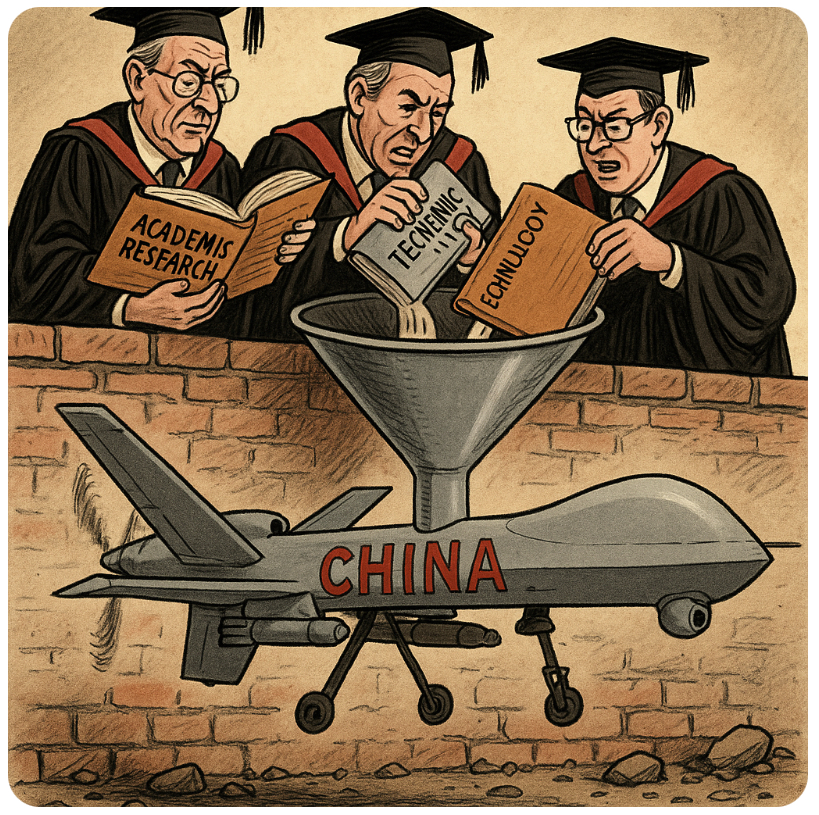
Britain’s world-class universities are exporting more than ideas — they’re unknowingly feeding China’s military machine with drone algorithms, naval defence strategies, and even tech tied to genocide surveillance. Oxford, Cambridge, and others are knee-deep in partnerships that would make a Cold War spy blush — and the best part? They still call it “civilian research.” 🕵️♂️💻🇨🇳
🎓 From Ivory Towers to Missile Silos
Once upon a time, British universities were temples of free thought. Now? They’re subcontractors for the People’s Liberation Army — just with nicer cafeterias.
Let’s take a quick campus tour, shall we?
- Southampton is getting cozy with Harbin Engineering University — a submarine warfare hotbed.
- Bristol is tag-teaming UAV swarm coordination with a Chinese aeronautics outfit.
- London South Bank is workshopping naval air-defence formations, because nothing says “welcoming international student body” like joint war simulations.
Meanwhile, Oxford — that hallowed sanctuary of tweed, tea, and totally-not-military-research — has trained tens of thousands of Chinese officials. Many of whom now work in surveillance, defence, or “state data collection,” which is the CCP version of a LinkedIn endorsement.
The US saw this game a mile away and hit the eject button. Britain? Britain poured tea, tightened its tie, and signed 40 more partnerships.
And if you’re wondering how all this is justified, the official explanation is:
“It’s civilian research.”
Which, under China’s Military-Civil Fusion doctrine, is like handing over the blueprints to your house and saying, “But I only meant it for the garden shed.”
💸 Let’s Call This What It Is: Weaponised Academic Naïveté
Our universities aren’t just “naive” — they’re voluntarily powering up the surveillance state of a geopolitical adversary for a taste of research funding and the warm glow of “global prestige.”
And yes, several UK institutions have collaborated with firms linked to the Uyghur genocide — only distancing themselves when the headlines hit. Like a drunk uncle quietly sliding his Huawei phone under the table when someone brings up Xinjiang.
This isn’t a few bad apples. It’s a pipeline. A Western-funded, taxpayer-assisted, ideologically oblivious conveyor belt that runs straight into the heart of China’s military-industrial complex.
But don’t worry, says the university PR team:
“We have rigorous controls.”
Oh yes, just like a screen door has “rigorous controls” against submarines.
🔥 Challenges 🔥
Still think this is just about research? Think again.
Are we letting our academic institutions accidentally train the architects of the next-generation weapons aimed back at us? Or are we so financially dependent we’ll trade national security for a bursary and a photo op?
Hit the comments — don’t let this conversation rot on a Facebook thread. 🧨🗣️
👇 Drop your take below. Comment, like, share — especially if you’ve ever worked in academia and seen this from the inside.
Best comments will be featured in the magazine. 🎯🧠


 Chameleon Magazine
Leave a comment