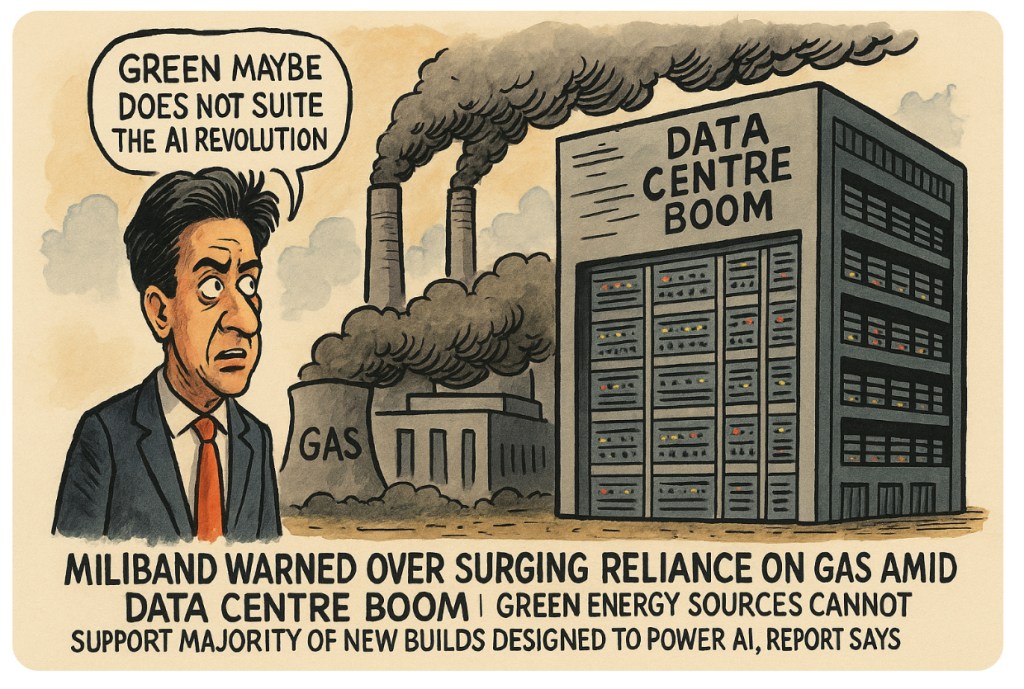
🤖🔥💨Ed Miliband, Labour’s clean-energy crusader and shadow net-zero czar, just got slapped with a reality check straight from the data-hungry depths of the AI revolution. A new report warns that Britain’s booming data centre industry—the industrial heartbeat of your ChatGPTs, TikToks, and moody Midjourneys—isn’t being powered by windmills and good intentions. Nope. It’s sucking up gas like a ’90s SUV at a monster truck rally. 💻⛽
💡 Green Dreams, Gassy Realities
The pitch was noble: AI-powered progress, delivered via eco-conscious energy grids. But as more hyperscale data centres rise like digital cathedrals across the UK, there’s one minor issue—the grid can’t keep up unless it’s chugging fossil fuel.
According to the report, the vast majority of upcoming AI-oriented builds can’t be supported by renewables alone. In other words: wind and solar are lovely for kettles and fairy lights, but ChatGPT wants a gas-powered buffet.
And Miliband? He’s stuck in a net-zero dilemma: champion the clean-energy message or admit the AI boom is essentially being fast-tracked by fossil fuels and wishful thinking. Not a great look when you’re banking on green credibility and the future suddenly looks like a glowing server farm powered by gas turbines.
So let’s say it out loud: Green doesn’t quite suit the AI revolution. It’s like trying to charge a spaceship with a bike pump. Nice idea, but not how physics—or politics—works.
Meanwhile, voters are being told to recycle their yogurt pots while Silicon Valley drains entire counties just to teach a chatbot how to write haikus.
⚠️
Challenges
⚠️
What’s the real cost of the AI boom? Can the UK actually go green while feeding data centres the energy appetite of a small nation? Or is “net zero” becoming just another political bedtime story? We want your fire, your satire, your inner chaos engineer. 🧠🔥
👇 Drop a comment, hit like, share with someone who thinks AI is solar-powered magic.
The smartest, saltiest, or sassiest takes will feature in the next issue. 💬⚡


 Chameleon Magazine
Leave a comment