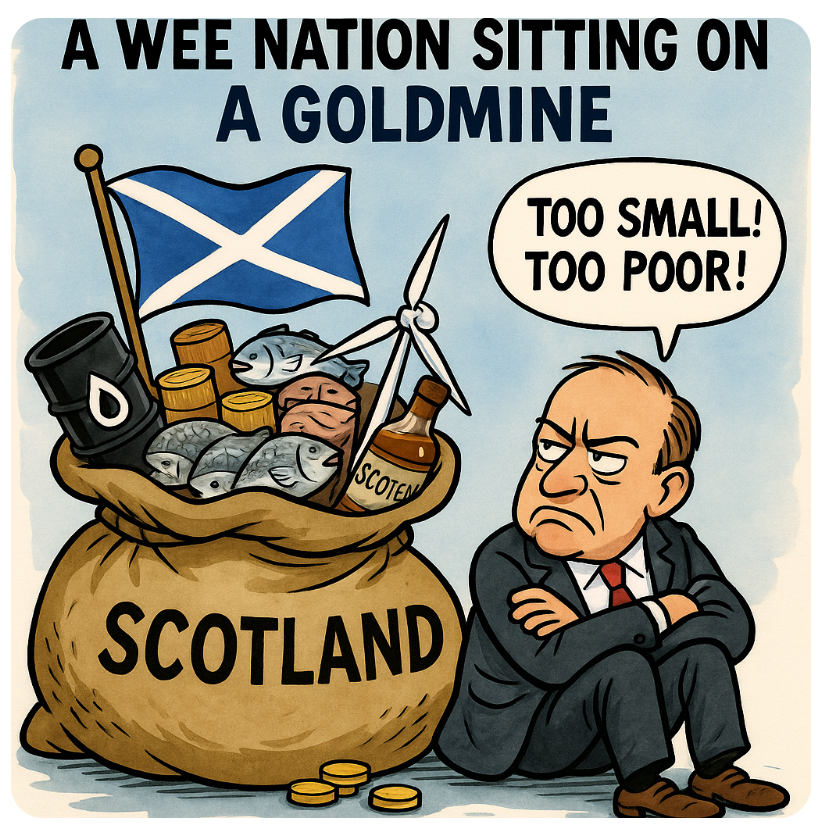
For a country that’s constantly told to “know its place,” Scotland seems to be sitting on a secret stash of natural and economic riches that would make most oil kingdoms blush. From hydro to whisky, wind to fish, this wee land is bursting with wealth — and yet, we’re meant to believe it can’t afford to stand on its own?
🍃 The UK’s Overachieving Underling (Who’s Still Told to Sit Quietly)
Let’s take a moment to applaud the sheer audacity of it all.
Scotland — home to just 8% of the UK’s population — somehow controls the majority of the UK’s actual physical assets. That’s not metaphor. That’s measurable.
Here’s the scorecard from Highland Hogwarts:
- 🏞️ 32% of UK land
- 🌊 61% of sea area
- 💧 90% of fresh water
- 🔥 96.5% of crude oil production
- 🌬️ 40% of renewable energy generation
- 🥃 100% of Scotch whisky (a.k.a. the UK’s drinkable GDP)
Yet the narrative from Westminster’s greatest minds?
“Too small, too poor, too needy.”
That’s like Jeff Bezos saying he’s not sure he can afford a Tesco Meal Deal. Get in the bin.
Scotland isn’t the needy roommate in this political house — it’s the one paying most of the bills and getting the smallest room.
🔌 A Nation Plugged Into the Grid… But Not the Power
If this were a Netflix docuseries, it would be called:
“The Country That Struck Gold and Got Gaslit.”
Because despite its absurd portfolio of wealth — from deep-sea gas fields to storm-powered turbines — Scotland doesn’t actually control the policies shaping its own energy, infrastructure, or exports.
Nope. That’s all decided in Westminster, where Scotland gets just enough say to technically be part of the conversation, but not enough to change the ending.
So who benefits? Not the people in Aberdeen. Not the Highlands. Certainly not the villages still waiting for a functioning rail line.
No, the real beneficiaries live hundreds of miles away in areas that somehow always get the investment, infrastructure, and influence. Scotland brings the natural wealth. Westminster brings… receipts.
🧭 Independence Isn’t a Dream — It’s a Spreadsheet
Here’s the kicker: Scotland isn’t just rich — it’s strategically, geographically, and globally rich.
Oil. Renewables. Water. Food exports. Whisky. Marine territory. Cultural capital.
This isn’t fantasy economics — it’s the makings of a high-income, high-leverage, future-ready state.
Think Ireland. Think Denmark. Think Norway — oh wait, Norway but with whisky.
And yet, we’re still stuck in the same tired debate:
“Can Scotland afford independence?”
No one asks:
- Who profits from its current wealth?
- Who sets the rules?
- Who takes the lion’s share?
Apparently, a nation overflowing with resources still needs permission to believe in itself.
📸 That Viral Map? It’s a Rorschach Test for National Confidence
The image that’s been floating around — a vivid heatmap of Scotland’s untapped might — doesn’t scream nationalism. It screams reality.
A visual punch to the narrative gut.
It’s not about flags, bagpipes, or Braveheart speeches. It’s about raw economic facts.
And what they show is a small nation with big country resources — yet operating on someone else’s terms.
🛑 “Too Small, Too Poor” — The Biggest Lies Ever Sold
Here’s a thought: maybe the problem isn’t capability — it’s confidence.
Because if any other country held Scotland’s assets, we wouldn’t be debating whether it could go it alone.
We’d be asking:
Why hasn’t it already?
💣 Challenges 💣
Still think Scotland needs to “prove” it can survive without Westminster? Think again. If you’ve ever muttered, “Scotland can’t afford independence,” ask yourself — who’s cashing in now? 💸
💬 Drop your thoughts in the blog comments — not just Facebook. Got a spicy take? A better analogy? A raging fact-check? We’re here for it.
👇 Hit comment, hit like, hit share. Help rewrite the narrative.
The best clapbacks and truth missiles will be featured in the next issue of the magazine. 🎯📝


 Chameleon Magazine
Leave a comment