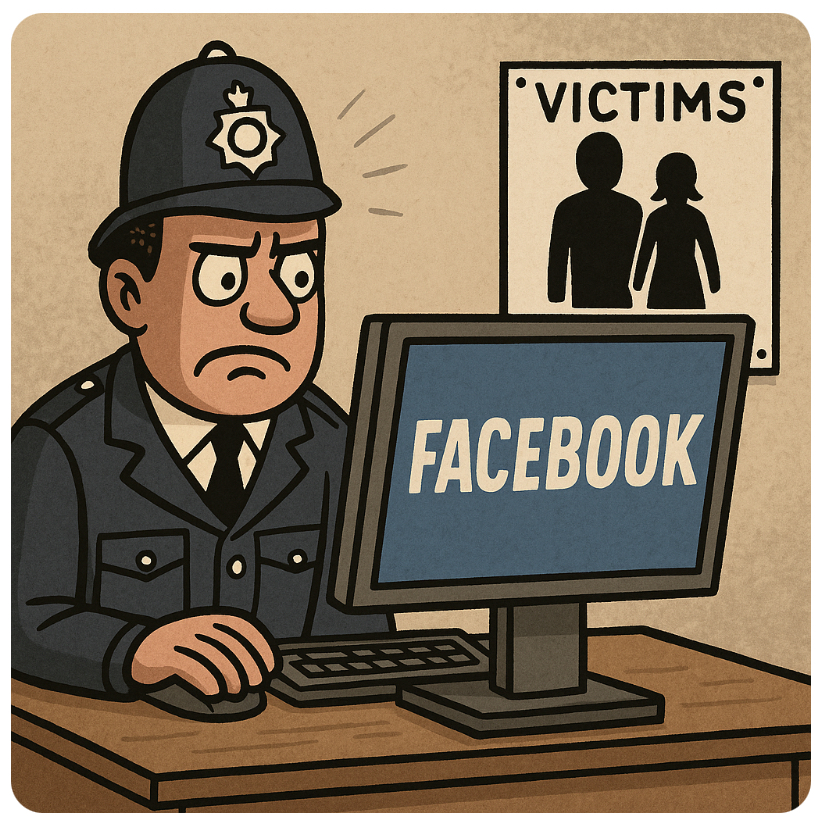
In an era where police can pull up your parking fine from 2007 in under 30 seconds, we’re somehow meant to believe that Facebook accounts tied to grooming gang victims were just too complicated to investigate? Too digital, too messy, too… revealing, perhaps? Because according to multiple sources, no meaningful attempt was ever made to examine the online trails of abuse—trails that could have named names, exposed networks, and, dare we say, led to justice.
🚫 Click “Ignore”: How Law Enforcement Logged Out of Responsibility
Let’s get this straight. The victims were on Facebook. Their abusers were on Facebook. Messages were sent. Connections could be tracked. And yet… police decided to give Zuckerberg’s playground a hard pass. Not because they didn’t know—it was because they knew exactly what they’d find: a swamp of negligence, complicity, and deeply uncomfortable truths.
This wasn’t a tech issue. This was a don’t-look-now policy.
We live in a world where someone can be tracked across continents for a wrong tweet, but entire grooming operations? Too tricky. Too sensitive. Let’s just say the files got… lost in the inbox. These girls were effectively screaming into the void while authorities tiptoed around the digital evidence like it might hurt their promotion chances.
It begs the question: What were they protecting? Reputation? Political optics? Themselves? Because nothing else explains how the clearest investigative tool in modern history—social media—was somehow off limits in one of the UK’s darkest abuse scandals.
The message to survivors? Loud and clear: your pain wasn’t convenient enough to investigate. Your abusers were too connected. Your evidence was too incriminating. So instead of justice, you got silence.
And now, we’re left wondering if the police ever planned to solve this—or if they were just managing it until people stopped looking.
📢 Challenges 📢
Why weren’t the Facebook accounts checked? Who made that call, and what were they afraid of uncovering? Is this incompetence—or something darker? Drop your thoughts in the comments. We want anger. We want clarity. And we want accountability. 👇🔥
💬 Like, share, and leave a comment if you’re tired of “oversights” that always seem to protect the powerful.
The sharpest takes will be featured in the next issue of the magazine. ⚖️🕳️


 Chameleon Magazine
Leave a comment