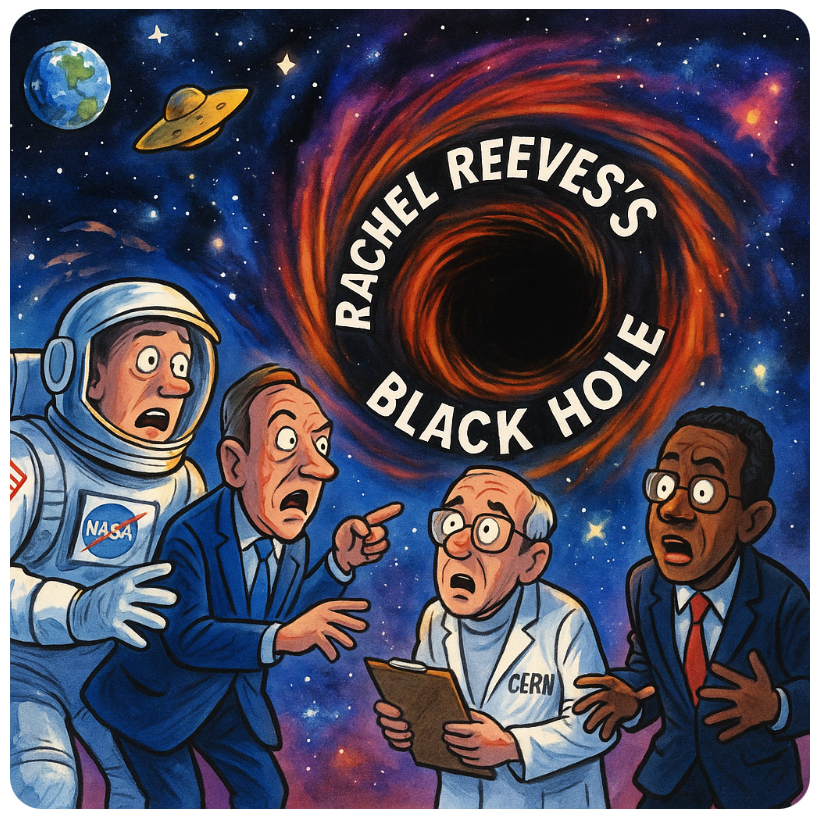
It started as an economic metaphor. Now it’s a cosmic crisis. The Treasury’s missing billions—dubbed “Rachel Reeves’s Black Hole”—has spiralled from fiscal fiasco to full-on sci-fi satire, complete with NASA consultations, CERN scientists scratching their heads, and the OBR launching an exploratory mission (with politicians as the payload—because who better to throw into a void?).
🌌 To Infinity and Beyond… Your Tax Receipts
Apparently, the government can’t find the £20-30 billion “black hole” in Reeves’s budget forecast. So naturally, they’ve done what any rational economic body would do: called in space agencies.
Yes, NASA and CERN—the folks who deal in quantum mechanics and cosmic spaghetti—have reportedly been asked to assist. What’s next? Professor Brian Cox modelling next year’s fiscal deficit with a telescope and a sigh?
And just when you thought it couldn’t get any madder:
Some members of the public have taken offence to the term “black hole”, arguing it could be racially insensitive.
Calls are being made: “Why not a white hole?”
As if the laws of astrophysics now require equal representation on a DEI compliance form. 🌈📄
Let’s be clear:
A black hole, in physics, is where light, time, and logic go to die—just like government budgets.
If anything, it’s a perfectly accurate metaphor for modern politics. No one’s offended by a “white paper,” but now we’re policing metaphors based on colour palettes?
At this rate, we’ll be renaming wormholes to “non-threatening space tubes.”
Meanwhile, somewhere deep inside the Treasury, Reeves is probably Googling “how to spin economic singularity as progressive policy.”
Spoiler: you can’t.
Even gravity’s given up.
🔥 Challenges 🔥
Have we hit peak political absurdity? Is this economic debate, cosmic comedy, or cultural collapse? Drop your sharpest thoughts, wildest analogies, or most unhinged policy metaphors in the blog comments—don’t let Facebook keep them all. 💬👽
👇 Comment, like, share—and tag someone who thinks NASA should be running HMRC anyway.
The cleverest takes will feature in the next intergalactic edition of the mag. 🪐📉


 Chameleon Magazine
Leave a comment