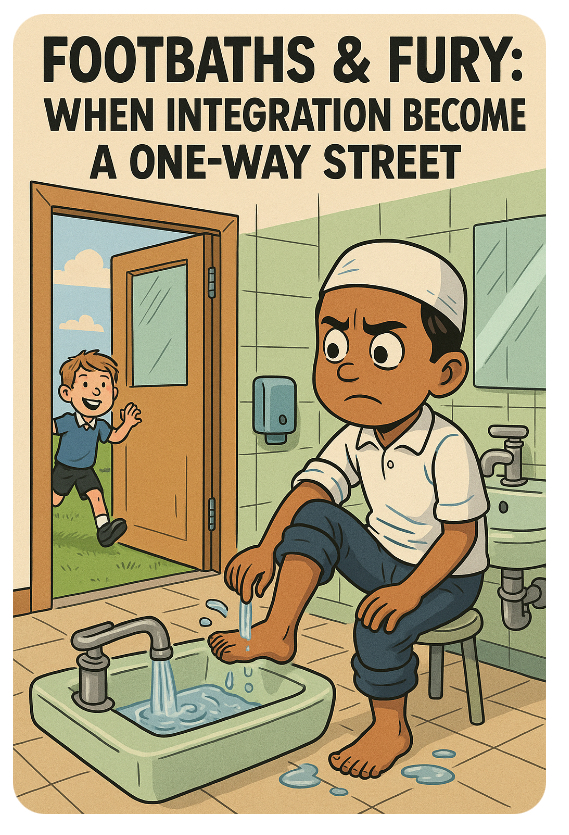
🏫🦶🇬🇧So here we are—yet another headline that reads like a deleted Ricky Gervais sketch: a British teacher booted for telling a Muslim child “This is a Christian country” after they were washing their feet in the school sink. Not the prayer room. Not the mosque. The school sink. Because apparently, the classroom is now a splash zone for whatever ritual fits the schedule.
🧻 Showers, Sinks & Selective Integration — What Happened to British Culture?
Let’s ask the question no one’s daring to print in the glossy reports: Where exactly is British culture in all this? The same British culture that migrants were once encouraged—no, expected—to integrate into. You know the one: “cleanliness is next to godliness” usually meant shower before school, not hold a plumbing summit in the Year 4 toilets.
This wasn’t about hygiene. It was about ritual over reason.
When did it become normal to repurpose a communal sink for religious ablutions—then declare any criticism to be Islamophobia? Since when is a teacher asking for some basic boundaries treated like a heretic?
Let’s be real. Schools are not mosques. Classrooms are not places of worship. We’re not banning anyone’s beliefs, but we’re also not obligated to remodel the national curriculum around every individual faith practice. If you want to live in a pluralistic society, that cuts both ways.
We’re bending over backwards to accommodate every imported practice while British values—moderation, secularism, the “no fuss” approach—are being quietly elbowed out of the room. And if you dare say something? Cancelled. Career over. Hope you enjoy your next job in retail.
Because when the rules of integration are redefined as “shut up and adapt,” you have to ask: who’s really integrating into what?
⚡️ Challenges ⚡️
Is Britain too scared to defend its own cultural norms?
Should schools accommodate everything in the name of “inclusion,” or has the pendulum swung too far?
Tell us where you stand. Keep it sharp. Keep it honest. 🗣️💥
👇 Comment, share, and stir the debate—because this is your culture too.
The best takes will feature in the next issue.


 Chameleon Magazine
Leave a comment