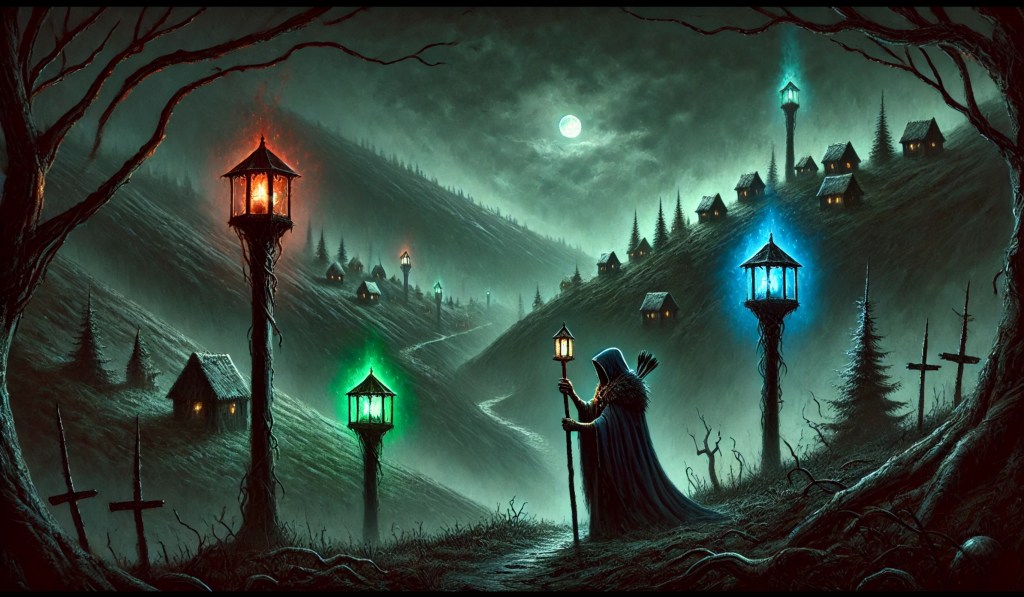
In the old country—where forests knitted themselves too tightly and shadows learned the names of travelers—four villages clung to a single frostbitten valley. Each village kept a lantern on a tall post at its center, for the elders taught that the valley’s safety depended on the lanterns burning clean. “Let them dim,” they warned, “and the hollow things will walk again.”
One blackening autumn, a stranger arrived. He was tall and wrapped in a coat stitched from night-bird feathers, a hood drawn low, a narrow lantern in his grasp that glowed with a cold, lunar flame. Folk whispered the old title: Night-Warder. A protector once… or a judge. Legends never agreed.
He went first to Hearthcross, the village of tireless workers. Their lantern burned steadily, but its light was thin, colorless. The Warder watched the people mend fences with numb precision, eyes dull from years of doing, never feeling. “Your hands remember devotion,” he murmured, “but your hearts have forgotten warmth.” When he brushed their lantern, frost crackled across its iron shell.
In Fennrush, the lantern burned brightly enough, but its smoke twisted with too many scents—herbs, resin, unfamiliar powders. The villagers boasted of new teachings brought by traveling “wisemen,” each more enchanting than the last. “Truth is not a festival mask to be exchanged,” the Warder warned. His finger passed over the flame, and it spasmed like something wounded.
In Wellowmere, the lantern glowed a sickly green. The people were cheerful, almost unnervingly so, and welcomed every outsider with open arms. Yet strange carvings had begun appearing on doorposts, and the folk spoke with borrowed words that were not theirs. “Compassion without discernment,” the Warder said, “is an unlocked gate in a forest that hungers.” When he touched the lantern, the flame recoiled as though ashamed.
Last he came to Starbriar, where the lantern still burned clean, though dim from long strain. The people held ancient rites faithfully, guarding the old boundaries—but they were tired, haunted by vigilance that never slept. “You have not fallen,” he said, “but you are fading. Hold fast. Remember the fire that once leapt within you.”
To each village he spoke the same old command: Remember. Turn back. Cleanse your flame.
Some trembled and obeyed. Some laughed behind closed shutters. Some whispered curses as the Warder walked away.
Winter arrived unnaturally fast. Those lanterns tended with renewed reverence flared with a fierce, ghostless brilliance that no wind could touch. But the lanterns of the defiant dimmed to embers, then to nothing. And when they went out, the hollow things crept from the treeline—shapes like silhouettes cut from deeper shadow—drawn to the places where memory had failed and compromise had taken root.
Those who kept the flame found strange gifts in the snow: fruits from no earthly tree, stones etched with names they had not yet grown into, crowns of frostlight, and a star-shaped charm warm as midsummer.
They survived the winter. The others became stories whispered by the fire.
Final distilled wisdom:
“In dark forests, only the flame that guards its own heart keeps the shadows from learning yours.”


 Chameleon Magazine
Leave a comment