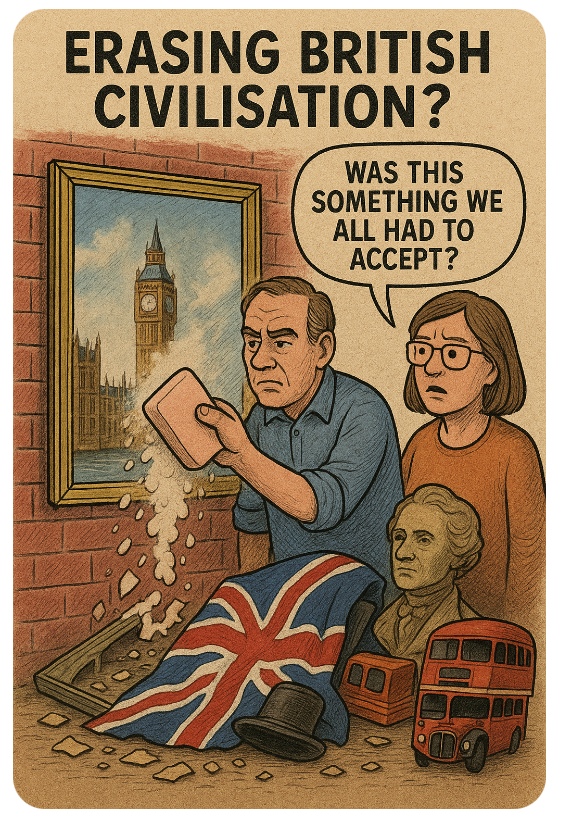
Mass migration is reshaping the UK—but were the people ever genuinely invited into the conversation?
🧼 Identity Cleansing by Committee
Step aside, statues and street names—now it’s national identity that’s being rebranded like an awkward PR crisis. From policy wonks in Whitehall to think tanks in Brussels-lite conference rooms, there’s been no shortage of voices telling us that mass migration is “just the way of the world” and that “change is inevitable.” But hold on—was anyone outside the bubble ever asked what they thought about all this? 🫥📉
British civilisation, for all its contradictions, quirks, and questionable culinary choices, wasn’t supposed to be something you could just re-theme like a restaurant. Yet across towns and cities, the transformation has been swift, dramatic, and—in many places—completely disconnected from public consensus.
It’s not about hating people or fearing difference. It’s about asking a fundamental democratic question: when did consent to this level of cultural upheaval become optional? You can’t preach inclusion while excluding people from the discussion about their own neighbourhoods, streets, and schools. That’s not progress—it’s an identity coup with a diversity rebrand.
Sure, the official narrative says it’s all fine, it’s all manageable, it’s all enriching. But try telling that to the communities that feel like strangers in their own postcodes, where familiar customs are vanishing like red phone boxes. 📵🇬🇧
This isn’t nostalgia—it’s an interrogation. Not of immigration itself, but of the top-down, elite-led process that bulldozes identity under the banner of inevitable change, then gaslights anyone who dares ask: was this something we all had to accept?
🔥 Challenges 🔥
Has Britain’s identity been democratically diluted—or are we just being told to get used to it? Have your say. Not just on social media—on the blog, where real debate lives. Speak your truth, question the silence, challenge the spin. 💬⚖️
👇 Hit comment, hit share, and tag someone who thinks “British values” should include actually listening to the British public.
The best insights will be featured in the next issue of the magazine. 🎯📢


 Chameleon Magazine
Leave a comment