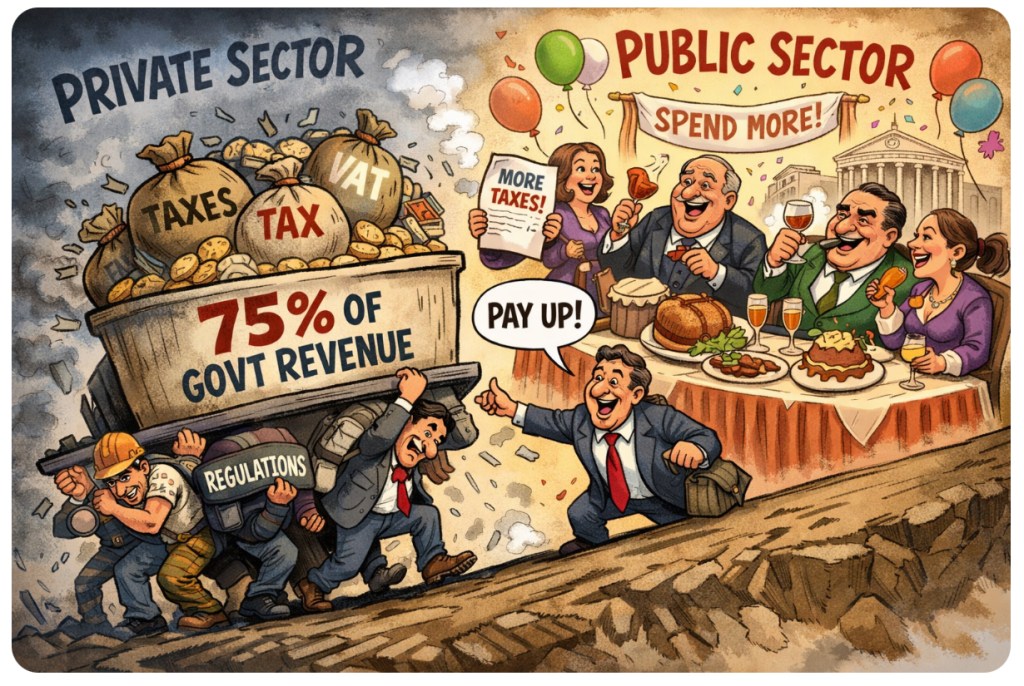
🏭🧾Over 75% of all government revenue comes from the private sector — wages, spending, and profits. That’s not a theory, that’s arithmetic. Yet somehow, the very people and businesses bankrolling the entire machine behave like polite guests at a dinner party they actually paid for, while the public sector carves up the roast and sends them the bill.
🧾 The Silent Majority Bankrolling the Bureaucracy
Let’s recap: your income tax? Straight from your pay packet. VAT? Every time you buy a coffee or a pint, the government is right there sipping 20%. Corporation tax? Risk your own money, build a business, and congratulations — the state thanks you by treating you like a piñata made of money and guilt.
Even public-sector salaries, often taxed as if they were a new source of money, are really just re-filtered private income that went on a quick bureaucratic joyride before looping back around. It’s not “redistribution.” It’s “laundering with extra steps.”
And yet — despite funding everything from potholes to pensions — the private sector wanders around with the political assertiveness of a dazed goldfish. No demands. No coordination. Just a shrug and a sigh as stealth taxes multiply like rabbits in a spreadsheet.
Meanwhile, public-sector unions organise like a Netflix villain squad: focused, loud, and always one sandwich away from a nationwide shutdown. They march for more. The private sector quietly pays for it.
Imagine if the engine actually realised it was the engine.
Imagine demanding:
- 🚧 Predictable taxes (instead of last-minute Treasury lottery spins)
- 📈 A link between public pay and private productivity (wild idea, we know)
- 🧮 Spending based on actual revenue, not vibes
- 🔍 Accountability for where trillions go
This isn’t about “slashing the state.” It’s about reminding the system who’s footing the bill.
Instead, we’re told tax hikes are “fair,” spending increases are “necessary,” and deficits are “inevitable.” Inevitable like gravity… if gravity were controlled by a committee with election anxiety and a press office.
The real tragedy? The private sector has leverage — serious leverage — but behaves like it’s just happy to be invited. As if it’s the intern in a meeting where it wrote the agenda, booked the room, paid for the snacks, and still gets blamed when the projector breaks.
History doesn’t look kindly on systems that overdraw from shrinking bases. But don’t worry — we’ll tax the robots next, right?
🔥 Challenges 🔥
Why does the group paying for everything stay silent? Why do we keep swallowing tax hikes dressed up as virtue? If the private sector flexed even half its actual power, would policy start looking less like improv theatre?
💬 Drop your comment on the blog — not just Facebook. What would a private-sector “union” even look like? What would you demand?
👇 Like, share, and debate — let’s make “who pays for this” a national conversation.
🧠 Best insights will be featured in the next issue of the magazine.


 Chameleon Magazine
Leave a comment