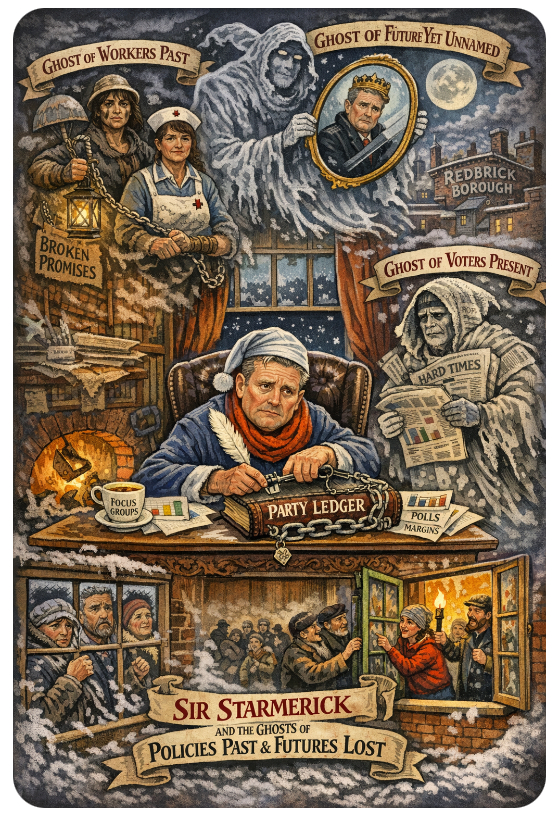
📜❄️In the grayscale borough of Redbrick—where old hopes huddle like pigeons around a fading coal brazier—there lives a man with the curious distinction of having marched through storms only to seek shelter in stillness. His name is Kier Starmerick, the Keeper of the Party Ledger, the Trimmer of Vows, the Archduke of Acceptability.
Once upon a more hopeful time, Starmerick’s shoes were thin and his promises thick, a man with wind in his coat and justice on his lips. But now? He resides in a fortified tower of inoffensiveness, where the windows do not open—for fear, perhaps, that a draft might ruffle the spreadsheets.
🪟 The Man Who Closed the Window and Called It Leadership
Every morning, with the solemnity of a medieval librarian and the PR instincts of a soft drink rebrand, Starmerick unlocks his mighty Ledger. This hallowed tome—once bursting with pledges, chants, and sweat-stained dreams—has become his personal cutting board. Out come the scissors. Off go the edges. A vow gets a haircut, a demand gets massaged into “fiscal responsibility,” and somewhere in the margins, someone quietly erases “renationalisation.”
You see, Starmerick doesn’t lead the people so much as curate their expectations. He believes the town will love him more if he never alarms it—if every policy is just exciting enough to be mentioned, but dull enough to be forgotten by lunch. His strategy is simple: offend no one, inspire fewer.
And then, on the coldest night, come the ghosts.
The first is familiar: the Ghost of Workers Past. She arrives with calloused hands and righteous rage. A nurse whose scrubs once marched beside him. A miner’s daughter, soot still under her nails. A courier with a bike chain for a belt and a manifesto in his heart. They show him hunger not on paper, but in pantries. They whisper, “You promised to remember.” Starmerick flinches—but closes the door gently, like declining a survey.
Then, the Ghost of Voters Present, wrapped in opinion polls and laminated talking points. She leads him to food banks in factory towns and to pubs where voters speak in blunt truths, not hashtags. “They listen,” she says, “but they no longer hear themselves in you.” Starmerick winces. “Have they seen the latest favourability tracker?” he asks, as if a pie chart might comfort a pensioner choosing between heat and meat.
Finally, the Ghost of Futures Yet Unnamed arrives—not a shade, but a mirror. It shows him a party that wins not because of what it stands for, but because the other side burned down the village. It shows a government of tactical silences and electoral nap strategies. It shows policy that lands, but never lifts. The people endure—but no longer sing.
And in that terrible stillness, Starmerick begins to remember.
He runs to the Ledger—not to subtract, but to restore. Out go the focus group edits. Back come the rough phrases, the principled stances, the words that burn a little when you read them out loud. He opens the windows. He lets in the wind. Down below, on Redbrick Street, the cold remains. But people gather. And someone—someone—starts to sing.
Leadership is not a synonym for silence. Victory is not just the absence of defeat. And a movement that saves its courage for later will discover that later has already passed.


 Chameleon Magazine
Leave a comment