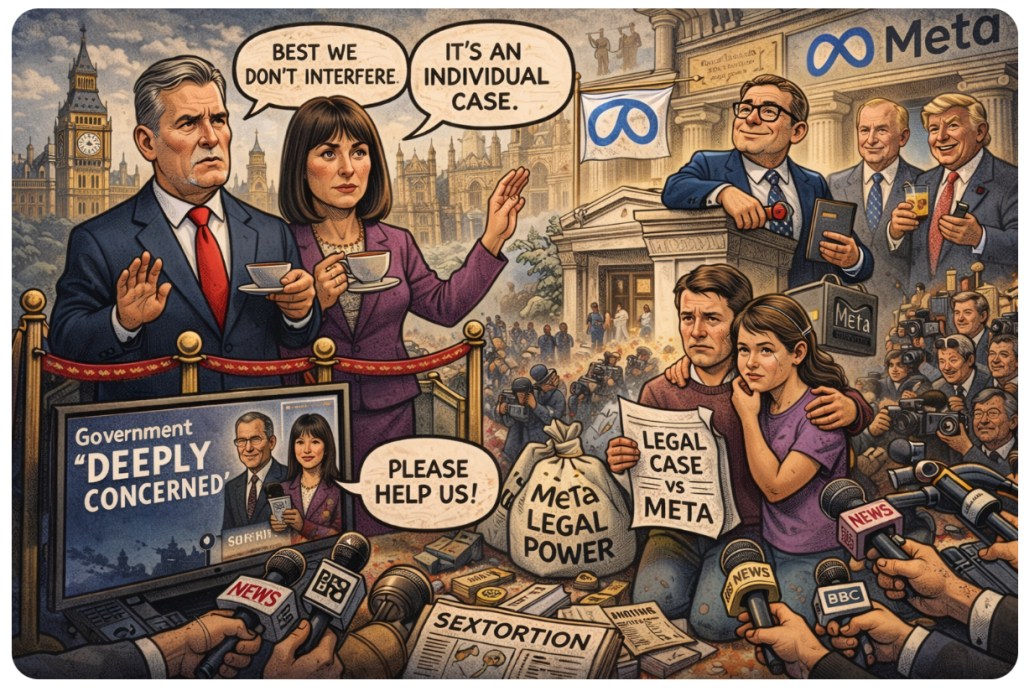
When a British family takes on a tech titan like Meta over a sextortion crime, you’d expect the government to roll up its sleeves and back them with the full force of justice, right? Think again. The likely response? A carefully staged TV interview, a well-rehearsed look of concern, and a robotic “We don’t get involved in individual cases.” Translation: Good luck fighting a trillion-dollar behemoth on your own. 🧊👋
🎩 Westminster’s Favorite Sport: Watching From the Sidelines
Let’s not pretend this is about policy. It’s about cowardice in a tailor-made suit. The UK government is terrified of upsetting Silicon Valley billionaires—especially if those billionaires have been palling around with Donald Trump at Mar-a-Lago over Brexit-flavoured cocktails. 🍹🇺🇸
A family is wading into the legal equivalent of a shark tank to confront one of the richest and most powerful tech companies on Earth, after a crime that should horrify any parent, policymaker, or pixel on a screen. And yet, Westminster prefers to play peekaboo from behind a privacy statement.
They’ll talk tough on online safety when it fits their polling strategy, but when it comes to actually confronting Big Tech? Suddenly, it’s all “due process” and “arms-length regulation.” Meta has lobbyists. The victims have lawyers crowdfunding justice. See the imbalance?
This isn’t about one case. It’s about whether victims of modern digital abuse can expect the state to defend them—or just the GDP of California.
Spoiler: If you’re hoping for a moment of courage from Whitehall, don’t hold your breath. They’re too busy making sure no one accidentally upsets Zuck or The Donald.
🛑 Challenges 🛑
Why is it always “we’re deeply concerned” until someone actually needs action? Why do governments tiptoe around tech giants like they’re sacred cows with data centers?
🔥 We want your fury, your frustration, your fire. Drop it in the blog comments—not just under a Facebook post that Meta will quietly downrank. This is about real lives, real harm, and real double standards. 🗣️📣
👇 Comment below. Share if you’ve had enough of selective backbone syndrome.
The most cutting responses will be featured in the next issue of the magazine. 📝🔥


 Chameleon Magazine
Leave a comment